
A Millionth of a Volt Makes a Quantum Circuit Shed Photons in Pairs
A new superconducting experiment turns selective photon loss into a useful ingredient for cat qubits. The protected qubit itself is still a next step.
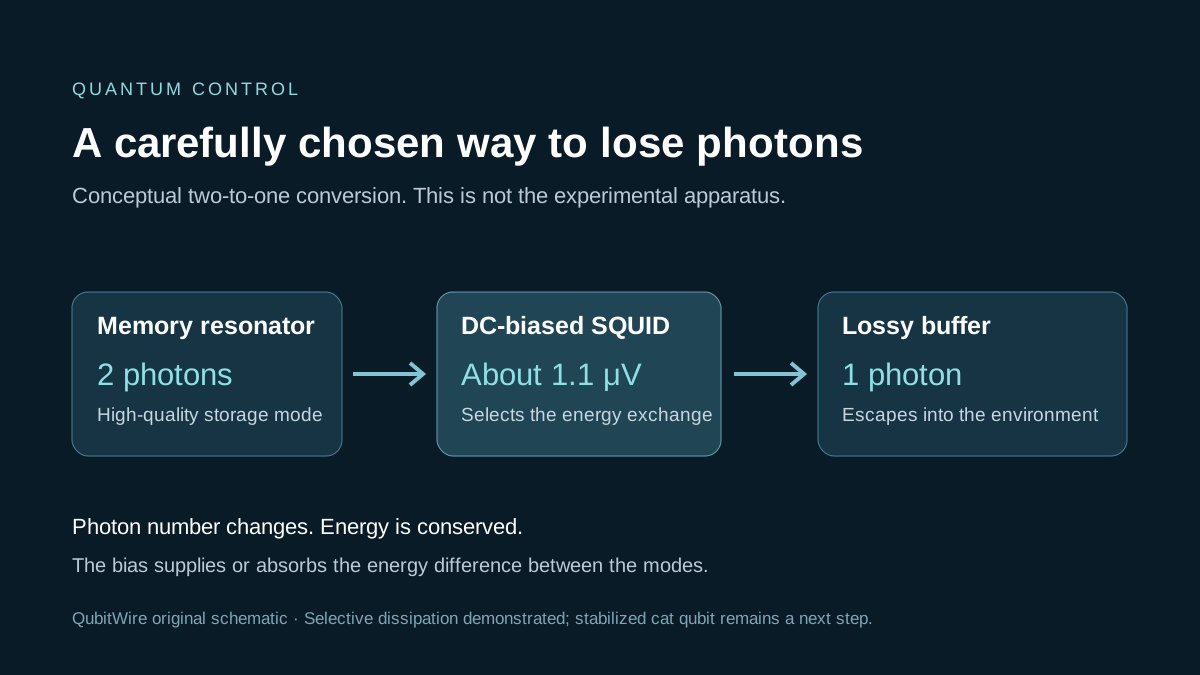
In a quantum computer, losing a photon is usually a problem. But a carefully chosen way of losing photons can also help protect information. The distinction is between a leak that happens to the device and a drain that researchers deliberately build into it.[3]
Alice & Bob and researchers at ENS Lyon have demonstrated a new kind of engineered drain. A steady voltage of about 1.1 microvolts enables a superconducting circuit to remove microwave photons from a memory resonator two at a time.[1]
The company announced the work on September 30. The experimental preprint first appeared on August 31 and was revised on September 25. Its result is a component for a possible cat qubit, rather than a completed protected qubit.[1][2]
A cat qubit stores quantum information in an oscillator, using separated configurations of its electromagnetic field. The name refers to the superpositions associated with Schrödinger’s famous thought experiment. The useful engineering idea is to make some errors much harder to produce than others.[3]
Earlier experimental research, published in Nature Physics in 2020, showed that greater separation between the encoded states could suppress bit-flip errors exponentially while phase-flip errors grew only linearly. That imbalance can simplify the remaining task. It does not remove every kind of error.[3]
The new circuit connects a memory resonator to a buffer designed to lose energy rapidly. A voltage-biased superconducting component called a SQUID makes a pair of memory photons convert into one buffer photon, which then escapes. The voltage selects the required energy relationship.[1]
Changing the bias also activated one-to-one and four-to-one photon conversions in the same device. Those additional processes are interesting because different ways of encoding information can require different interactions. They are not demonstrations of a four-qubit computer.[1]
Why replace a microwave pump with a tiny steady voltage? Alice & Bob sees a route to simpler wiring and less heat inside future refrigerators. Those are prospective system benefits, not a measured reduction in the energy use of a complete quantum computer.[1]
The theoretical groundwork appeared in Physical Review Applied on April 17. That study proposed and simulated a voltage-biased circuit that could produce strong two-to-one interactions while averaging away unwanted nonlinear effects. It also addressed the drift that voltage noise could introduce into a cat qubit’s orientation.[4]
The experiment’s limits explain why that theory still matters. Researchers used Wigner tomography to examine how the memory state evolved, but unwanted single-photon loss and dephasing remained. Their paper traces these effects to extra electromagnetic modes and imperfections in the bias circuitry.[2]
Most decisively, the authors say that an additional two-photon drive would be needed to stabilize the memory and turn it into a cat qubit. Selective loss is an ingredient in the recipe. Showing that ingredient works does not establish a , a or a useful computation.[2]
The next task is to improve the circuitry, add the stabilization drive and test the resulting encoded information. A strong drain alone is not the scorecard. Researchers must show that the whole arrangement preserves the information they want to keep while eliminating the disturbances they intend to remove.[2]
For readers, that is the revealing shift: protecting a quantum state does not always mean isolating it from everything. Sometimes the design deliberately creates a connection to the outside world, then makes that connection selective. The important question is what the connection is allowed to take away.
Keep your reading trail
Keep up with these topics
Choose the subjects you want to find again in Your Updates.