
A theory predicts an electron pattern that never repeats
Two layers of electrons could settle 30 degrees apart. A calculation traces the twist to the motion that remains even at absolute zero.
Reading tools for text size, copying, printing and your reading list
On a sheet of graph paper, you can slide a tracing by one square and every line matches again. A quasicrystal has long-range order, but no such slide works. Three MIT physicists have proposed a reason electrons might arrange themselves that way. Physical Review Letters accepted their theoretical study on November 2.[1][2]
The electrons in the model occupy two thin layers with equal densities and aligned spins. Within each layer, mutual repulsion can space the electrons out in a triangular array called a Wigner crystal. It is the electric charge that forms the pattern. The atoms of the semiconductor need never turn.[2]
If the charges could sit perfectly still, two offset arrays in the same orientation would favor a honeycomb pattern in the regime the team examined. Quantum mechanics gives even the lowest-energy state a residual motion. Twist the arrays and some collective vibrations soften. Their lower frequencies reduce the energy associated with that motion. At the right density and layer spacing, a 30-degree twist wins overall.[1][2]
Turn one layer of electrons
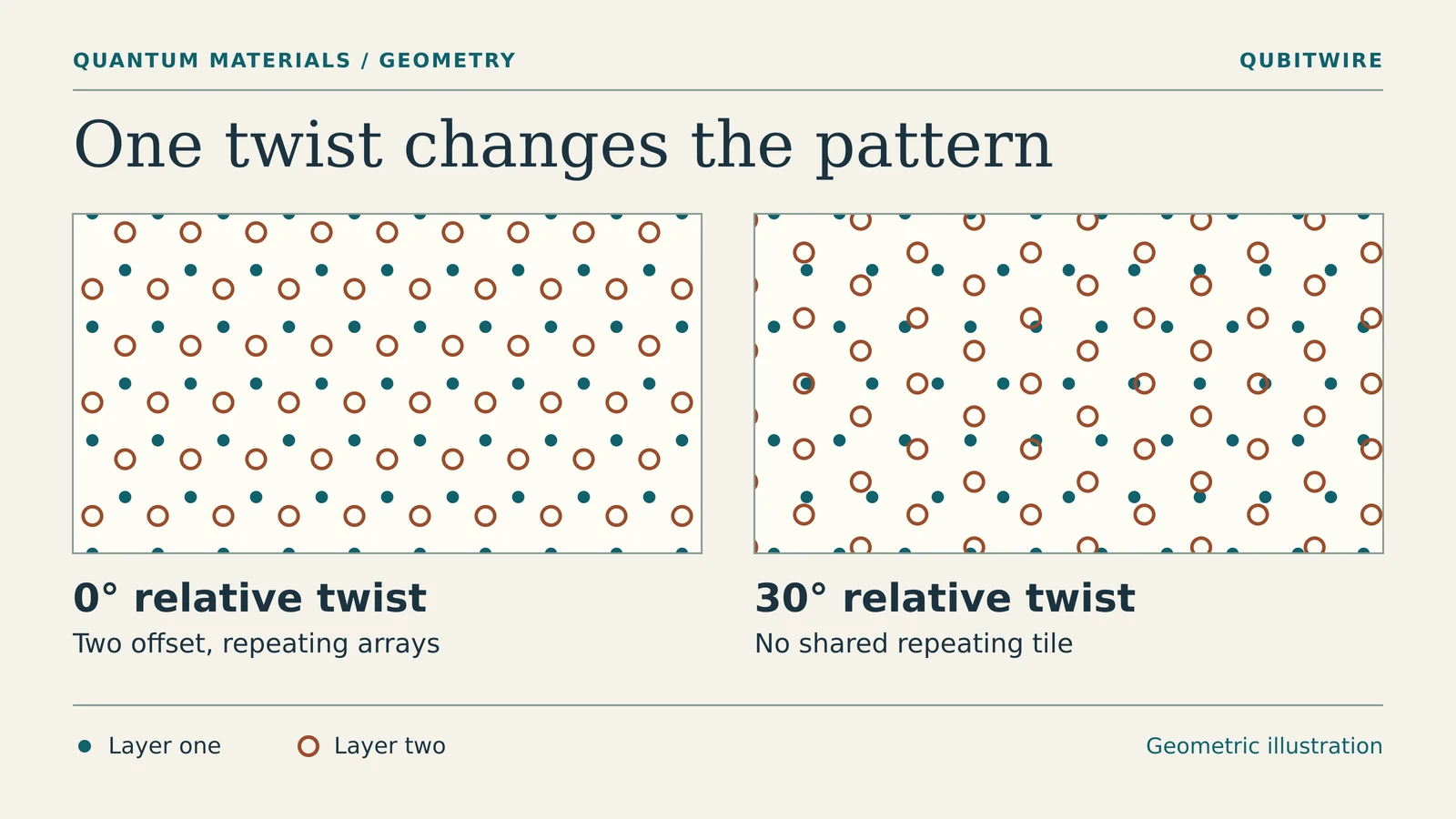
At 0°, rows of solid dots and open rings repeat together. At 30°, each layer still has regular rows, but the two arrays share no repeating tile. The drawing changes their angle. The paper’s energy calculation explains why electrons might favor one.
An earlier simulation by the same researchers, first posted in December 2025, had already picked out this pattern in a semiconductor quantum well. Pierre-Antoine Graham, Filippo Gaggioli and Liang Fu made the explanation public on May 7. The November milestone is journal acceptance. Both studies used calculations.[1][3][4]
The authors suggest several ways to look for the effect, including scanning tunneling microscopy. An image that resolved the two electron arrays could reveal whether they take up the predicted relative angle. Changing the density could then test where that order gives way. A laboratory observation of the proposed phase is still missing.[2]