
The ripples faded, but the whirlpools stayed in a quantum gas
Physicists mapped how a thin cloud of ultracold potassium was moving. The new measurement separated fast-fading sound-like motion from the tiny vortices that dominated later.
Reading tools for text size, copying, printing and your reading list
When a disturbance moves through water, it can send ripples outward and leave little eddies behind. A team at Heidelberg University has found a way to tell those kinds of motion apart inside a quantum gas. After stirring a thin sheet of ultracold potassium atoms with a flash of patterned light, the researchers found that sound-like motion faded. Swirling flow remained concentrated around tiny vortices and accounted for more of the motion later on.[1]
The cloud was a Bose–Einstein condensate. At sufficiently low temperatures, many atoms occupy the same collective quantum state, so the cloud can flow as a quantum fluid. The atoms formed a very thin layer, with their motion mainly confined to two dimensions. A dark or bright patch in an ordinary density image tells you where the atoms are, not which way they are moving. That distinction becomes important after a disturbance, when density ripples can hide a vortex core.[1]
A camera frame with five clouds
Elinor Kath and colleagues used pulses of laser light that select which atoms get kicked based on their original velocity. The team pulsed along two directions, then gave the atoms 4.5 milliseconds to separate. An absorption image showed a central cloud and four smaller ones; the relative number of atoms in those clouds at corresponding positions let the team estimate the original in-plane velocities as well as the local density. Those that scattered gained or lost a fixed amount of momentum along an interrogation direction, which made the cloud populations a record of the flow.[1]
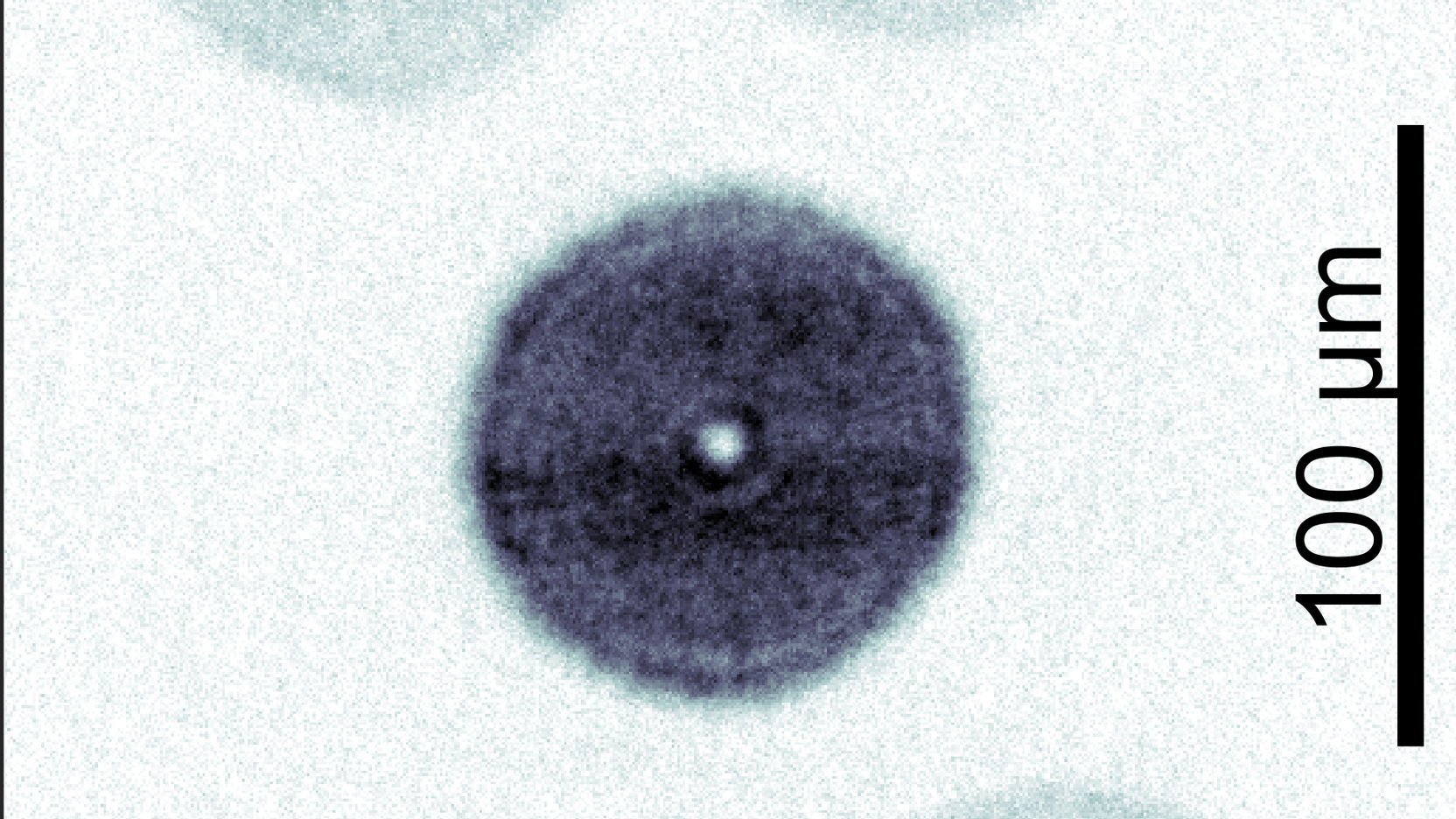
The measurement was designed to work on individual trial images. That matters because the disturbed cloud did not create the same pattern of vortices every time. Averaging trial images could wash out the very motion the researchers wanted to see. For a separate benchmark, they did average 15 runs with a vortex placed near the center. The resulting flow speed fell with distance in the expected way away from the core and edge. The photograph above is from that averaged benchmark, not a standalone frame from the disturbed cloud.[1]
What the flow map revealed
The team used the density and velocity maps to split the energy of the flow into two parts. One captures motion that compresses or spreads the cloud, as a sound wave does. The other captures circulation. Early after the disturbance, the sound-like component showed up in localized moving features. Later it was more diffuse and had lost energy, while the circulating component was still gathered around vortices, even as some vortices began to disappear.[1]
The technique has limits. It works over a calibrated range of velocities, and preparing the cloud for imaging can alter motion near sharp density changes. The work is a preprint, not yet peer reviewed. It gives researchers a way to study where the energy of a quantum fluid goes instead of having to infer the whole story from a picture of where the atoms ended up.[1]