
Mirrors made of light let physicists imitate a black-hole horizon
A wave of ultracold atoms sits between two light barriers. Moving one barrier reveals horizon-like dynamics—and a clever way to study them in the lab.
Reading tools for text size, copying, printing and your reading list
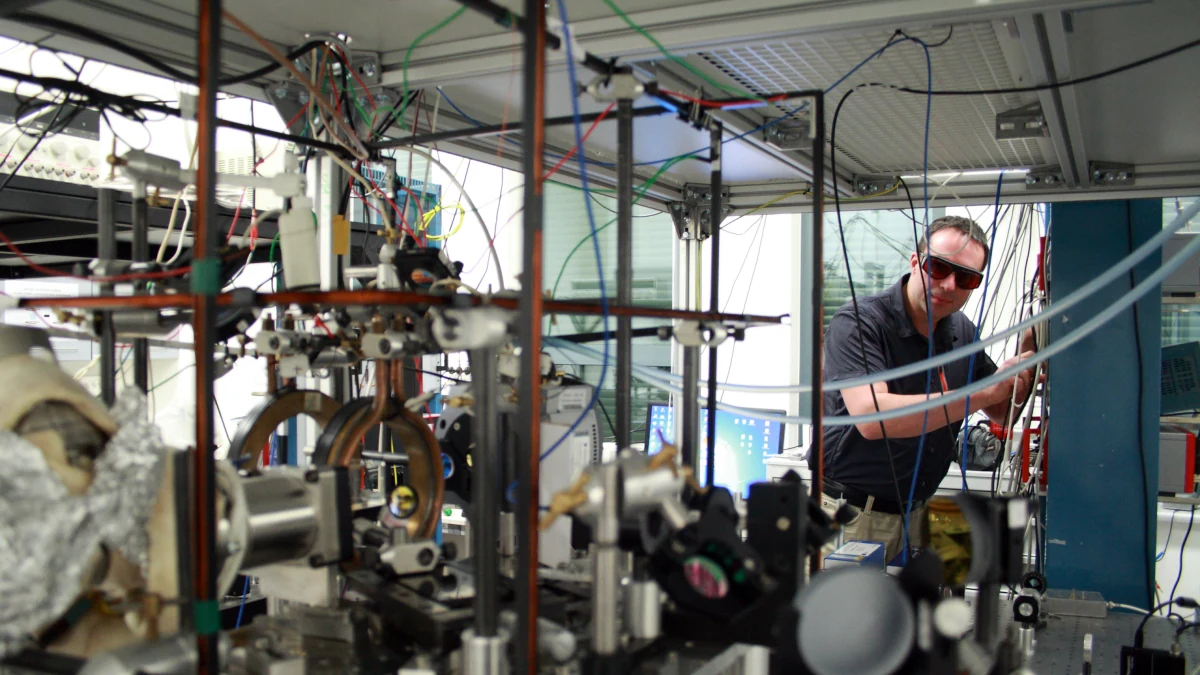

Physicists have turned a familiar optical setup inside out. Instead of trapping light between material mirrors, they trapped a wave of ultracold atoms between barriers made of light and moved one barrier. The observed wave dynamics imitate selected mathematical features of black- and white-hole horizons; the apparatus did not create a gravitational black hole. The work appeared in Physical Review Letters on November 4, following a January preprint.[1][2]
It is an ingenious way to make an inaccessible question experimental. A laboratory can give researchers something astronomy rarely offers: a controllable setup they can adjust, repeat and examine from different angles.
Why exchange light and matter?
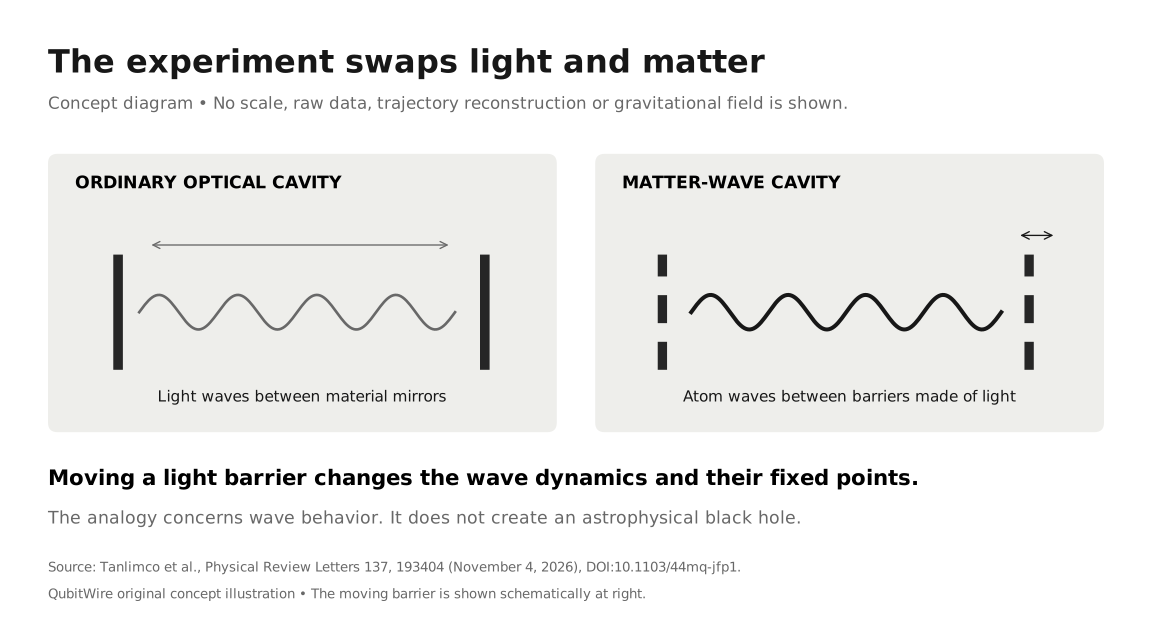
Start with a pair of mirrors. Light trapped between them repeatedly crosses the space in the middle. Move a mirror, and you change the conditions the wave experiences each time it returns.
Timing matters. A small, well-timed push can build a large motion on a playground swing. Waves also respond to repeated changes, although their interference makes the possibilities richer than a swing’s back-and-forth motion. A moving boundary can reshape where a wave’s energy accumulates.
The obstacle is speed. Light travels so quickly that moving a material mirror at an appreciable fraction of its speed is an enormous experimental challenge. A slower wave gives the moving boundary a better chance to keep up.
Atoms provide that slower wave. Quantum mechanics allows matter to behave as a wave; a Bose–Einstein condensate brings many atoms into a shared quantum state. Laser light can also form barriers that redirect atomic motion. Put those ideas together and the familiar relationship between the mirror and its contents can be exchanged.
The team used ultracold lithium and engineered the atomic wave’s motion with an optical lattice. One light barrier moved periodically. Near the cavity’s fundamental resonance, the atomic density gathered into a pulse; driving at twice that frequency produced two pulses.[1][2]
The revealing view is a sequence of snapshots
To understand the horizon connection, imagine looking at a moving system only once during each repeated cycle. This is a stroboscopic view—the same basic idea that makes a spinning wheel appear strangely slow under a flashing light.
The snapshots remove some of the motion’s visual clutter. They can reveal places toward which nearby trajectories converge and places from which they separate. Those patterns tell you something deeper than the appearance of any individual frame: they show how the system organizes motion over time.
In this experiment, the driven wave developed stable and unstable trajectories. Changing the drive’s phase could exchange their stability. The corresponding theoretical description connects these patterns to horizon-like behavior in curved spacetime.[1][2]
That connection is the scientific payoff. An analogue experiment lets researchers investigate selected relationships from a difficult physical problem in a system they can actually manipulate. Its value lies in precisely identifying which relationships carry across.
Here, the analogy concerns wave dynamics. The apparatus did not create a gravitational black hole. Nor should the experiment’s reversal of certain wave dynamics be presented as time itself running backward.
A new publication, with an earlier public history
The paper appeared in Physical Review Letters on November 4. Its first preprint was posted on January 28, so this week’s development is the peer-reviewed publication rather than the experiment’s first public disclosure.[1][2]
The memorable achievement is the experimental design: use light as the walls, let matter become the wave, and adjust the walls to investigate a horizon analogy. A change of roles made an otherwise demanding regime accessible to a laboratory.