
Skip to content
RESEARCH · EXPLAINER

A quantum measurement can use fewer qubits by giving one a second job

Explainer: A worked example shows how a measurement helper can become part of the quantum output, using fewer qubits at once but more stages.

Published Source report Sources checked
Reading tools for text size, copying, printing and your reading list
My reading list
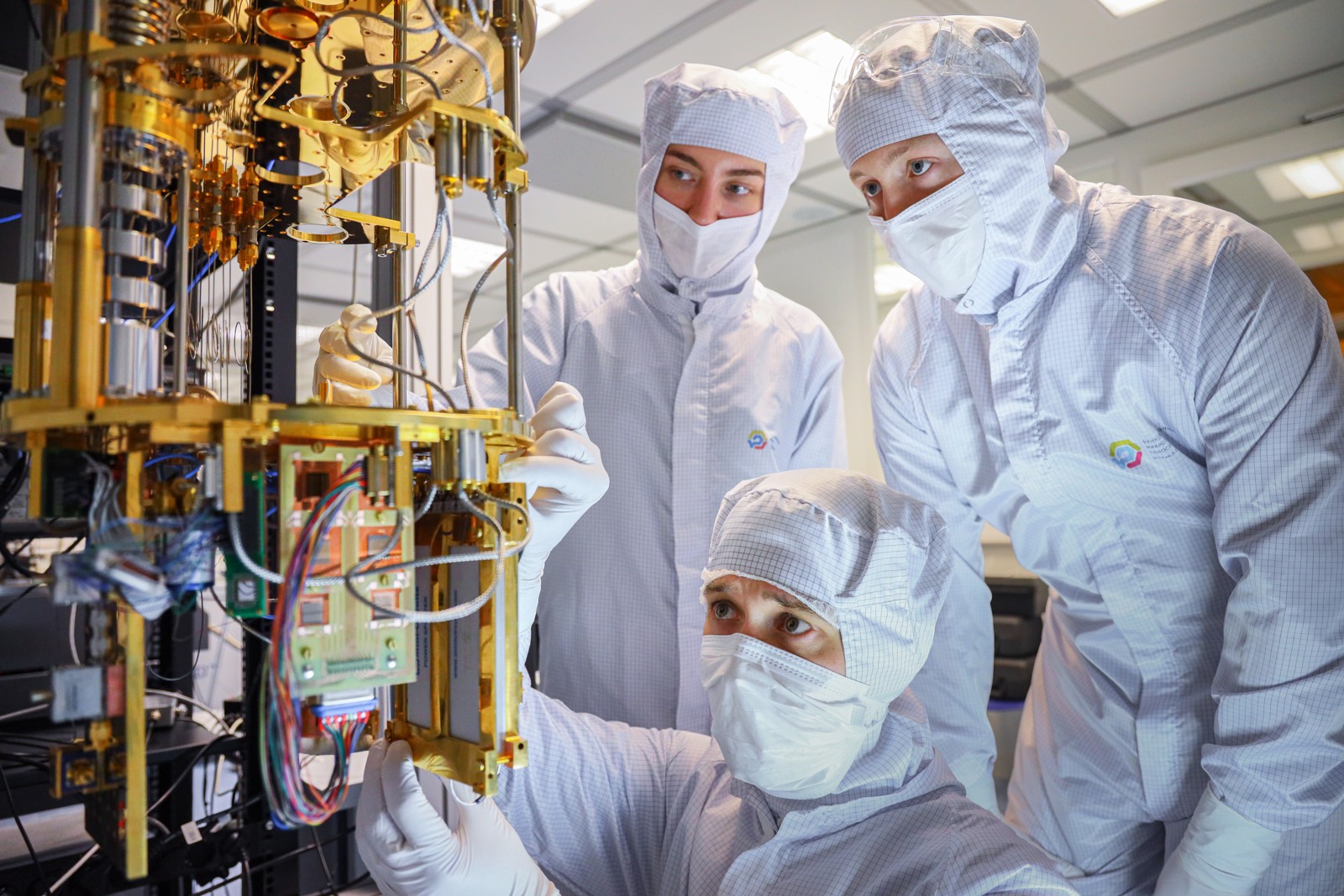
Three FMN Laboratory engineers in cleanroom clothing inspect cryogenic stages, wiring and microwave components.
Illustrative photoSergey Kushlevich / FMNLab

A quantum computer can sometimes save hardware by making one do two jobs: help carry out a measurement, then become part of the quantum result. The trick is scheduling, not squeezing extra storage into a qubit.[3][4]

A theoretical study by Soham Sau and Michal Sedlák, published in Quantum on November 10, gives a general construction for such adaptive measurements. The work first appeared as a preprint in December 2025. This week's development is journal publication, not a new experiment.[1][2]

A quantum measurement produces more than a number. It also changes the quantum system left behind. A “quantum instrument” describes both, so replacing one implementation with another must preserve the outcome probabilities and the corresponding output states.[3]

Consider a worked example calculated by QubitWire: one input qubit, a two-qubit output and four possible measurement labels. Choose an instrument whose state change for each label is represented by a single matrix. The standard one-step construction adds three qubits: one for the enlarged output and two for the four-way measurement record.[3][4]

An adaptive construction needs just one added qubit. It helps obtain the first binary result, is reset, and helps obtain the second. Those two recorded bits distinguish four labels. After another reset, an operation chosen from the recorded results makes that qubit part of the two-qubit output. This third stage involves no measurement. The total falls from four qubits to two, with three stages instead of one. This is an ideal resource calculation, not a measured hardware saving.[4]

The output preserves the specified measurement’s state change; it does not create a second copy of the input.[3][4]

Reusing measurement helpers is not new: a 2008 paper already described binary-tree generalized measurements. Sau and Sedlák’s broader framework includes the state left behind and cases where the quantum output grows.[5][4]

The practical catch is the extra control work. IBM's hardware documentation identifies classical decision latency and limited qubit coherence as constraints on adaptive circuits. Reset and readout must also work reliably. Sau and Sedlák assume error-free operations and do not establish a general gate-count saving.[6][7]

For readers comparing quantum machines, the useful question is therefore not just how many qubits a task needs. It is how many must exist at once, what extra steps reuse demands, and whether the final output still meets the same accuracy target.[6][7]

Keep your reading trail

Evidence & context

7 linked sources

Peer-reviewed theory, originally posted in December 2025. The original QubitWire worked example checks exact branch equivalence; it is not a physical-device test, speedup or universal optimality claim.

How to read the evidence and dates

An announcement records what an organization stated. An experiment reports an observation. A simulation or resource estimate depends on its assumptions. QubitWire’s analysis connects these sources; the labels are not quality scores.

Published is the article’s first QubitWire publication. Updated marks a substantive content change. Sources checked records a review of the underlying evidence. An older paper can support a new explanation, and another press release about the same work is not independent replication.

QubitWire take

Compare simultaneous qubits, extra adaptive stages and final accuracy together; a smaller ideal construction is not a measured hardware advantage.

Sources

  1. Quantum journal publication

    Journal publication dated November 10, 2026; the theoretical work first appeared as a preprint in December 2025.

  2. arXiv version history

    First submitted December 16, 2025; latest revision November 2, 2026. Journal reference: Quantum 10, 2262 (2026).

  3. Quantum instruments and one-step resources

    Definition includes outcome probabilities and conditional output states. The worked example uses one input qubit, two output qubits and total Kraus rank four.

  4. Adaptive construction and output qubits

    Section 4.3, Corollary 3.4. The third stage is a conditional isometry without measurement. The QubitWire example checks branch equivalence algebraically, not physical-device performance.

  5. Andersson and Oi: earlier binary-tree measurements

    Physical Review A 77, 052104 (2008). Prior generalized-measurement work establishes that resettable helper reuse is not newly invented here.

  6. IBM dynamic-circuit considerations

    Hardware considerations for classical decision latency and qubit coherence; not an implementation or test of the Sau–Sedlák construction.

  7. Paper discussion and limitations

    Idealized error-free theoretical construction. Qubit and stage counts do not establish a general gate-count saving, noisy-hardware advantage or universal optimality.

READ NEXT

Continue exploring

All Research stories
  1. Quantum software / Benchmarking

    A simpler check for quantum computers that measure while they calculate

    A new preprint finds a manageable reference for selected measurement records, with cloud-hardware tests and a clear limit on what it can certify.

    Published · Source report · Sources checked · About 3 min read
  2. Error correction benchmarks

    A Cheaper Test for Quantum Error Correction Starts Before the Logical Qubit

    An October 5 preprint tests a hardware-screening method across ten quantum processors. Its strongest question is whether cheaper checks can identify where logical-memory experiments will work best.

    Published · Source report · Sources checked · About 6 min read