
A Quantum Switch Can Put Two Operations in Both Orders
Experiments with light make the order of quantum operations a controllable resource. The gain is specific—and it is not time travel.

.jpg)
Most computer programs make a quiet assumption: when two operations depend on each other, their order is settled. First do A, then do B. A quantum switch asks what becomes possible when the choice between those two orders is itself controlled quantum mechanically.
This is an experimentally studied idea, not a proposal to send your laptop back in time. In an October 2025 paper, researchers reported generalized quantum switches on a programmable photonic chip and tests certifying the resulting processes. The experiment offers a route into a surprising question: can the arrangement of a computation become part of its quantum resources?[1]
Order can change the answer
Take the number three. Add two and then multiply by four, and you get twenty. Multiply by four and then add two, and you get fourteen. The ingredients are identical; their order changes the result. This everyday arithmetic example is an analogy for why the order of operations deserves attention, not a recipe for making a quantum switch.
In quantum theory, an operation changes a system's state. The 2013 theoretical account of the quantum switch describes using a control to determine which of two unknown operations comes first. When the control is prepared in a suitable superposition, the output coherently connects the alternatives. It is more than a circuit designer choosing one ordering in advance.[2]
There are three ideas worth keeping separate. One can run A before B. One can run B before A. Or one can build a physical process that preserves quantum coherence between the two alternatives. Merely tossing a coin to choose the order produces ordinary uncertainty, not that third resource.
A photon makes the idea tangible
A landmark experiment published in 2015 used light to investigate this distinction. Procopio and colleagues applied operations to a photon's polarization, with its path providing control over their order. Their carefully selected task asked whether two otherwise unknown gates commute or anticommute: roughly, whether reversing the order leaves their mathematical product unchanged or changes its sign.[3]
The team distinguished those promised possibilities using one query to each gate. Under the fixed-order comparison considered in the study, one gate must be used again. The gain concerns the number of calls to the operations. It is not a measured acceleration of ordinary software, and the task comes with a promise about which kinds of gates are being compared.[3]
That distinction makes the experiment more useful to understand. Imagine an expensive measuring station that charges each time an object passes through it. A method that needs fewer passes saves that particular resource. Whether the complete installation is cheaper or faster still depends on the equipment around the station. Query counting provides a precise comparison without settling every engineering cost.
Random order is not enough
How do researchers establish that the experiment preserved the relevant quantum process? Seeing an unusual output once would not be enough. An ordinary mixture of fixed orders might produce surprising results too. A useful test needs a boundary that the specified fixed-order alternatives cannot cross.
Rubino and colleagues addressed this with a causal witness, a mathematical combination of experimental measurements. Their 2017 publication reported a result inconsistent with a definite causal order under the experiment's assumptions. The associated author manuscript describes how measurement information was collected without destroying the coherence needed for the test.[4]
A witness is best understood as a targeted diagnostic. It answers the question for which it was designed, with its own assumptions and uncertainties. It does not establish that every component is trusted for every possible application. Nor should a statistical violation be translated into a claim that familiar cause and effect has disappeared throughout the laboratory.
The experiment has moved onto a chip
The October 2025 study by Deng and colleagues broadened this line of research. Its publisher abstract reports a programmable integrated photonic implementation of generalized, multidimensional and multipartite indefinite causal orders. The authors describe violations of definite-order bounds and a protocol for concentrating the resource from a single input copy. These are findings about the processes they implemented and certified.[1]
Putting optical elements into an integrated device is an engineering direction, not a universal performance verdict. It would be misleading to turn that report into a claim that the chip runs every quantum program faster. The publicly accessible publisher record supports the broad demonstration; it does not by itself justify additional claims about a commercial machine's cost, throughput or readiness.
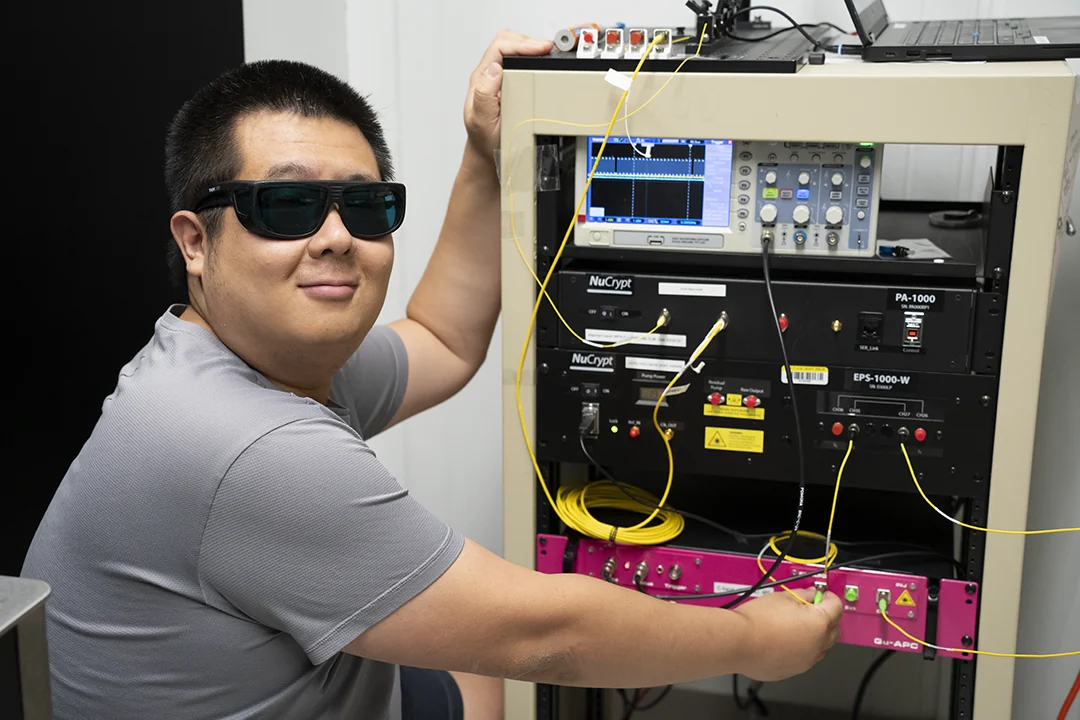
The photographs accompanying this explanation show related quantum-photonics research and fabrication. They do not show either cited quantum-switch experiment. A cleanroom explains something about how delicate optical hardware is made; it cannot independently prove what a different team's chip accomplished.
More orders introduce a different scaling question
Two operations give a convenient starting point, but researchers have also studied coherent control of larger sets of orders. Taddei and colleagues reported an optical-fiber experiment with four gate orders in 2021. Their work introduced a particular promise problem that allowed a small target system and demonstrated instances using photonic polarization.[5]
The result helps distinguish two kinds of scale. One concerns how many operations and orderings the method can address. The other concerns the physical resources needed to realize and read out the experiment. Increasing the first while ignoring the second would make an incomplete comparison. A theoretical resource saving is a motivation for engineering work, not permission to omit that work from a benchmark.
For a future practical proposal, ask which task benefits, what information is known in advance, what counts as one use of an operation and how success is recognized. Then ask about losses, repeated trials, controls and the strongest applicable comparison. These questions turn an attractive diagram into a testable computing claim.
A different meaning of quantum control
The familiar introduction to quantum computing emphasizes superpositions of states. A quantum switch extends the discussion to coherent control over how operations are connected. The control must retain the relationships that allow the alternatives to interfere; a list of possible schedules is not enough.[2]
This is why neither time-travel language nor an ordinary networking analogy quite fits. A network switch directs traffic between destinations. The switch discussed here is a process acting on quantum operations. The shared word does not make the devices interchangeable, and these optical experiments do not establish communication with the past.
The most interesting lesson is a design question. When evaluating a computer, we usually ask which components it contains and how accurately each component works. These experiments invite another question: which aspects of their arrangement can be controlled coherently, and does that control help with a clearly specified job? There is no need to promise a universal shortcut to appreciate the answer already taking shape. Small, carefully defined experiments can reveal resources that a familiar circuit picture leaves out. Finding out when those resources justify the apparatus is the next part of the computation.