
Your Quantum Program Gave a Different Answer. That May Be Good News.
Repeated results can look inconsistent even on a perfect quantum device. The useful answer often lives in the pattern that emerges across many runs.


You press run, get a zero, then press run again and get a one. For many ordinary calculations, that would start a debugging session. For a quantum circuit, it may be exactly the intended behavior. The program can prepare a state whose measurement has several possible outcomes, with predictable probabilities.
Consider a prepared with equal chances of zero and one in the chosen measurement. A thousand repetitions should usually produce roughly equal totals, without promising exactly five hundred each. Each repetition prepares the state again. You are collecting fresh experiments, rather than repeatedly peeking at an unchanged hidden answer.
Researchers call those repetitions shots. Software such as IBM’s Sampler returns the observed bit strings, which can be counted and compared. One result is a sample; the collection reveals how often different outcomes occur. In a useful algorithm, the question determines which features of that distribution actually carry the answer.
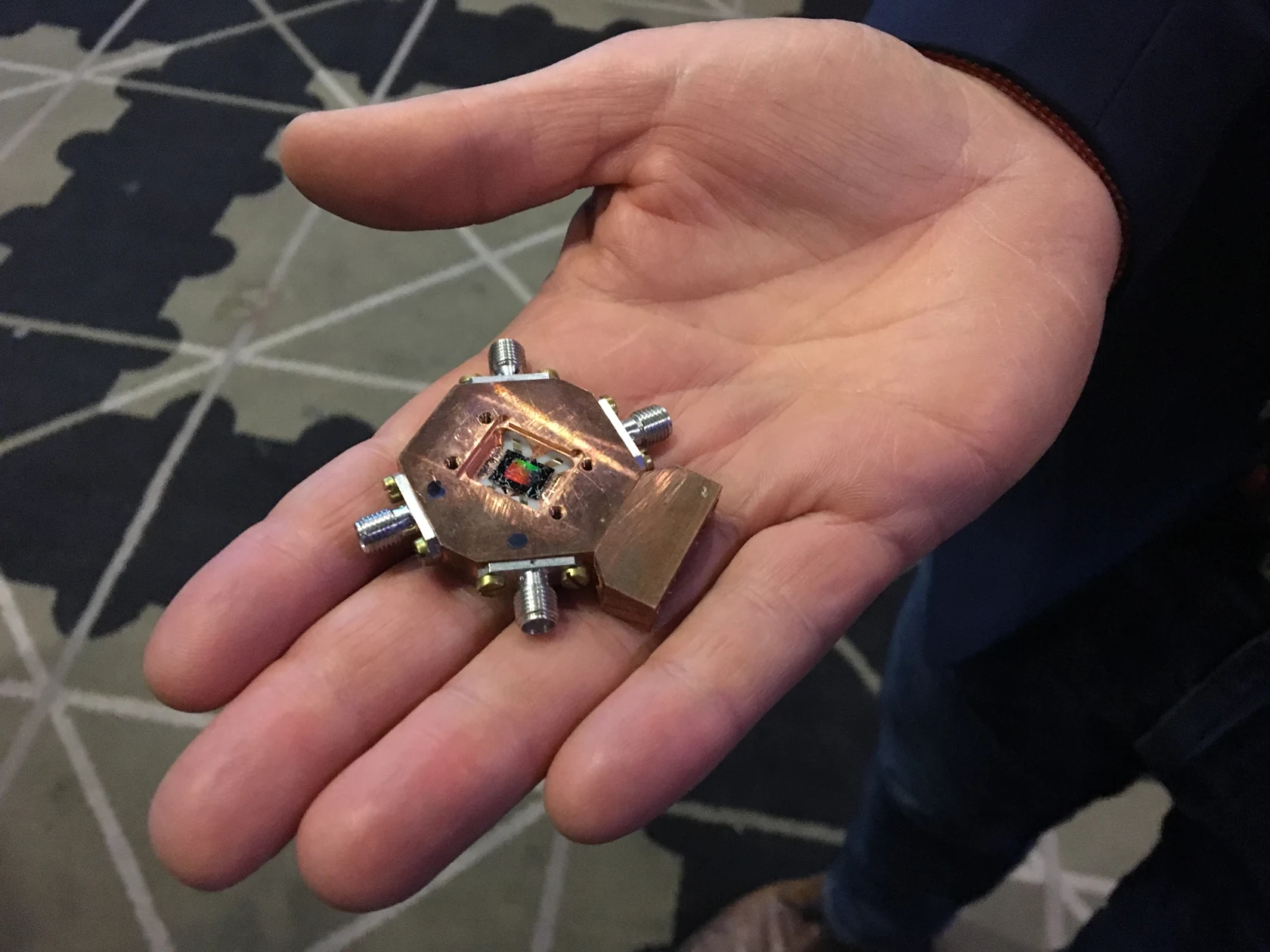
There is a second source of variation: imperfect hardware. Gates, readout and environmental disturbances can shift the observed distribution away from what the circuit intended. Taking more shots helps estimate the distribution being produced, but cannot automatically remove that bias. Error mitigation addresses certain effects, often requiring additional measurements and assumptions.
That changes how to read a quantum result. Look for the expected pattern, the number of repetitions and an account of uncertainty. A beginner’s circuit can display meaningful randomness without solving a useful industrial problem. Conversely, an impressive-looking single output tells you little about whether the underlying experiment is reliable.