
A Quantum Readout Got Cleaner. The Decision Did Not.
A superconducting-qubit study found that a tested adaptive filter reduced trace noise without resolving a fidelity gain. Choosing the measurement window did more.
Reading a usually begins with a deliberately simple tool: average the measured signal across a fixed window, then decide which state produced it. A new preprint asks whether a smarter digital filter can beat that boxcar baseline in the decision that actually matters.[1][2]
The researchers trained a finite-impulse-response filter with the least-mean-squares algorithm on an FPGA controller, froze the learned filter and compared it with boxcar averaging on measured shots. The filter reduced trace noise, but the tested readout lengths showed no resolved improvement in state-assignment fidelity. Earlier superconducting-qubit research showed that machine-learning classifiers can improve assignment fidelity and expose systematic errors, making this operating-point limit a useful counterexample rather than evidence that signal processing never helps.[1][2]
The paper explains why that result is not as paradoxical as it sounds. When all filtered samples are summed, the tested filter largely collapses to the boxcar sum multiplied by one complex number, apart from a small edge correction. Signal separation and noise scale together, so the picture can look cleaner without making the classes easier to distinguish.[1]
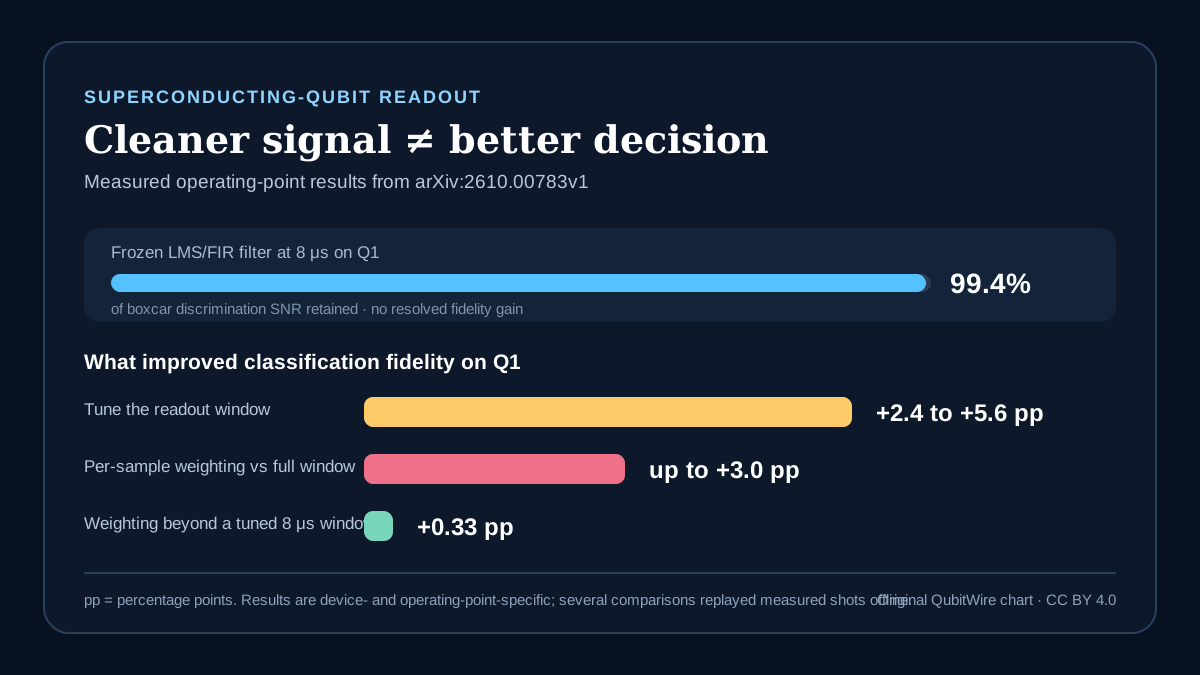
At the eight-microsecond operating point of the tested 2D transmon, the frozen filter retained 99.4% of the boxcar discriminator's signal-to-noise ratio. That is close to the baseline, but closeness is not a gain. The result is a useful reminder that waveform quality and classification quality are different measurements.[1]
Timing produced the clearer improvement. On that qubit, optimizing the window's start and duration raised contrast-readout fidelity by 2.4 to 5.6 percentage points across four readout lengths. Per-sample weighting added as much as 3.0 points over full-window integration, yet only 0.33 points beyond an already tuned window at eight microseconds.[1]
A second operating point supplied a different lesson. An offline sequential test made most decisions early while staying within 0.5 percentage points of boxcar fidelity. The crossover between waiting and deciding depended on the operating point, and a matched-filter template built from about 30 labeled shots per class performed nearly as well as one built from hundreds.[1]
The boundaries are important. This is a preprint covering two qubit operating points, and several comparisons replayed measured shots offline rather than demonstrating every method as a live FPGA improvement. The findings do not prove that adaptive filtering is useless across devices, resonators, noise regimes or control stacks.[1]
The practical message is narrower and more valuable: optimize the measurement and the decision rule before assuming more signal processing will help. Replication across devices, live controllers and changing drift conditions would show when adaptive methods earn their complexity. For now, the simplest timing choice delivered the larger verified gain.[1]