
A Qubit Has Two Levels. Why Stop There?
Qudits use more than two quantum levels. They offer a different way to build and measure quantum information—not unlimited readable data.

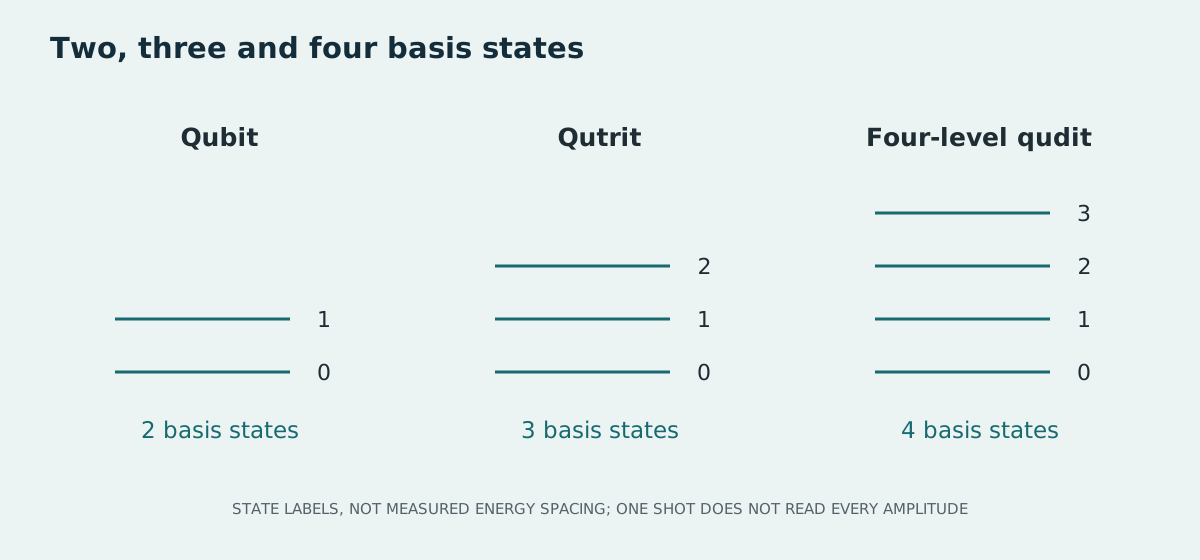
A quantum computer does not have to build every unit of information around only two possible measurement labels. The familiar uses two basis states, usually labelled 0 and 1, and can occupy a superposition of them. A qudit extends the idea to more basis states. Three levels make a qutrit. Four make a four-level qudit. The unusual possibility is not that scientists have discovered extra ordinary digits. It is that some quantum hardware already contains a richer set of controllable states than a two-level description uses.[1]
For anyone who has just learned what a qubit is, that can sound like moving the goalposts. But it is also a revealing question about technology: should a computer’s building blocks follow familiar notation, or should its notation follow the physics?
An atom is not born with a binary user interface
A classical bit is a useful abstraction. A physical device is arranged so that two distinguishable conditions reliably represent its values. A qubit is another abstraction, with distinctly quantum rules governing how its states combine and change.
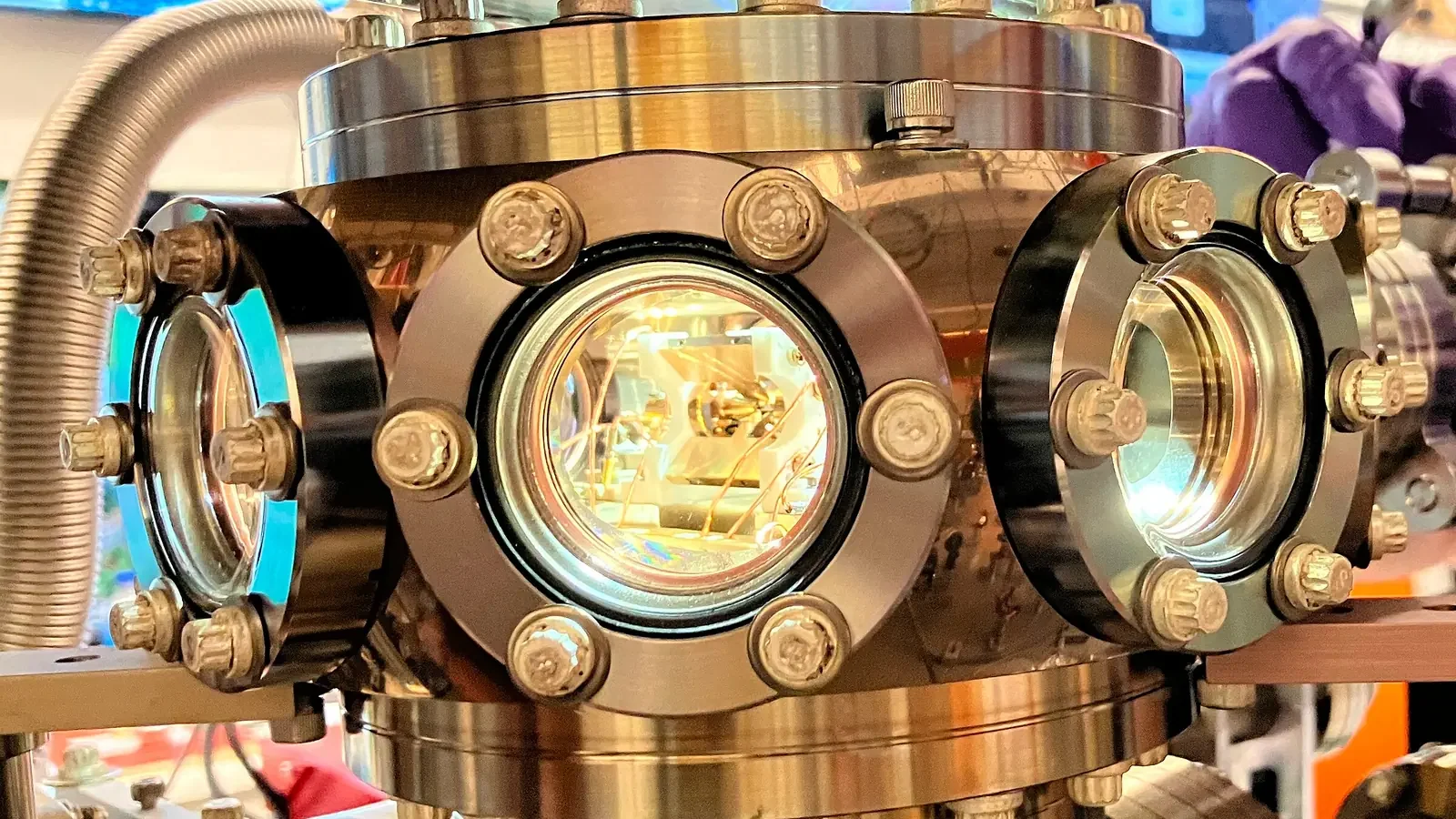
Atoms, however, can have more than two relevant energy levels. Choosing two of them for a qubit does not make the others vanish. In 2022, Innsbruck researchers described a processor designed to use multiple states of trapped ions for computation rather than treating every additional level as something to avoid. Their work is an experimental foundation for this approach, not a newly announced 2026 invention.[1]
Imagine a building with several usable floors where the control system usually permits access to only two. Opening more floors may make some activities more convenient. It also means the controls must reliably distinguish where someone is going. The comparison illustrates the design choice, not the behaviour of quantum superposition.
This distinction is important because the headline “beyond zero and one” can otherwise mislead. Ordinary qubits already go beyond classical bits. Qudits do not introduce superposition for the first time; they enlarge the space in which a quantum state can be represented.
More levels do not mean you can read everything at once
A four-level system has four distinguishable basis outcomes. In that limited counting sense, its state space has the same dimension as two two-level systems: four equals two times two. That does not make one four-level atom interchangeable with two separately controllable qubits in every practical setting.
The operations available, the way subsystems interact and the kinds of noise they experience still matter. This is simple dimension counting, not a speedup benchmark. It is no more a proof of faster computing than knowing a vehicle has more gears proves it will finish a journey sooner.
There is a second trap. A superposition can involve several basis states, but a measurement does not hand over a complete list of all their amplitudes. Reconstructing an unknown state requires appropriately designed measurements over repeated preparations. More levels do not create a loophole for extracting unlimited classical information from a single quantum system.[3]
That is why a careful diagram should show possible levels and measurement outcomes, not a promise that every answer is simultaneously available. The interesting resource is what the system can coherently do before measurement—not an imaginary ability to read an entire hidden spreadsheet in one shot.
The measurement itself can be redesigned
A July 2026 Innsbruck report highlights another part of the story: researchers can ask richer questions of a quantum system than a basic projective measurement allows. The collaboration developed a way to certify genuinely non-projective measurements and demonstrated the approach experimentally. In accessible terms, the test distinguishes a broader quantum measurement from strategies that merely randomise among standard projective measurements. The point is not just obtaining a longer list of outcomes; it is establishing what kind of measurement process produced them.[2]
Consider a camera that can be fitted with different filters. Changing the filter changes which information the resulting image emphasises. Quantum measurement is not literally photography, but the analogy helps separate the state being examined from the procedure used to examine it.
The research paper combines a theoretical certification method with an experiment. Its conclusion is about the measurement capabilities tested. It does not demonstrate that qudits outperform qubits on every computational problem, or that conventional quantum computers cannot implement generalised measurements using additional resources. Those are different questions.[4]
Why a richer alphabet might help
Suppose the problem you want to model naturally contains several local states. One approach is to encode those states across multiple two-level units. Another is to use a multilevel unit whose structure more closely resembles the problem.
The attraction is a possible reduction in translation overhead. A more natural representation may simplify some operations or make a model easier to implement on a particular device. The Innsbruck work points to this fit between multilevel hardware and applications as a motivation for exploring qudits. It is a design opportunity, not a blanket claim of superiority.[1]
A familiar parallel is the difference between typing a mathematical formula directly and describing it through a long sequence of menu clicks. Both can express the same idea. The convenient interface depends on the task and on what the system supports well. The fair comparison therefore needs an actual problem, an actual implementation and a defined cost. Counting fewer particles while ignoring harder controls would tell only part of the story. So would celebrating a simpler circuit while overlooking the precision required to run it.
.jpg)
The extra levels come with extra questions
For a proposed multilevel design, ask how reliably the relevant states can be prepared, manipulated and distinguished. Ask whether errors leak into unwanted states. Ask what happens when two multilevel units interact, and how protection would work at larger scales. These are engineering questions rather than objections to the idea. Every architecture deserves them. A successful answer for one operation on one device is evidence about that operation and device—not a transferable guarantee for every future processor.
There is also a language problem. Terms such as qubit, qutrit and qudit make useful distinctions for specialists, but a public explanation should not require readers to memorise a new dictionary before reaching the point. The point is that quantum information can be packaged in different physical forms, and those choices can alter which operations are convenient.
The future need not use only one alphabet
It would be premature to declare that qudits will replace qubits. It would be equally limiting to assume that familiar two-level notation defines the only sensible way to build a quantum machine. A more interesting possibility is a varied toolbox: different encodings, devices and measurements chosen for the work they do well. Whether that becomes practical depends on evidence from complete systems, not the appeal of a name.
For now, the shareable insight is simple. Nature offers more than a binary-looking set of ingredients. Quantum engineers are learning which of those ingredients they can control, how to measure them and when using more of them is genuinely helpful. The computer is not learning ordinary counting all over again. We are learning not to force every quantum component into the same alphabet.