
QuiX’s next quantum-computer challenge: lose less light, react faster
A Dutch project targets the components needed to scale light-based computing. Its newly detailed goals show why a count of qubits, the units of quantum information, is only part of the story.
Reading tools for text size, copying, printing and your reading list
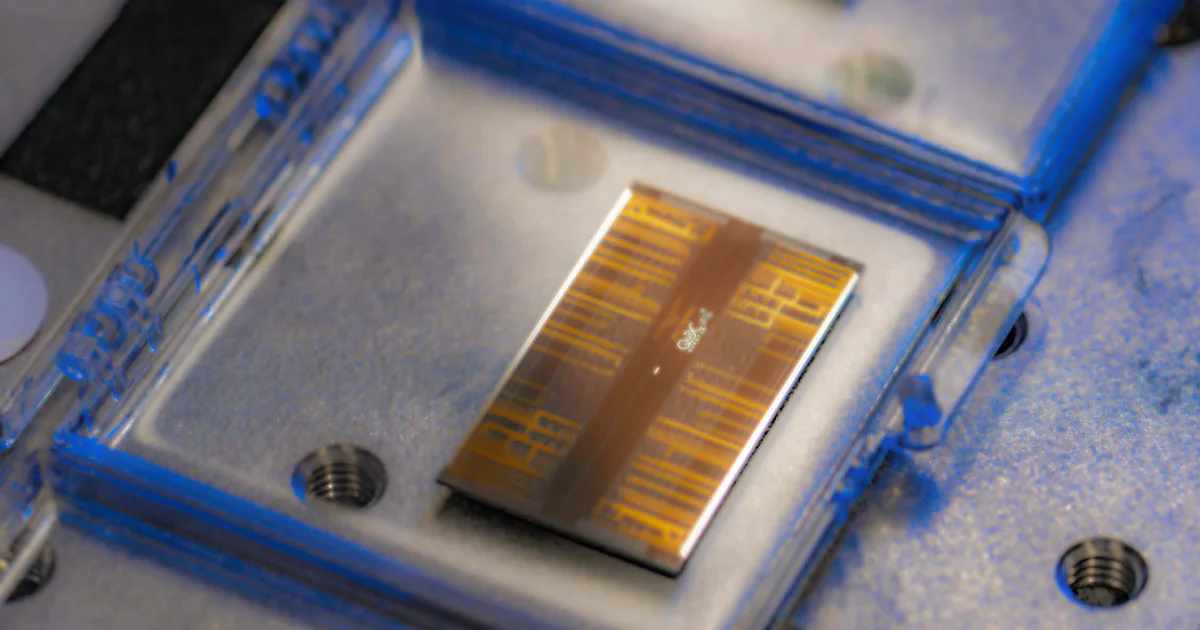
QuiX Quantum has detailed a Dutch-funded effort to tackle two obstacles to larger light-based quantum computers: losing the particles that carry information and waiting too long for electronics to react. The November 10 announcement describes component goals for an existing project, rather than a newly delivered computer.[1]
The company’s PhotonDelta mission runs from January 2026 through December 2028. A university recruitment notice already described the project in October. The announcement gives targets including lower-loss connections between optical fibers and chips, better photon sources and detectors, and faster control electronics. Its published project description ends with a manufacturing strategy for 100-plus-qubit systems.[1][2]
A photon that disappears cannot finish its job
Photonic computers use particles of light to carry quantum information. Keeping enough of them through a long sequence of components is an engineering problem: a small loss at each connection can accumulate. The mission targets 0.1 decibels of loss at each fiber-to-chip facet, or connecting edge.[1]
A simple calculation gives that number a scale. A 0.1 dB loss corresponds to about 97.7% transmission. Two identical such interfaces would transmit about 95.5%, before any additional component loss. Ten would transmit about 79.4%. These are illustrative compounded-loss calculations, not measured mission performance or the success probability of a complete quantum algorithm.[3]
The ordinary intuition that a connection works because most light gets through is therefore insufficient. The relevant question is how a whole chain behaves and what the design does when photons are lost.
Electronics have to keep up
The mission targets control chips with latency below 10 nanoseconds, which QuiX compares with 150 nanoseconds for its existing feedforward control. Its 2026 Carina whitepaper reports that existing figure as a measured response to detector signals. Feedforward means using an earlier measurement to decide a later operation.[1][4]
The announcement does not provide matching test conditions for the proposed chip and existing unit. The target is not a demonstrated result or a measure of the whole computer’s speed.[1][4]
The distinction matters when reading a headline about 100 qubits. A larger information capacity is useful only if sources, connections, detectors and control work well enough together.
What the mission does not yet establish
QuiX places loss-tolerant demonstrations in 2028–2030 and commercially deployable fault-tolerant systems beyond 2030. Those are company plans. Fault tolerance means a calculation can continue reliably despite individual faults; it is more than building components with promising specifications.[1]
The next informative evidence will be measured component results, their integration and a clear account of the overhead needed to protect information. The new disclosure supplies concrete engineering targets to watch. It does not establish that a useful 100-qubit machine is already working.
Keep your reading trail
Keep up with these topics
Explore the subjects covered in this story.