
A single atom makes a quantum link at a fiber-friendly wavelength
A new journal paper describes a direct atom–photon link in the telecom C-band. The quality is promising; collecting the photons remains difficult.
Reading tools for text size, copying, printing and your reading list

A quantum network needs a way to connect something that stays put—such as an atom—to something that can travel. Researchers at the University of Science and Technology of China have demonstrated one such connection using a photon emitted directly at a wavelength suited to optical fiber.[1][2]
The work appeared as an accepted manuscript in Nature Communications on November 4, following an August preprint. The appealing idea is straightforward: make the quantum messenger in a useful form from the start. Turning that laboratory result into a dependable network remains a separate challenge.[1][2]
Why the color of the messenger matters
Light is useful for carrying information because it can move between otherwise separate devices. But an optical fiber does not transmit every wavelength equally well. The telecom C-band is especially useful for low-loss communication. Here, the researchers used a single rubidium-87 atom and a cavity-assisted protocol to create with a 1530-nanometer photon. Entanglement means their measurement results have a joint quantum relationship; it does not mean the atom can send an instant message.[1][2][3][4]
Direct emission matters because it can remove a wavelength-conversion step for this particular interface. That is a design choice with potential advantages, not proof that every indirect approach is worse. A working connection must be judged as a whole: what survives preparation, collection, transmission and detection, and what quality remains at the end. Skipping one stage is helpful only if the stages that remain perform well enough.[1][2]
State quality and delivery are different questions
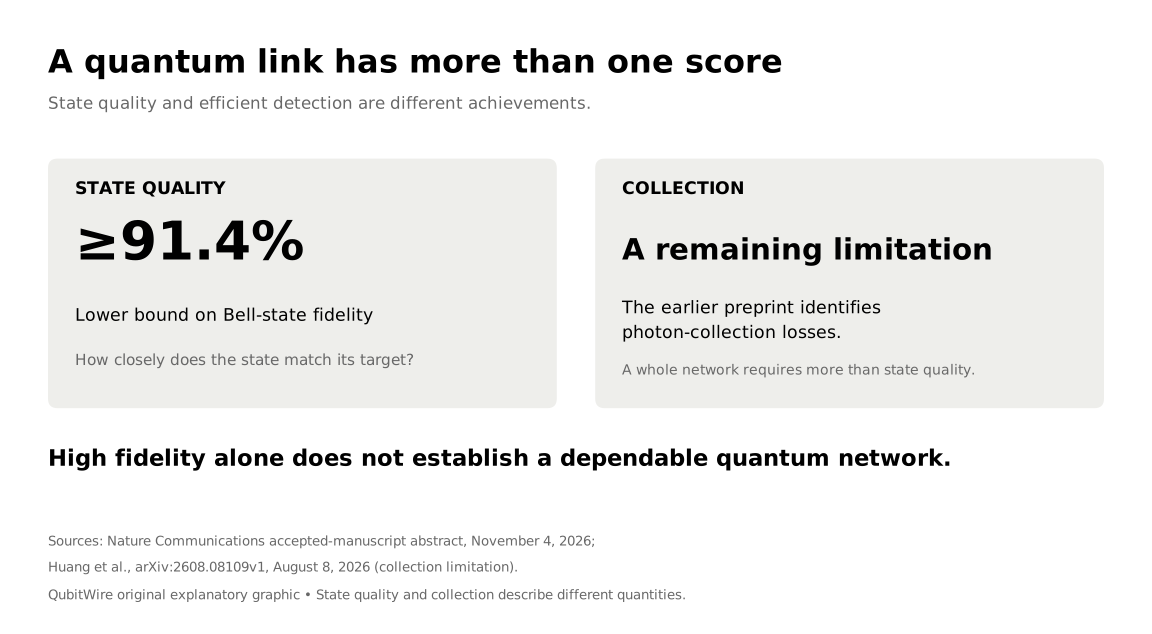
The researchers report a Bell-state fidelity lower bound of 91.4%. Fidelity measures how closely the observed state matches the intended entangled state. A statistical test of the correlations also gave 2.455 ± 0.077, above the relevant Bell-inequality bound of 2. These results concern the measured quantum relationship. They are not a statement that 91.4% of network attempts deliver a usable photon.[1][2]
The August preprint also identifies photon collection as a major limitation. That illustrates why state quality and delivery efficiency must be considered separately: fidelity measures how closely the observed state matches its target, while efficiency asks how often a specified preparation or detection event is obtained. Neither is, by itself, the success rate of a deployed network.[2]
Imagine assessing a mail service. The share of delivered envelopes that arrive intact is one question; the share of posted envelopes that arrive at all is another. That analogy does not describe entanglement itself, but it makes the reporting problem clear. An impressive answer to the first question cannot substitute for an answer to the second. Nor can either number alone tell us how a network behaves as distance and the number of users increase.
What would make this more useful?
The next practical questions are specific. Can the interface collect more of the useful photons while preserving the measured state quality? Can it operate between remote nodes, repeatedly, with all the relevant losses and timing included? Does a later comparison use the same task and counting rules? Those are the results that would justify a stronger claim about network performance.
For now, this is a building block for quantum communications. It does not demonstrate a deployed quantum internet, a faster consumer internet connection or faster-than-light communication. The useful advance is an experimentally tested interface between a stationary atom and a traveling photon in a fiber-friendly band. The useful lesson for readers is equally durable: when a quantum headline gives you a percentage, first ask what was counted.[1][2][4]