
Telecom Quantum Dot Keeps a Hole Spin Coherent for 21.8 Nanoseconds
Peer-reviewed measurements link a semiconductor hole spin to 1.55-micrometre photons, but this remains an interface experiment—not a network node.
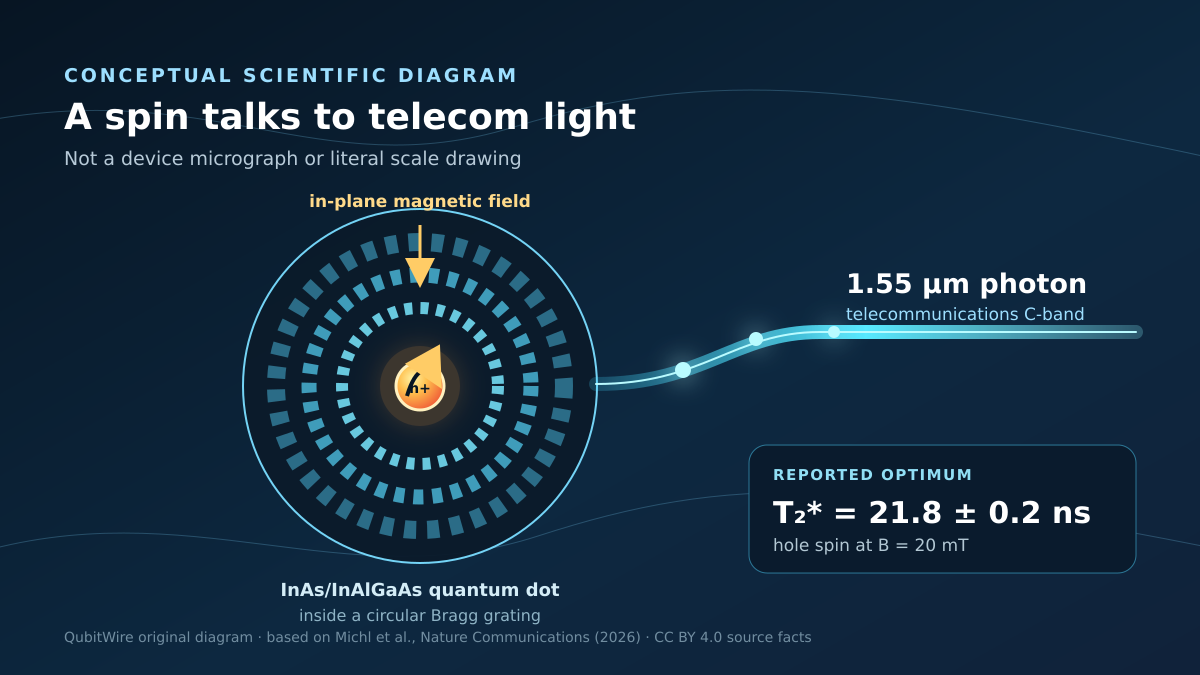
A Würzburg-led team has built a semiconductor interface that connects a stationary hole-spin to photons emitted directly in the telecommunications C-band. The peer-reviewed device combines an InAs/InAlGaAs quantum dot with a deterministically positioned circular Bragg grating and emits at 1.55 micrometres.
That wavelength matters because ordinary optical fibre is engineered for low-loss telecom transmission. A coherent spin can store and manipulate quantum information locally, while a photon can carry it between nodes; putting both functions in one solid-state device is a route toward networked quantum processors.
Using polarization-resolved measurements and two-photon correlations, the researchers tracked a ground-state hole spin in an in-plane magnetic field. Nature Communications reports an inhomogeneous dephasing time, T2*, of 21.8 ± 0.2 nanoseconds at the study's optimal field of 20 millitesla.
The result is not a quantum network or a fault-tolerant computer. It characterizes one interface and one selected operating point. An earlier author preprint reported 15.9 ± 1.7 nanoseconds for a pulsed measurement; that earlier value should not be treated as interchangeable with the later journal result.
The practical test is whether this platform can repeatedly create high-fidelity spin-photon and longer photon strings while preserving coherence, collection efficiency and indistinguishability. Those system-level measurements—not the wavelength or dephasing time alone—will decide whether the device can serve as a useful network node.