
This Crystal Gives Quantum Light 180 Microseconds to Wait
A cold crystal preserved quantum correlations while information waited in a spin state. That is a useful component for a future network, with more work still to do.
.jpg)
The internet is full of waiting. Packets wait for links, responses and other packets. A future quantum network will also need to wait—but preserving quantum information is not as simple as leaving a file in a buffer.
An ICFO experiment offers a concrete example of how to buy that time. The team reports storage that preserves quantum correlations out to 180 microseconds in a crystal-based memory. That is 0.00018 seconds: brief on a human scale, meaningful on the timescale of light moving through a network.[1]
The memory does not keep a photon in a box
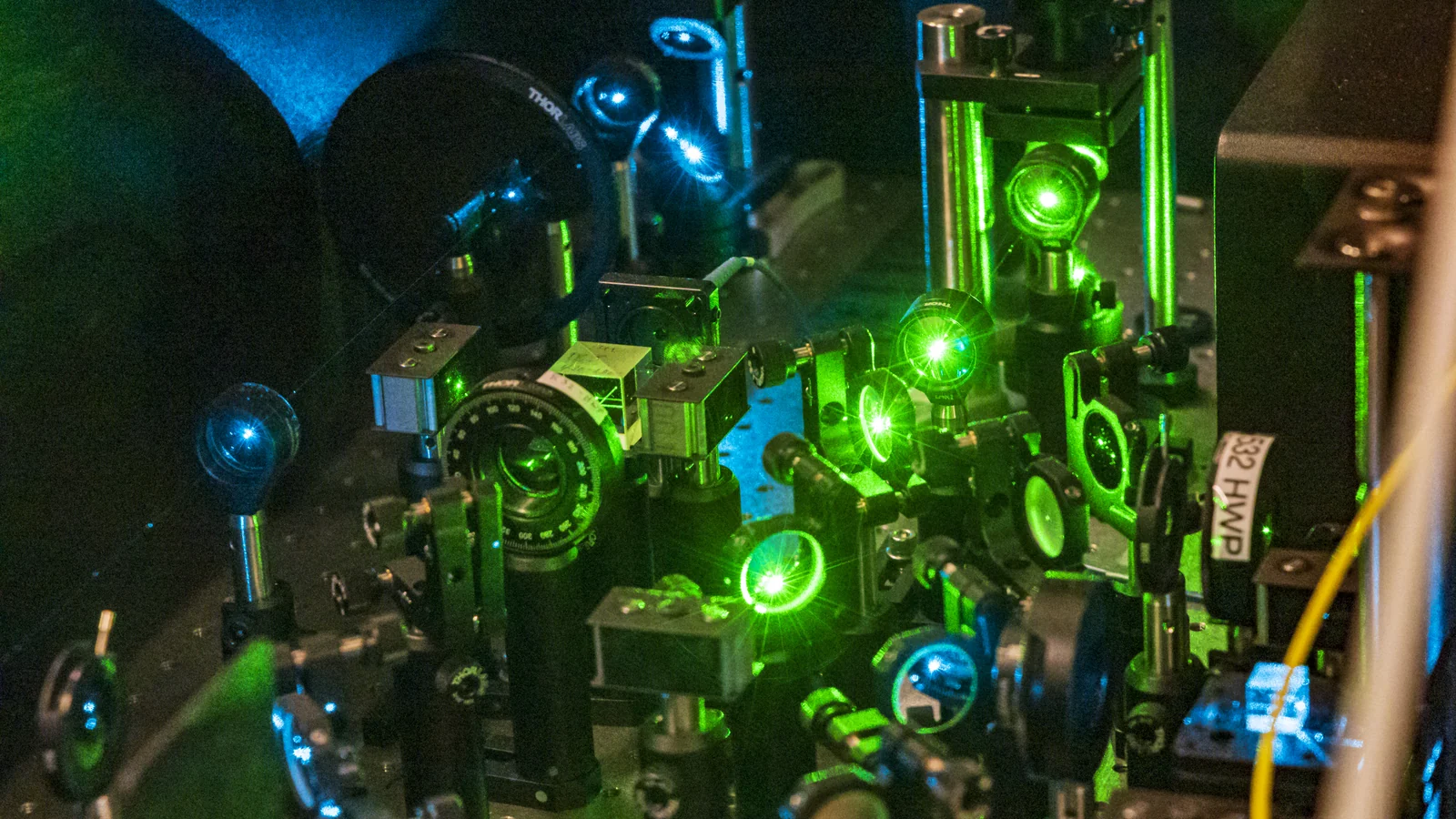
The experiment starts with a pair of correlated photons. One serves as a telecom-wavelength herald, signalling its partner. The other is absorbed into a praseodymium-doped crystal, with control pulses transferring the excitation into a longer-lived spin state.[1][3]
The useful mental model is a handoff. Information carried by light is mapped into the material and later returned to light. The same photon is not sitting motionless in a tiny waiting room.
A challenge is that the stored spins gradually lose their shared timing. The team uses radio-frequency control to rephase them, helping recover a coordinated signal rather than an increasingly disorganised collection of contributions. The system operates near three kelvin, so this is not a room-temperature memory result.[2]

A small number with a network-sized meaning
ICFO frames the storage interval as longer than the travel time for light through more than 30 kilometres of optical fibre. That comparison supplies scale. It does not mean the researchers operated a complete 30-kilometre quantum network.[2]
In a network built from separate links, success need not occur everywhere at once. A useful memory could keep one resource available while another part of the system catches up. The payoff would be coordination, not communication faster than light.
The qualification is important because holding information longer is only one performance measure. A network also needs useful retrieval efficiency, low noise and a practical way to connect components. A storage interval is not a substitute for an end-to-end demonstration.
Why the photon-level test matters
The experiment also reports longer storage with classical probe light. That is a different test. The approximately three-millisecond classical-probe result must not replace the 180-microsecond quantum-correlation result in a headline about single photons.[3]
A device that works with a strong probe does not automatically work well enough with a fragile quantum signal. A compelling account therefore has to explain which property survived, how it was checked and under what conditions, rather than celebrating the largest time printed anywhere in the paper.
That is why this particular result is worth following. It makes the waiting problem tangible: an actual crystal, a real control sequence and a measured signal, rather than a diagram of an imagined global quantum internet.
The next useful milestone would combine these memory properties with the rest of a functioning link and a convincing account of its losses. Until then, the distinction between a promising component and an operational network remains essential.
For a future quantum internet, doing nothing for long enough may be one of the hardest things to do well.