
Atoms on a ladder made of light formed an insulator with room to spare
A quantum microscope found signs of an insulating state in cold rubidium, even though the atoms occupied only about half the available spots.
Reading tools for text size, copying, printing and your reading list
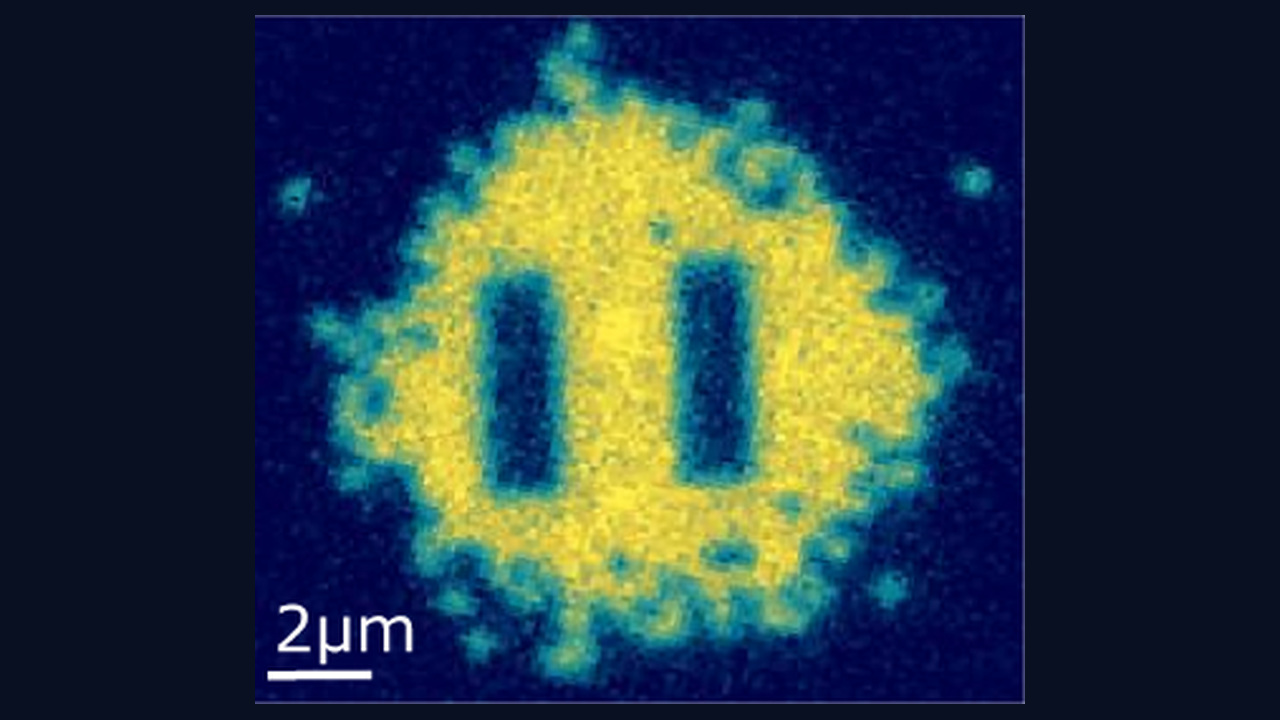
The University of Strathclyde built a ladder out of laser light and loaded it with cold rubidium atoms. When the team made it much easier for atoms to cross a rung than to travel along either rail, the gas began to resist being squeezed. In the middle of the ladder, the atoms had roughly one atom for every two spots, yet behaved like an insulator. The result, reported in a November 25 preprint, shows how changing the paths available to particles can change what a gas does without changing what it is made of.[1]
Half the spots, but one atom per rung
Think of each rung as a row of two seats. With one atom per row, half the seats are empty. But the left and right spots on a rung are coupled, so the atom's quantum state can extend across both. Many atoms nevertheless resist rearranging along the rails. The rung, rather than each spot on its own, is the unit that tends to stay occupied. Physicists call this a rung-Mott insulator. The team had previously proposed looking for it after experiments on single chains, and an August paper from some of the authors mapped out where it should appear in calculations.[1][2][3]
The researchers made five ladders, each two spots wide and 16 rungs long. They froze the arrangement for imaging, then collected the faint light scattered by individual trapped atoms. Those snapshots record where atoms were detected, not which path they took. Instead of tracking an atom as it moved, they took snapshots and asked how often each rung had an odd count. Near half filling, a lone atom makes the count odd; an empty rung or a rung with two detected atoms makes it even. As the team made hopping along the rails harder, the measured odd-rung fraction rose from about one-half to three-quarters in the selected data. It did not reach one on every rung. The researchers describe the change as a gradual crossover in their small, finite-temperature system.[1]
How they checked it wasn't just a pattern
An empty spot was not the same thing as room to fit another atom: moving a neighbor onto an already occupied rung cost energy. A second test asked how much the local density changed when it became more energetically favorable to put an atom there. Near one atom per rung, the density changed less than it did in a comparison with equally strong coupling across and along the ladder. The team also shook the light lattice at different frequencies and saw that the frequency that most disrupted the one-atom-per-rung pattern moved up as the rungs became more strongly connected relative to the rails. Explaining the exact frequency took a model of the driven experiment, not just a calculation of the ideal ladder.[1]
The value of the setup is that researchers can build a simple model of matter, alter its geometry and check what changed one spot at a time. This study didn't measure transport along the rails directly. The next test is whether a wider ladder, with more than two spots per rung, still gives up mobility in the same way.[1][3]