
Tiny pillars help quantum sensors shine more consistently
A laboratory preprint tackles a practical bottleneck: collecting a tiny sensor’s light.
Reading tools for text size, copying, printing and your reading list
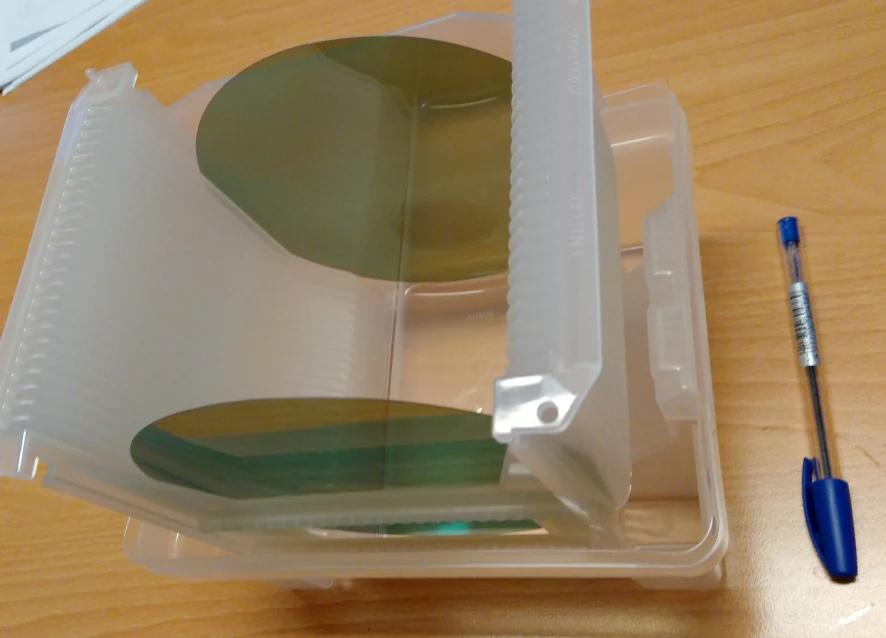
Tiny pillars etched into silicon carbide made experimental quantum sensors brighter and more consistent, a November 12 preprint, not yet peer reviewed, reports. The University of Science and Technology of China team also detected magnetic signals from hydrogen nuclei in oil.[1]
The sensors are crystal defects whose quantum spins respond to magnetic fields. Light reveals that response. The fabrication process aligns the implanted region near each light-guiding pillar’s center.[1]
Across 19 sensors of one defect type and 17 of another, average fluorescence at saturation reached roughly one million and two million detected counts per second, respectively, with relatively little variation within each group.[1]
The distinction is consistency, not simply a bright individual device. Earlier silicon carbide work had already demonstrated nanoscale magnetic-resonance sensing. A separate 2023 experiment reported more than a million counts per second using a different optical arrangement. Those results cannot be ranked by their headline count alone.[2][3]
This is quantum sensing, not a computing speedup. The useful engineering idea is that a device can improve when more of its existing signal reaches the reader. Adding is not the only route to progress, and brighter readout alone does not guarantee proportionally better measurements.[1]
The small sample leaves a practical question: will the consistency hold across many more devices?[1]