
Skip to content
RESEARCH · SILICON QUBITS

Scientists map electron energy levels inside a silicon quantum device

What chip diagnostics can reveal, and what they cannot prove.

Published Updated Source report Sources checked
Reading tools for text size, copying, printing and your reading list
My reading list
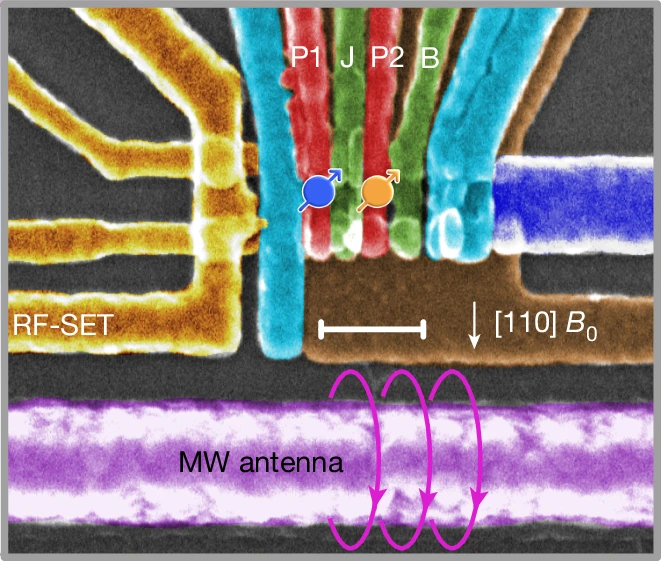
False-colour electron micrograph of silicon-device metal gates, with the original spin and microwave-antenna annotations.
Context: annotated electron micrograph of a silicon spin-qubit device from a 2025 study.Samuel K. Bartee et al.

Knowing which energies electrons can occupy helps engineers understand a quantum device. Published in Nature Communications on November 15 after a March preprint, this silicon study maps those states without demonstrating improved performance.[1][2]

The useful starting point is an artificial atom. A quantum dot confines electric charge in a tiny region, where electrons can occupy only particular energy levels. Bringing two dots together lets their states interact. NIST’s separate work on graphene dots illustrates that general principle, although it uses a different material and measurement technique from this silicon study.[3]

The UCLA team used voltage pulses and charge sensing to map energy levels while varying coupling and magnetic field. These are electrical measurements, not photographs of electrons.[2]

Stronger coupling produced shared, molecule-like states. The study also examined a two-electron configuration.[1][2]

That distinction matters when judging a quantum-chip claim. A map tells an engineer where the available states lie; it does not demonstrate that instructions reliably keep the system on the intended route. The next useful test would connect this diagnostic information to measured improvements in operating a device.

Temperature limits resolution; pulse calibration adds uncertainty. Intel supplied the device. Co-author Jason Petta discloses a significant financial interest in Halcyon Quantum; the other authors report none.[1][2]

Keep your reading trail

Evidence & context

3 linked sources

Experiment

How to read the evidence and dates

An announcement records what an organization stated. An experiment reports an observation. A simulation or resource estimate depends on its assumptions. QubitWire’s analysis connects these sources; the labels are not quality scores.

Published is the article’s first QubitWire publication. Updated marks a substantive content change. Sources checked records a review of the underlying evidence. An older paper can support a new explanation, and another press release about the same work is not independent replication.

For material corrections, check the article’s context note and source trail. A routine formatting or link change does not create a new scientific result.

Sources

  1. Yoo et al., energy levels in quantum-dot molecules (Nature Communications)

    Published online November 15, 2026.

  2. Yoo et al., energy levels in quantum-dot molecules (arXiv v2)

    First submitted March 31, 2026. Version 2 submitted April 2, 2026.

  3. NIST: coupled quantum dots

    January 29, 2020; independent background in graphene, a different material and technique.

READ NEXT

Continue exploring

All Research stories
  1. More on silicon qubits

    Silicon qubits stayed coherent longer but needed a stronger drive

    Two silicon chip designs exposed a trade-off. Qubits made with Intel’s process resisted some electrical noise better, while RIKEN’s reference needed less microwave power to turn a spin.

    Published · Source report · Sources checked · About 2 min read