
Skip to content
SECURITY · QUANTUM COMMUNICATION

A four-city quantum network puts its key output to a security test

Slovak researchers report real-time delivery while finding limits in the software’s security calculations.

Published Updated Source report Sources checked
Reading tools for text size, copying, printing and your reading list
My reading list
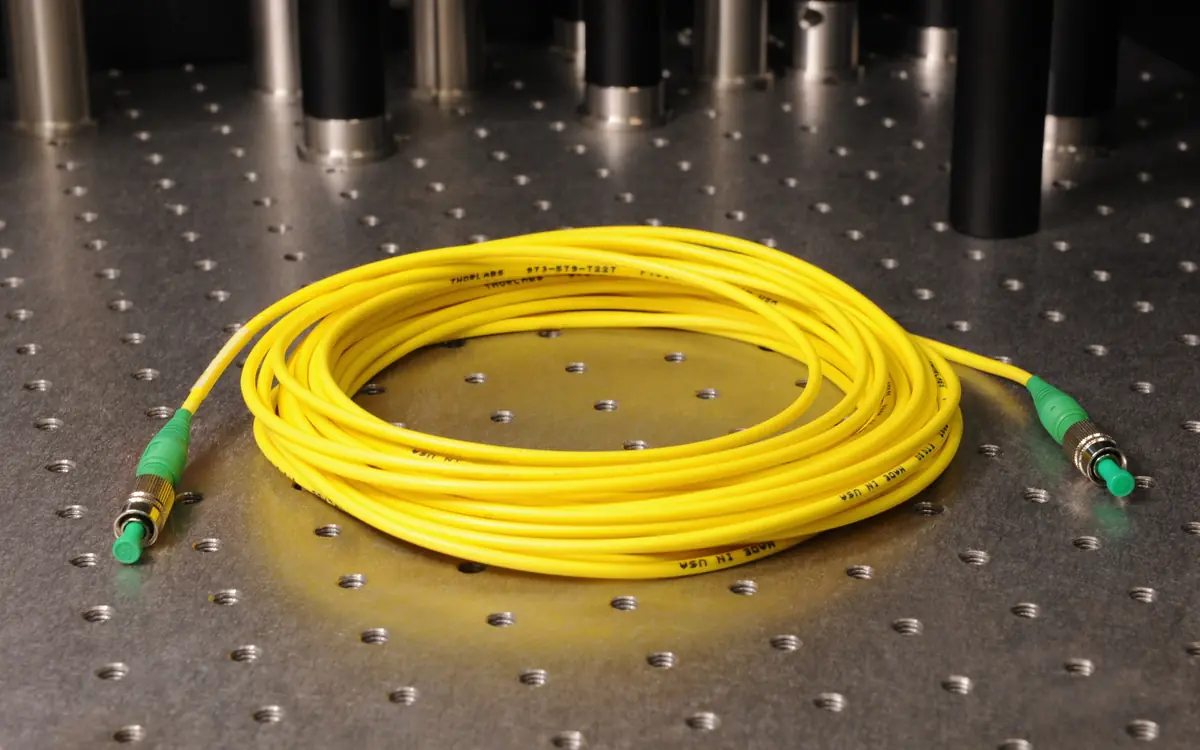
A coiled yellow optical-fiber cable with green connectors rests on a metal optical table.
Single-mode optical-fiber patch cable on an optical table.Illustrative photoGeek3

A quantum communication experiment in western Slovakia delivers encryption-key bits while all its links run together. But a November 12 preprint finds that the software produces more output than the authors’ security calculations can justify.[1]

The network connects Bratislava, Trnava, Nitra and Trenčín using existing telecom fiber. A source in Trnava distributes pairs of photons. Three cities form a fully connected mesh; the fourth connects to Trnava. Quantum key distribution aims to give two parties shared secret keys for encrypting messages. Slovakia’s broader infrastructure was publicly launched in June, so this is a technical report on its operation, not a new network launch.[1][2]

The team reports 13.5 output bits per second over 109 kilometers. A longer, 142.9-kilometer connection delivered 4.3 bits per second, but the implemented method’s finite-key analysis could not certify any of that output as secure.[1]

“Finite-key” calculations account for uncertainty when only a limited amount of measurement data is available. The software uses a heuristic, rather than a security proof, to choose its final output length, and omits finite-size corrections. The network discards blocks when checks flag mismatches. The authors estimate that classical error correction could reconcile the measured bits and yield more secure key material. They did not test that upgrade.[1]

The practical lesson is that delivering bits and establishing their secrecy are separate tests. A useful next test would combine real-time operation with security-proof-based processing and report the resulting secure-key rate.

Keep your reading trail

Evidence & context

2 linked sources

Field-deployed QKD technical preprint; author security analysis, not independent certification.

How to read the evidence and dates

An announcement records what an organization stated. An experiment reports an observation. A simulation or resource estimate depends on its assumptions. QubitWire’s analysis connects these sources; the labels are not quality scores.

Published is the article’s first QubitWire publication. Updated marks a substantive content change. Sources checked records a review of the underlying evidence. An older paper can support a new explanation, and another press release about the same work is not independent replication.

For material corrections, check the article’s context note and source trail. A routine formatting or link change does not create a new scientific result.

QubitWire take

A key-output rate alone does not establish the secrecy of the delivered bits.

Sources

  1. Borges and colleagues: deployed four-city QKD network and finite-key security bounds, arXiv:2611.17265v1

    November 12 technical preprint; sections 2.4 and 3.2 distinguish delivered output from finite-key security bounds.

  2. QUTE: Slovakia joins EuroQCI, June 24, 2026

    Older public infrastructure launch, not independent certification of the preprint results.

READ NEXT

Continue exploring

All Security stories
  1. Quantum networks / Quantum key distribution

    Sweden’s month-long quantum-key test shows why distance is not enough

    A newly posted KTH preprint reports sustained key generation on one rented fiber link, while exposing the gap between a feasible connection and a certified secure service.

    Published · Source report · Sources checked · About 3 min read
  2. Quantum networks

    A Prototype QKD Box Leaked State-Dependent Radio Signals at 3 Metres

    Researchers detected distinct RF patterns from four generated quantum states outside an unshielded prototype. A closed rack cut the measured leakage by 21.2 dB on average.

    Published · Source report · Sources checked · About 3 min read