
Frozen neon holds two electron qubits close enough to work together
Electrons trapped just above solid neon can respond to each other under microwave control. A Nature Physics paper shows how that interaction becomes a two-qubit operation.
Reading tools for text size, copying, printing and your reading list
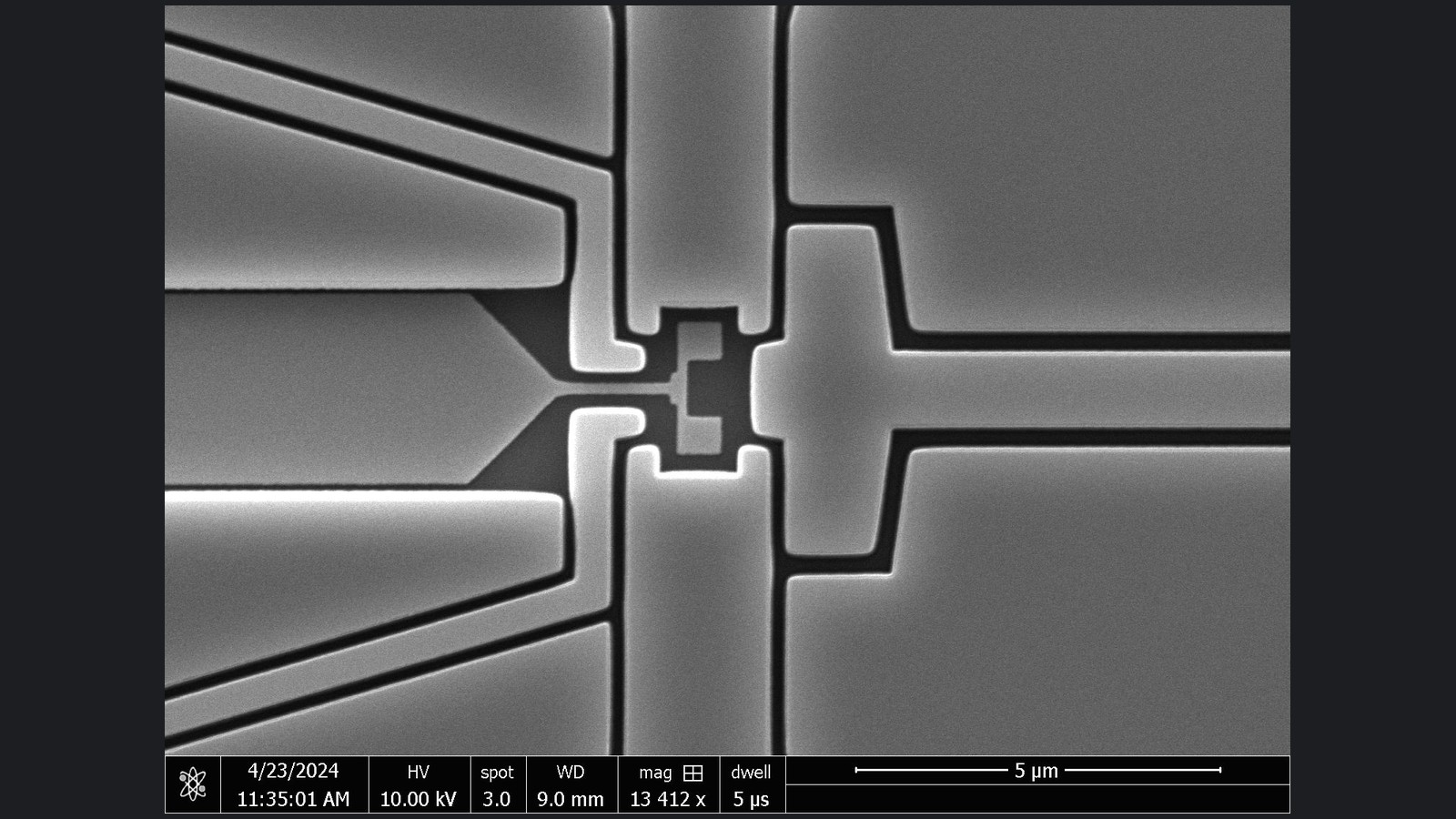
Freeze neon onto a chip and its surface can hold electrons in tiny traps. One trapped electron can store quantum information, but a computer has to do more than operate on each electron separately. In a Nature Physics paper published November 25, Xinhao Li and colleagues show how to drive two kinds of operation between neighboring electrons on solid neon. The experiment moves this hardware beyond keeping single stable: it shows a pair can interact in a controllable way.[1][2][3]
The team first disclosed the experiments in a March 2025 preprint. The journal publication is the peer-reviewed account, not evidence that the researchers built a larger device this week. Its central question is still worth asking: Can the same surface that helps protect individual electrons also hold them near enough to do something useful together?[1][2]
The surface does some of the work
Each electron hovers just above the solid surface in a vacuum. Its quantum bit is stored in two states of its motion, not in its spin. Tiny variations in the surface help trap electrons. If two traps happen to lie close enough together, the electrons’ electric charges interact directly. The neon is a surface that helps position them; it does not carry an instruction from one electron to the other.[1][2][3]
The team had previously put two electron qubits on the same device and linked them through a shared microwave resonator. That connection was too weak for the real-time two-qubit operations in this study. Here the researchers found a pair whose direct interaction was strong enough to make its effects visible as they adjusted the device. The orientation of the electrons’ motion helped determine which qubit the resonator could see.[1][2][3]
One electron responded readily to the resonator’s microwave field. The other coupled too weakly to be read directly in the same way. The researchers call the first qubit bright and the second dark. The bright qubit gave them a handle on its neighbor: the team could drive changes that involved the dark qubit, then briefly tune the pair to swap populations so the bright qubit could reveal information about the dark one. A qubit that is hard to see is not necessarily hard for another qubit to influence.[1][2]
A stronger connection isn’t a better gate by itself
The authors also found a substantially stronger interaction in a separate three-qubit configuration. That was a measurement of coupling, not a demonstration of a three-qubit gate or proof that a processor made this way would run with fewer errors. The final paper’s analysis uses numerical simulations. That is a different kind of evidence from a direct benchmark of how often the hardware operations succeed.[1][2]
The trade-off is repeatability. Naturally occurring surface features can bring electrons close together without a separate set of precisely placed trapping electrodes for every qubit. But a manufacturer would need to put the right traps in the right places and know how strongly nearby electrons would interact. The same surface variation that helped this pair work is something a larger chip would have to control rather than leave to chance.[1][2]