
A quantum sensor spotted microwave nudges about nine times smaller
A Nature paper shows how to concentrate a microwave field’s photon count without dimming it. The trick improves a specific laboratory measurement, not every kind of sensing.
Reading tools for text size, copying, printing and your reading list
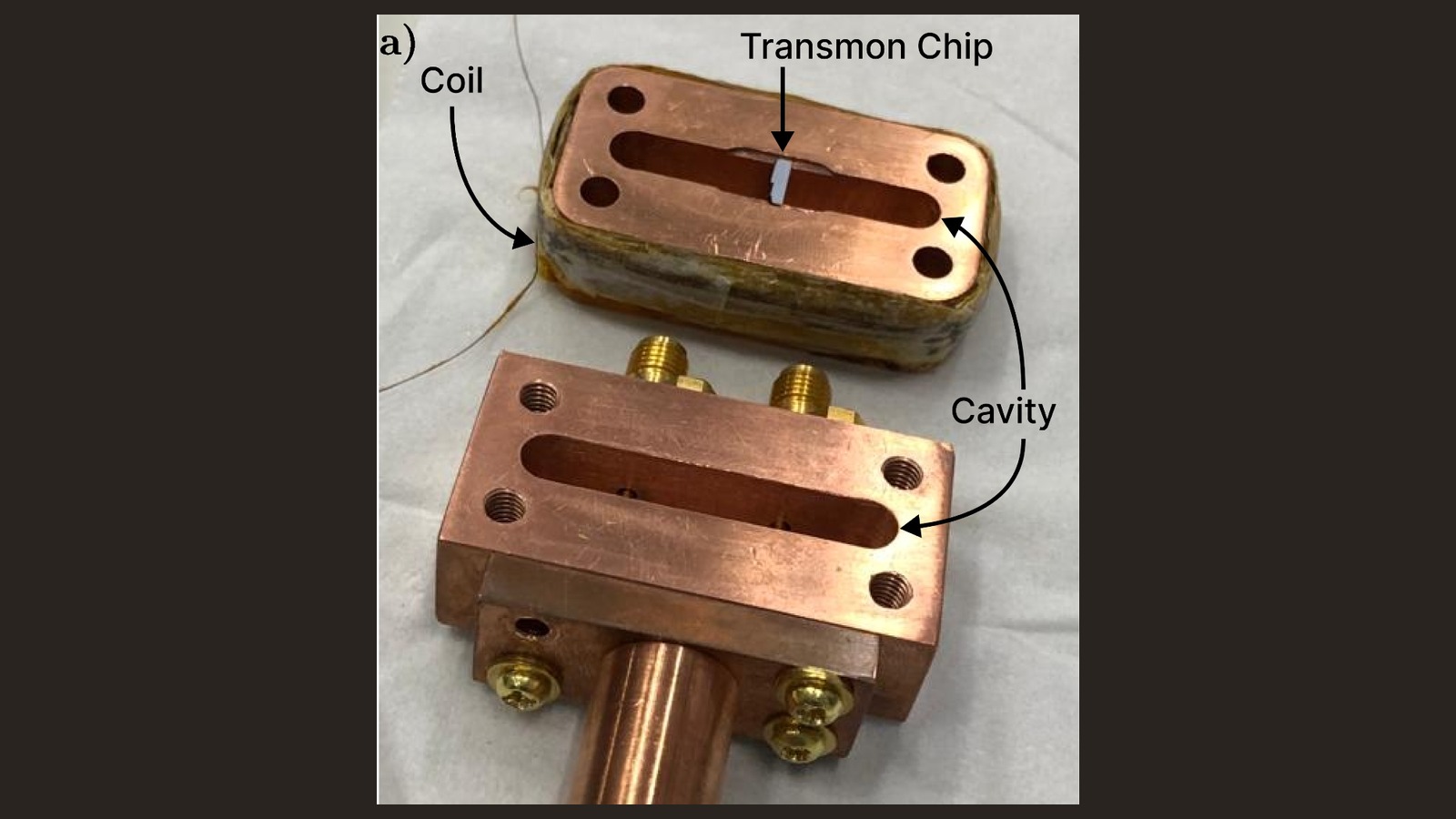
A small nudge to a microwave field can be hard to distinguish from the field’s own quantum noise. Researchers led by Ziyue Hua, Chuanlong Ma and Yilong Zhou built a way to prepare the field so that such a nudge is easier to see. In a study published in Nature on November 25, their experiment resolved a change in field amplitude about nine times smaller than the reference limit for an ordinary coherent microwave probe. The measurement took place inside a laboratory cavity, not in a deployed sensor.[1][2]
The team first described the approach in a February preprint. The result now in the journal reports a best gain of 19.20 ± 0.20 decibels at an average of 400 photons. The preprint reported 19.06 ± 0.13 decibels at 350 photons. The new figure documents the final experiment; the two uncertainty ranges overlap, so the difference is not evidence of a meaningfully bigger gain on its own.[1][2][3]
What a lens does when it isn’t focusing light
A photon is one unit of electromagnetic energy. An ordinary coherent microwave pulse with a mean of 500 photons does not contain exactly 500 in every measurement. Some measurements land higher, others lower. The bigger the pulse, the wider that typical spread gets, even if the source is behaving as intended.[1][3]
The researchers borrowed an idea from optics: use one lens to focus a beam and a second to collect it. In this experiment there is no glass lens, and nothing is being focused onto a smaller spot. The first operation concentrates the probabilities around a target photon number. The microwave field stays in a three-dimensional cavity, a hollow resonator that stores it while a superconducting circuit helps control and read it.[1][2][3]
After the test signal nudges the field, a second lens-like operation and a final adjustment bring an undisturbed probe close to its empty state. That gives the experiment a straightforward readout: a tiny shift changes the odds that the cavity looks empty. The team can infer the size of a small change without having to count hundreds of photons precisely on every trial.[1][2][3]
Why the paper has two different photon counts
Five hundred was the highest average photon number the team prepared in its concentrated state. At that setting, the spread measured as variance was about 0.71% of the variance of a coherent state at the same average. The sensor’s best reported result, by contrast, was at an average of 400 photons. The first number tells you how tightly the researchers could group the possible photon counts. The second is where they found their greatest gain in detecting a change to the field.[1][2]
The decibel scale can obscure what a gain means. For this paper’s field-amplitude measurement, 19.20 decibels corresponds to a factor of about 9.1 in the smallest resolvable nudge against the coherent-state reference. It does not mean the researchers measured the motion of an object nine times more precisely or built a microwave detector that is nine times better in the field. Their test deliberately introduced the change to a stored field under controlled conditions.[1][2][3]
The result matters because preparing an unusual quantum state is only half the job. A useful instrument has to extract the answer before loss washes out its advantage. Here, the second lens is what makes the complicated probe easier to read. The next question is how much of that gain survives when an unknown signal, rather than a controlled laboratory nudge, is what the sensor must pick up.[1][3]