
Skip to content
RESEARCH · RESEARCH SPOTLIGHT

Simulating the strong force needs more than a qubit count

A lattice-QCD study bounds memory and evolution costs without pricing practical hardware.

Published Updated Source report Sources checked
Reading tools for text size, copying, printing and your reading list
My reading list
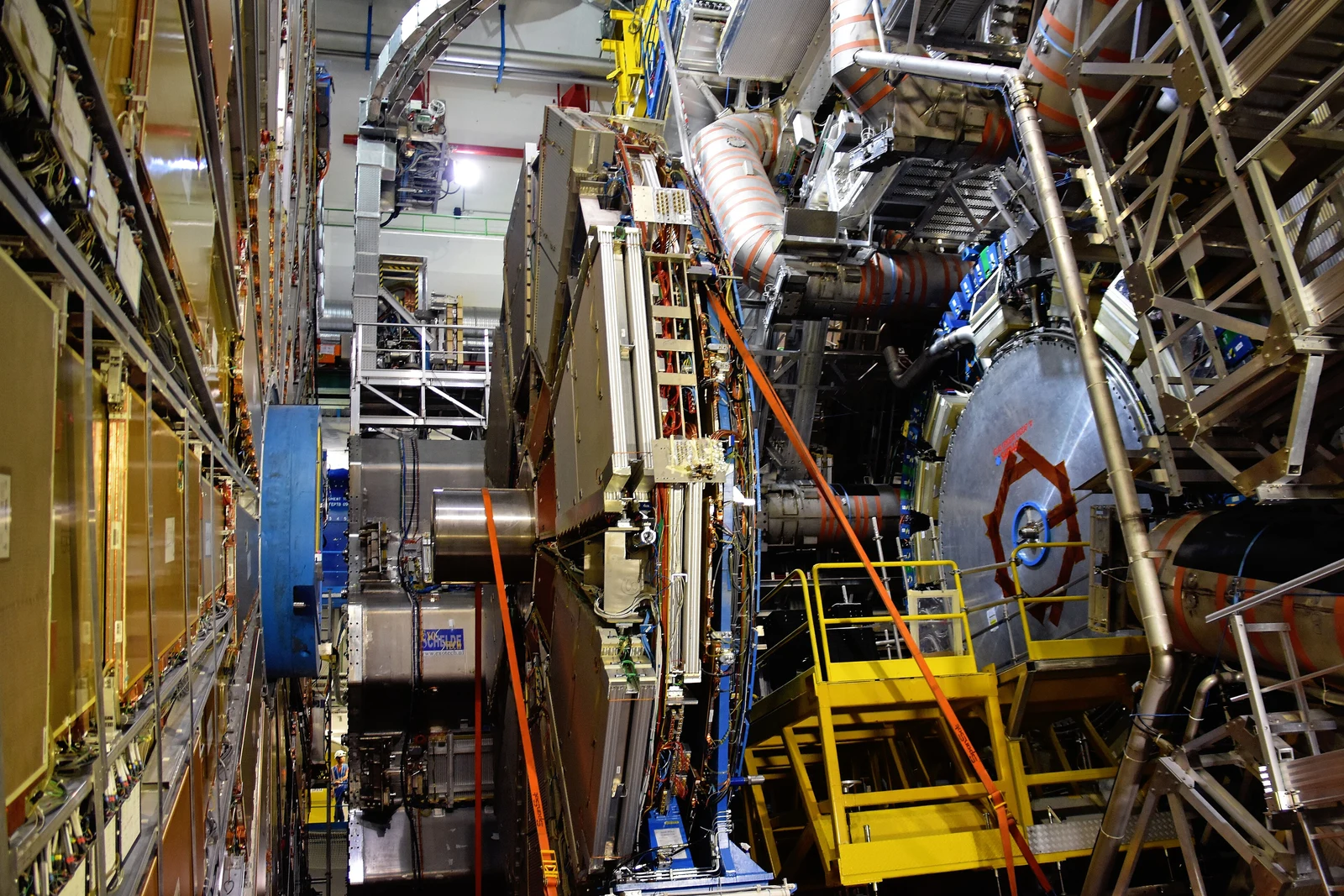
Detector modules, silver pipes and yellow access stairs inside the ATLAS cavern at CERN.
Illustrative photoSimonWaldherr

How much work would a quantum computer need to simulate the force that binds quarks inside protons and neutrons? In a November 13 Physical Review D paper, Xiaojun Yao estimates the cost for a model that represents the theory, quantum chromodynamics (QCD), on a three-dimensional grid.[1][2]

The model describes quark and gluon fields using a finite set of values a quantum circuit can store. The November 11 accepted revision adds bounds on errors from advancing the simulation in discrete time steps. The proof uses fixed boundaries and a mathematical description called axial gauge.[2][3]

Storage depends on the range of field values kept and how finely the circuit distinguishes them. For states below a specified energy, Yao bounds the number of and operations needed at a chosen accuracy.[1][2]

The bound is polynomial, not necessarily small. For a fixed number of quark types, one leading per-step two-qubit gate-count term grows as the number of grid sites to the five-thirds power. Double the sites along each edge and that term grows 32-fold, before counting the required time steps. That is a scaling illustration, not a runtime estimate.[1][2]

Preparing a starting state, extracting an answer and correcting hardware errors need separate budgets. This is a field-to-circuit construction, not a hardware demonstration or practical speedup.[1][2]

Keep your reading trail

Evidence & context

3 linked sources

Theory

How to read the evidence and dates

An announcement records what an organization stated. An experiment reports an observation. A simulation or resource estimate depends on its assumptions. QubitWire’s analysis connects these sources; the labels are not quality scores.

Published is the article’s first QubitWire publication. Updated marks a substantive content change. Sources checked records a review of the underlying evidence. An older paper can support a new explanation, and another press release about the same work is not independent replication.

For material corrections, check the article’s context note and source trail. A routine formatting or link change does not create a new scientific result.

Sources

  1. Physical Review D
  2. Accepted author manuscript
  3. Preprint version history
READ NEXT

Continue exploring

All Research stories
  1. Applications / Quantum algorithms

    A quantum plasma algorithm makes its hidden arithmetic explicit

    Explicit circuits expose the arithmetic behind a prescribed-field plasma model. State preparation, output and self-consistent feedback remain distinct costs.

    Published · Source report · Sources checked · About 3 min read
  2. Research / Error correction

    A quantum algorithm needs a resource budget before it needs a machine

    Classiq’s Fault Tolerance Engine translates logical circuits into surface-code plans. The estimates depend on the hardware and error assumptions supplied.

    Published · Source report · Sources checked · About 2 min read