
A dark matter signal could carry a fingerprint of the Sun
A new model finds that the Sun’s gravity and Earth’s motion could distort a hypothetical signal from ultralight dark matter. Nothing was detected.
Reading tools for text size, copying, printing and your reading list
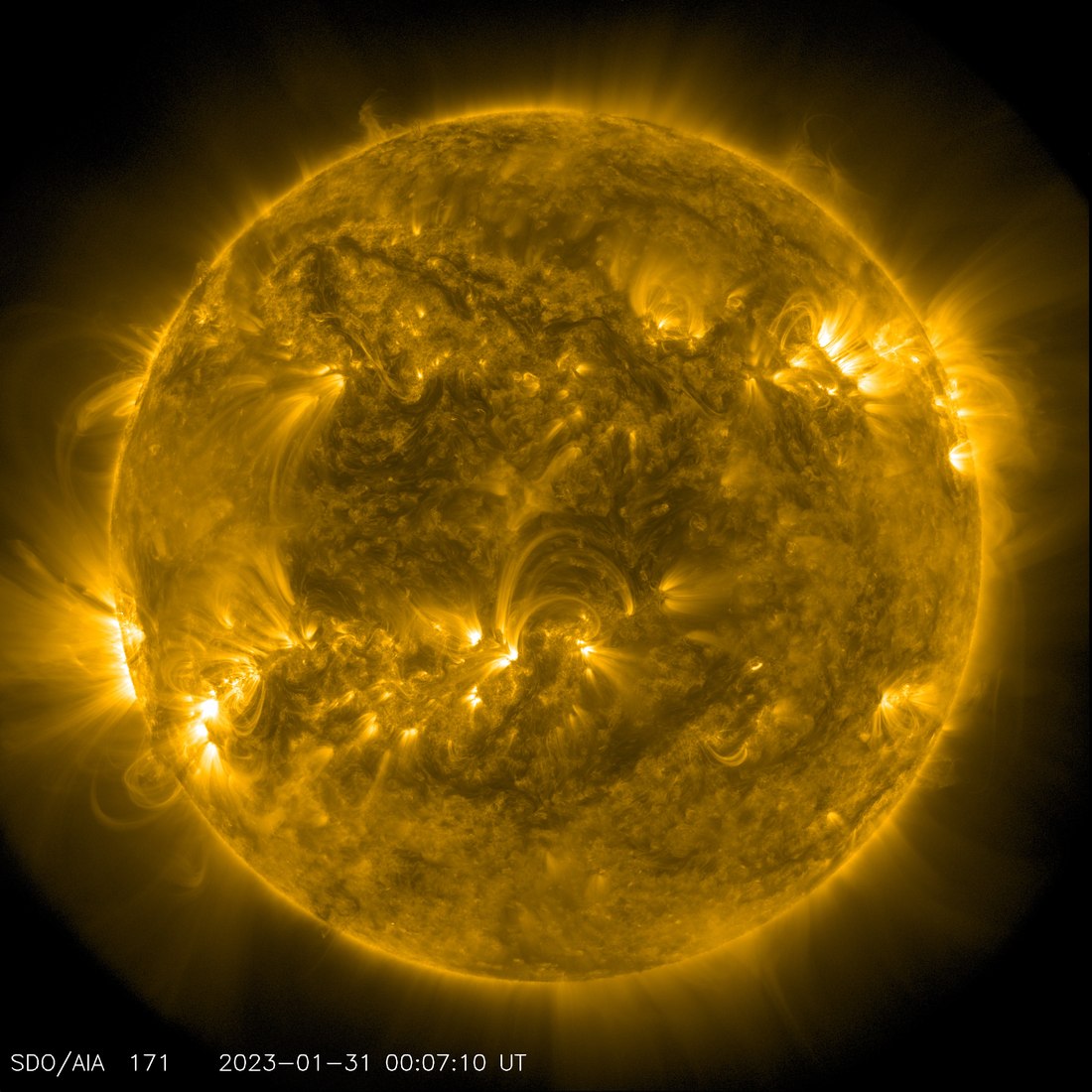
If an instrument on Earth ever picks up a signal from ultralight dark matter, the exact shape of that signal could help researchers tell what they found. But it may also carry a local imprint. In a preprint released in arXiv’s November 26 issue, Shao-Feng Ge, Yong Tang and Yue-Hui Yao modeled two influences: the Sun’s gravity and the motion of the detector as Earth orbits. They found that leaving those effects out could bias estimates of how fast the hypothetical dark matter moves past us. Their test used simulated data, not a new observation.[1][2]
Why the signal would change with the seasons
Some proposed forms of dark matter are so light that their collective behavior is better described as a wave. If such a field interacts with ordinary matter, it could cause tiny oscillations in a sensitive instrument. The signal would span a narrow band of frequencies rather than sit at exactly one frequency, because the dark matter would have a range of speeds relative to the detector. Researchers have proposed quantum sensors among the tools for looking for those oscillations.[1][3]
The two effects work differently. The Sun’s gravity changes the distribution of the hypothetical dark matter near Earth, a process called gravitational focusing. Earth’s own motion changes the speeds the detector would infer, which shifts the frequencies it would see. In the model, motion produces most of the correction across much of the band, where changes are typically on the order of a percent. Solar focusing matters more near the low-frequency edge, where slower-moving dark matter would contribute. The two effects reinforce each other around December in this particular model. That is a prediction about a possible signal, not a measured seasonal pattern.[1]
What a better fit would and wouldn’t prove
The team generated mock data with intentionally clear signals and then tried to recover the parameters it had used to generate them. In one test, the simpler model still recovered the assumed particle mass within statistical uncertainty, but estimated the Sun’s speed relative to the dark matter incorrectly. Including both effects moved that speed estimate much closer to the input. Even then, neither approach recovered the true density within the reported 95% credible interval for that test.[1]
This matters more for interpreting a convincing signal than for declaring a discovery. The example assumes a particular distribution of dark matter speeds and much clearer data than a just-detectable signal. A real candidate would still need checks against instrument noise, other possible backgrounds and, ideally, independent observations. The study gives researchers a way to test whether a future signal’s shape and seasonal changes fit one hypothesis, not a shortcut to knowing what dark matter is.[1][3]