
This tabletop diamond lab lets students test quantum spins for under €900
Researchers put a laser, optics and electronics into small 3D-printed holders. Their cost estimate assumes the lab assembles the circuit boards itself.
Reading tools for text size, copying, printing and your reading list
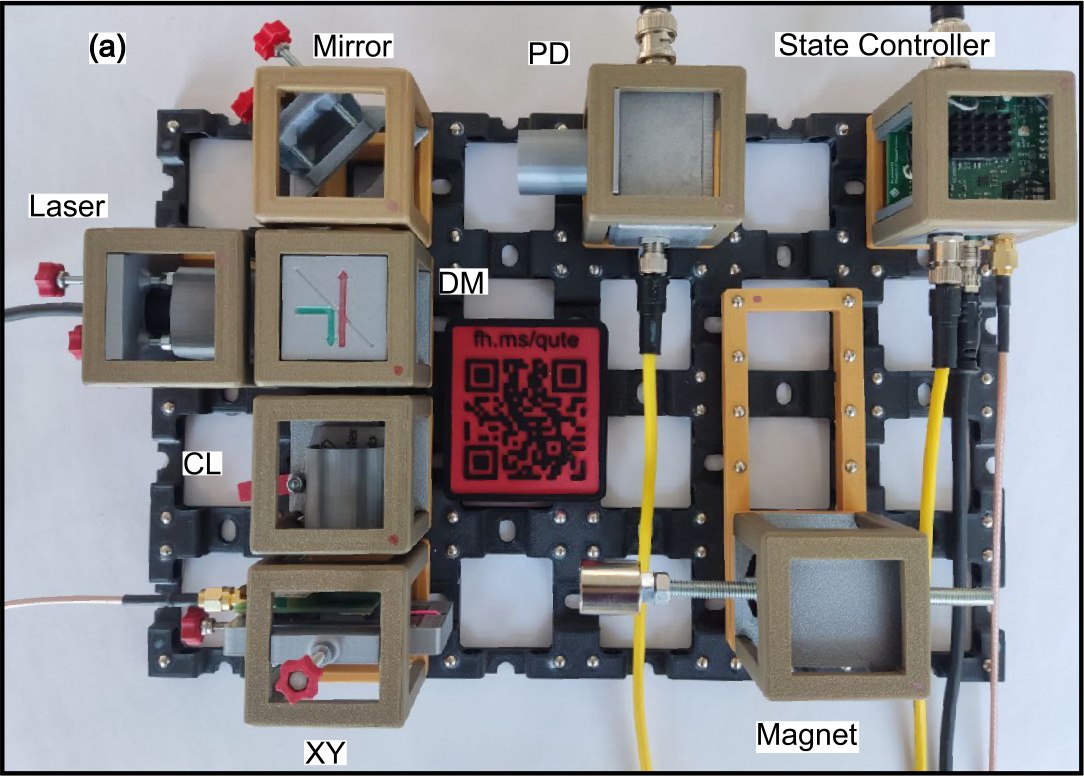
A quantum physics lab can start with a speck of diamond, a green laser and a row of plastic cubes. In a November 26 paper, researchers in Münster, Germany, showed how to put those pieces together to run experiments on quantum spins at room temperature. The team estimates that one setup can cost less than €900 in parts and basic soldering equipment under its own assembly and tax assumptions. It’s a teaching instrument, not a miniature quantum computer.[1]
The diamond does the quantum part. Some sites in its carbon lattice contain a nitrogen atom next to an empty spot. These defects emit red light when excited by the laser, and their brightness changes with the state of their electron spin. The researchers use that change to read the spins. The signal comes from many defects in a tiny diamond, rather than from a single individually controlled defect.[1]
A pulse can do what a steady signal can’t
A steady microwave signal can reveal the frequencies at which the spins respond. With short pulses, experimenters can also watch what happens when they change how long the spins are driven and how much time they leave between pulses. In one demonstration, the team varied the length of a microwave pulse and saw the spin signal swing back and forth. That is a Rabi oscillation: a sign that the pulse can steer the quantum state rather than simply make it brighter or dimmer.[1][2]
A second experiment used a sequence called a spin echo. It reverses some of the drift that makes a collection of spins fall out of step, letting experimenters measure how long a recoverable signal lasts. Both effects were known long before this setup. The contribution is to make them measurable on the same desk as a simpler resonance experiment. A 2023 teaching kit used similar printed holders for steady-drive measurements, and a 2024 paper had already shown inexpensive pulsed electronics. The new paper combines and redesigns those pieces and documents the measurements on a single platform.[1][2]
What the price doesn’t buy
The estimate is not a retail price for a ready-to-run kit. The paper assumes a 20% value-added tax and in-house circuit-board assembly for the sub-€900 figure. Using the same optical components, the authors put one self-assembled set at €714 before tax and one set with board assembly outsourced at €1,775 before tax. The comparison makes the trade-off clear: a lab can save on the bill if it already has people who can assemble the electronics. Preparing and positioning the tiny diamond also takes care: the authors note that grains can clump and change the signal. The published design files and notebook controls give a teaching lab a starting point, but the team didn’t report a classroom deployment or measure what students learned from it.[1][3]