
Skip to content
RESEARCH · HARDWARE

A quantum link carries a third level

Two superconducting nodes exchange a three-level state. The measured transfer and tomography-based capacity need different interpretations.
Published Source report Sources checked
My reading list
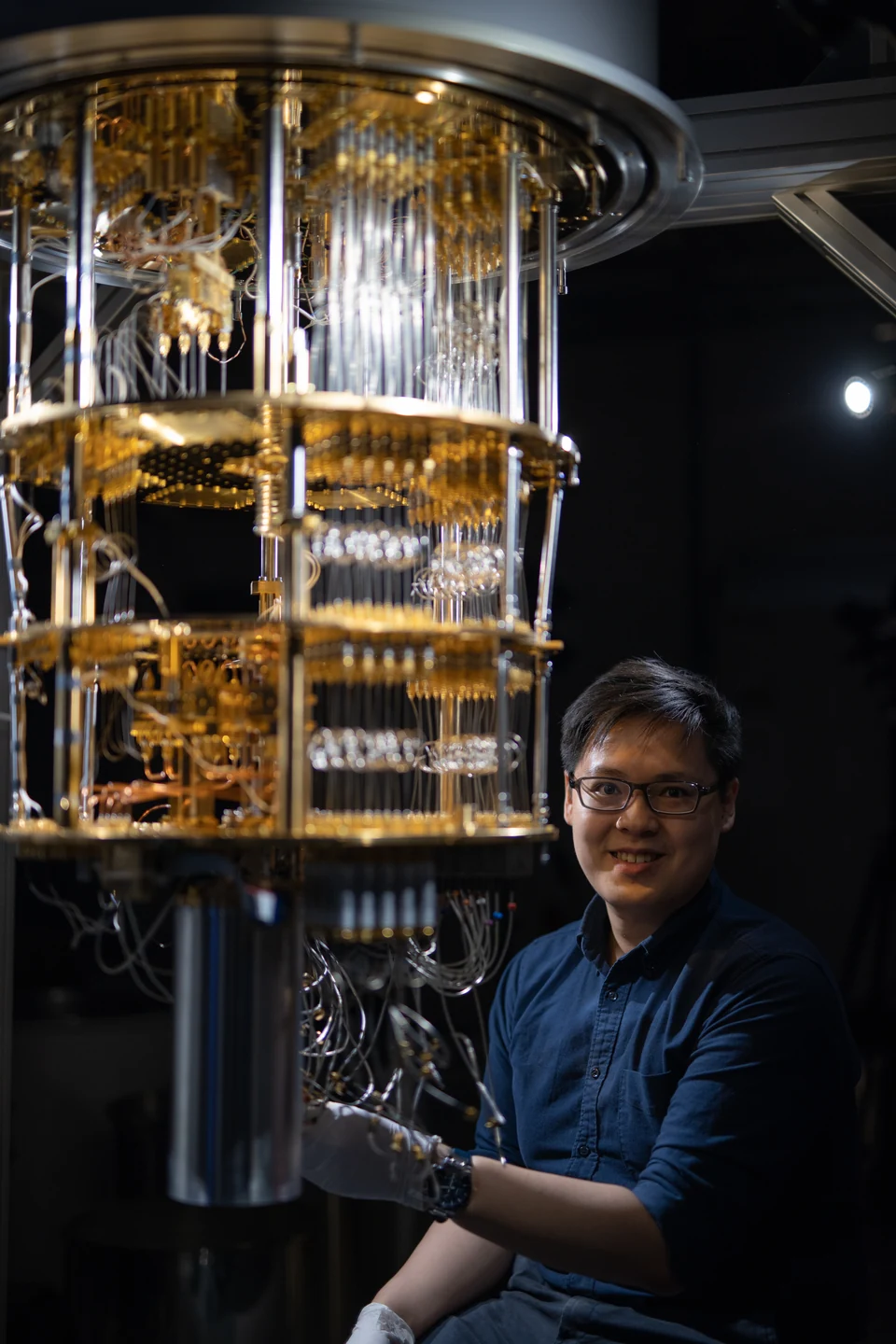
Quantum engineer Jeffrey Chan stands beside an exposed cryogenic assembly at IQM.
Quantum engineer Jeffrey Chan beside a cryogenic assembly at IQM. Archival hardware context; this is not the qutrit-transfer apparatus.Image: IQM engineer Jeffrey Chan beside an open cryostat · Ragsxl · CC BY-SA 4.0Full image credit

A superconducting experiment transfers qutrit states between two separately packaged nodes over a one-metre microwave link. Published October 28 in Physical Review Letters, the study reports readout-corrected mean state fidelity of 83.68% and process fidelity of 77.12%.[1][2]

The protocol sends the two excited-state amplitudes through separate time windows in the same channel. Remote is also reconstructed. Its reported 2.273-bit dense-coding capacity is inferred from tomography; it is not an observed communications throughput.[2]

A qutrit has three basis states rather than a ’s two. The extra level creates more room for encoding, but also makes preservation of the state more demanding. The receiver must retain the relationships among all three components, not merely identify which energy level was occupied.

That is why the two fidelity numbers answer different questions. State fidelity compares selected outputs with their intended states. Process fidelity evaluates the reconstructed operation. Neither number alone tells a network operator how many useful messages a complete service could deliver in a second.

The paper also identifies its Bell parameter as tomography-inferred, with calibrated readout corrections. It does not report a loophole-free Bell test or a direct dense-coding experiment.[2]

The most informative comparison is therefore dimensional: does the transfer retain information that a two-level channel cannot carry under the stated benchmark? It would be misleading to turn that into a universal claim that qutrit hardware is faster or easier to scale than qubit hardware.

For modular computing, this opens an architectural question worth pursuing: can extra local levels reduce the number of physical connections required for a given task? A useful follow-up would measure the full cost of using them, including preparation, calibration, transfer and recovery after errors. That cost comparison remains separate from demonstrating the link itself.

Keep your reading trail

Your Updates →

Evidence & context

2 linked sources

Peer-reviewed experiment characterized with readout-corrected tomography. Physical Review Letters publication on October 28, 2026; an October 4 preprint revision is verified. The exact original submission day needs confirmation before it is displayed.

How to read the evidence and dates

An announcement records what an organization stated. An experiment reports an observation. A simulation or resource estimate depends on its assumptions. QubitWire’s analysis connects these sources; the labels are not quality scores.

Published is the article’s first QubitWire publication. Updated marks a substantive content change. Sources checked records a review of the underlying evidence. An older paper can support a new explanation, and another press release about the same work is not independent replication.

Sources

  1. Superconducting Qutrit Link beyond the Qubit Limit

    journal; source date 2026-10-28. Publisher publication date and abstract verified.

  2. A superconducting qutrit link beyond the qubit limit

    preprint_fulltext; source date 2026-10-04. Version 2 PDF: main text, transfer tomography, entanglement qualifications and readout-correction discussion read.

READ NEXT

Continue exploring

All Research stories
  1. More on superconducting hardware

    Unwanted drive paths help suppress quantum-chip crosstalk

    A small superconducting circuit suppresses microwave crosstalk through interfering drive paths. Residual coupling limits the model’s agreement.

    Published · Source report · Sources checked
  2. More on superconducting hardware

    Bare loops give a superconducting sensor a magnetic reference

    A journal publication describes an experimentally tested array design. The result first appeared as a 2025 preprint.

    Published · Source report · Sources checked
THE QUANTUM BRIEFING

A clearer signal.
Read the latest edition.

A little perspective on a fast-moving field.

Read the on-site briefing →

Read selected quantum coverage in the on-site briefing, or register your interest below.