
A Thin Layer of Titanium Helps Grow Quantum Chip Metal at Room Temperature
Delft researchers used roughly one atomic layer of titanium to grow low-loss tantalum on sapphire. They tested the method on a ten-qubit chip that still needed a refrigerator to run.
Reading tools for text size, copying, printing and your reading list
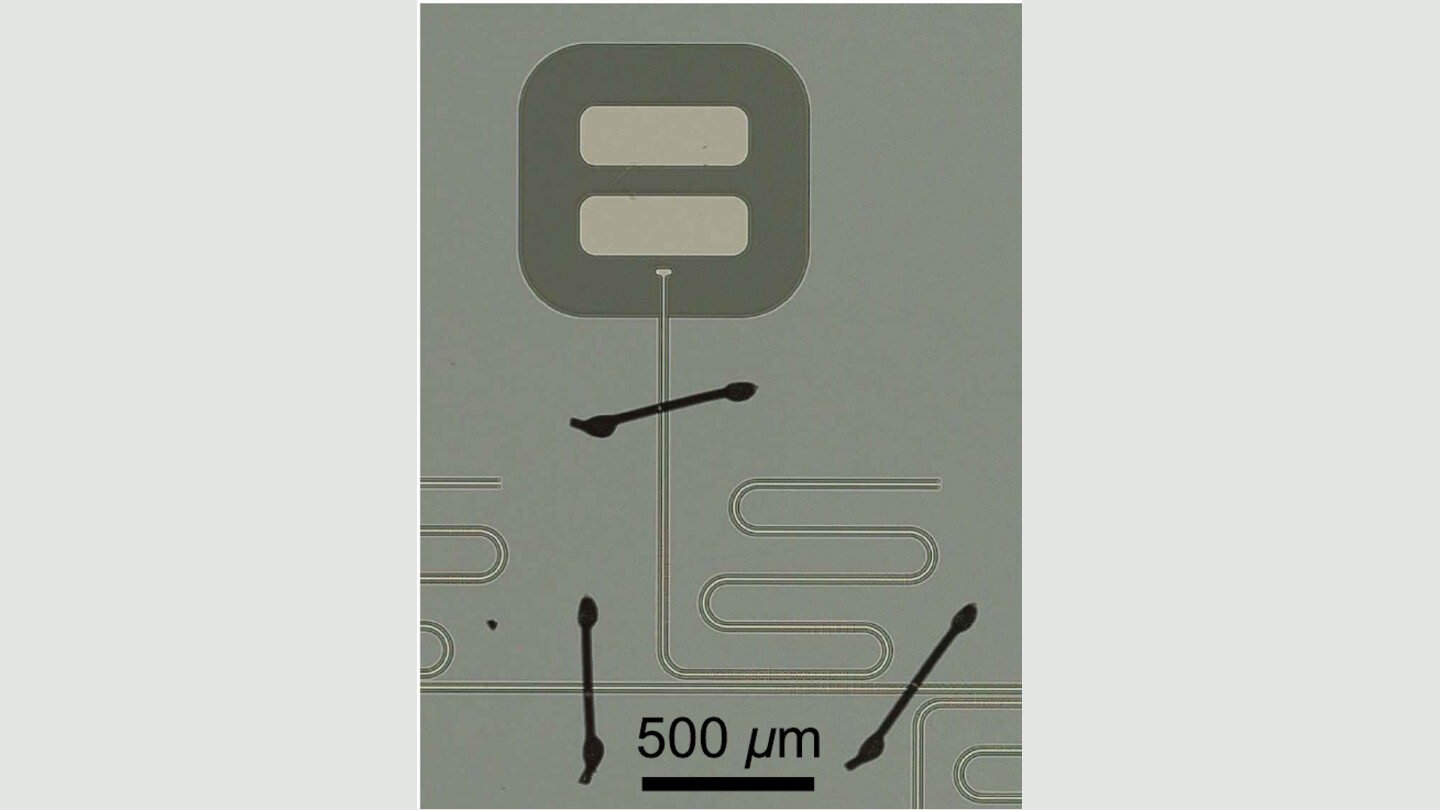
A quantum chip spends its working life in the cold. Making one can be a different story: to grow the right form of tantalum, one of the metals used in superconducting circuits, researchers sometimes heat the surface it grows on to hundreds of degrees. A Delft-led team reports a different route in a preprint released November 25. It used an ultrathin layer of titanium to guide tantalum growth on sapphire at room temperature and built a ten-qubit test chip using the resulting film.[1]
The titanium layer is roughly one atom thick in the sense of how much material is deposited per unit area. The study doesn’t say that it forms a perfectly uniform sheet everywhere. The researchers found that this small amount changed how the tantalum atoms arranged themselves as they settled onto the surface. Without the seed layer, room-temperature deposits were mostly the beta form of the metal. With the right amount of titanium, the team repeatedly obtained the alpha form it wanted.[1]
What the lower temperature changes
This is not the first way to grow alpha tantalum at room temperature. Earlier experiments used other starting layers, including niobium on silicon. What stands out in the Delft study is that the titanium approach worked in two deposition systems, over a range of settings the group tested. It wasn’t indifferent to the settings: when the titanium got too thick, the researchers found mixed forms of tantalum again. In their hot-growth comparison, they brought the sapphire to 750°C. That is a comparison of the film-growth steps, not the temperature of every step in chip fabrication.[1][2]
The team first tested the films in microwave resonators, structures that hold an oscillating signal. If a resonator loses energy quickly, it can flag a materials problem before researchers build a full qubit. At roughly 20 millikelvin, the optimized titanium-seeded film performed comparably to the high-temperature reference in that test. Some samples, including high-temperature films and titanium-seeded films that had undergone longer chemical cleaning, developed additional losses as they warmed. The researchers didn’t establish the cause.[1]
Then the team put the film into ten transmons, a common type of . Their average energy-relaxation time was 96 microseconds, with a reported spread of 19 microseconds across the device. That measures how long an excited qubit tends to retain its energy, not gate accuracy. Other tantalum devices have reported longer lifetimes; the result here shows that the lower-temperature film can be turned into working qubits, not that those qubits set a performance record.[1][3]
The useful next test is whether the lower-temperature process delivers consistent performance across many chips and wafers, not just across deposition settings and one small qubit device. That would tell chipmakers whether a trick at the scale of one atomic layer makes production easier at a much larger scale.[1]