
Scientists Switched a Room-Temperature Quantum Signal With Electricity
A Tohoku-led experiment connects an unusual electrical response to a controllable magnetic state. The result gives researchers a way to manipulate the effect, while leaving a clear practical challenge: dependable operation still uses a magnetic bias.
Reading tools for text size, copying, printing and your reading list


An unusual quantum response in a magnetic film has gained a useful new feature: researchers can change its sign with an electrical pulse. Tohoku University announced the work on November 5, describing an experiment that brings a subtle property of electrons closer to something an engineer could control. The immediate significance is a controllable response in a material. The practical test is whether that response can become a dependable part of a device.[1]
According to the participating institutions, the experiment uses a thin film of the chiral antiferromagnet manganese tin, Mn3Sn. At room temperature, the researchers observe a third-order nonlinear Hall response: a sideways voltage with a contribution proportional to the cube of the applied current. They connect that response to quantum geometry and reverse its sign by switching the material's magnetic state.[4]
Those facts deserve to be separated, because each answers a different question. A measurable signal establishes that an effect is available to study. A reproducible way to alter it offers a possible control mechanism. A useful component would need more: a defined operating range, acceptable energy use, tolerable variation between devices and a way to distinguish the intended response from unwanted signals.
The control mechanism is the central development here. The participating institutions report that current pulses through an adjacent heavy-metal layer exert spin-orbit torque on the magnetic film. Opposite pulse polarities switch the magnetic order and the sign of the cubic Hall response. The university also reports a consequential limitation: switching is deterministic under a finite magnetic bias, while removing that bias produces fluctuations.[1]
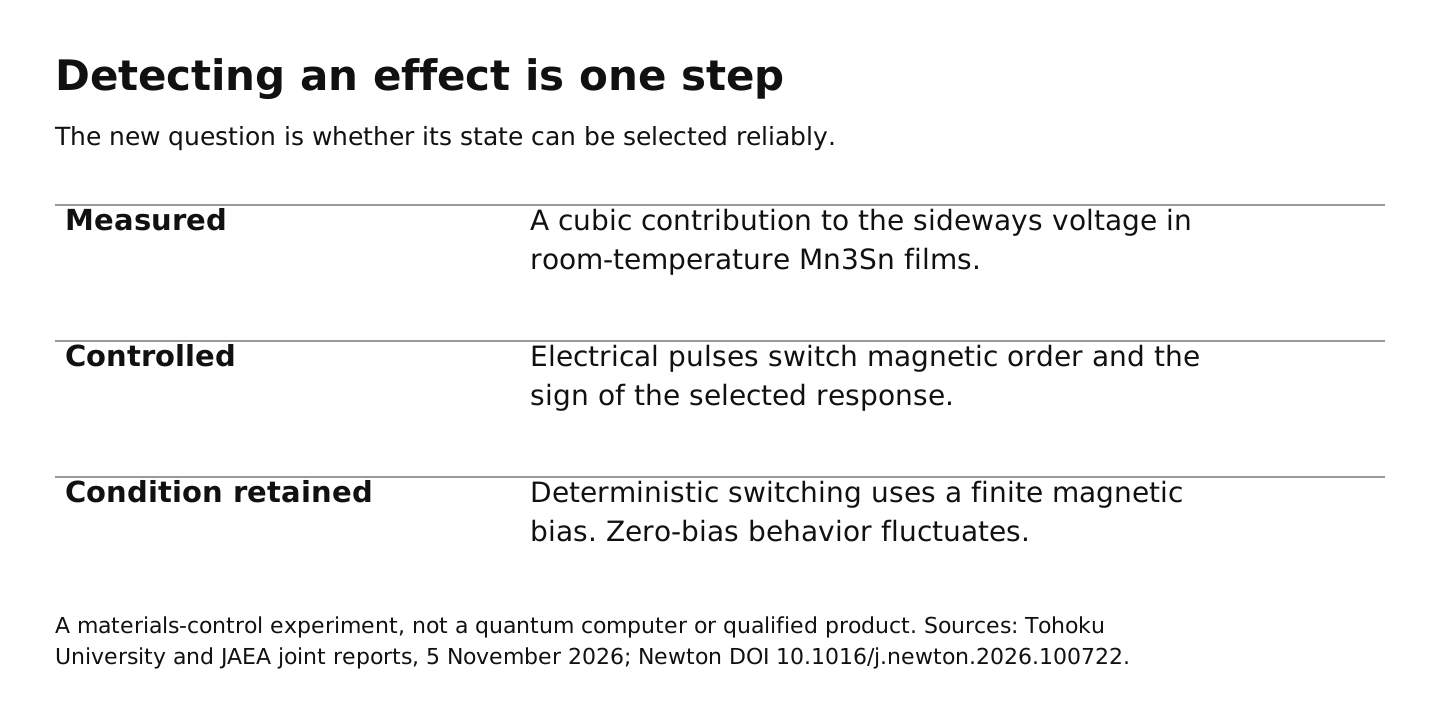
That qualification is useful engineering information. If a device needs a bias field, its surrounding system must provide or accommodate one. That requirement can affect packaging, neighboring components and the procedure used to set an operating state. A successful laboratory control experiment therefore creates a sharper practical question: can the required conditions be supplied simply enough for the intended application?
Why the word “cubic” matters
A familiar linear relationship keeps the same ratio between input and output. Double the input and its linear contribution doubles. A cubic contribution behaves differently: doubling the input multiplies that contribution by eight. This is a mathematical illustration, not an additional experimental result or a claim about the total voltage in this device.
That difference changes what researchers must measure. An appealing trace at one current does not establish a cubic relationship. A convincing account has to separate contributions that scale differently, identify the range over which the chosen description works and show how the relevant term responds when the magnetic state changes. Readers should look for that chain of evidence, rather than treating any sideways voltage as proof of the proposed mechanism.
“Quantum geometry” can also sound more mysterious than the experimental question requires. The useful idea for a general reader is that a quantum state has structure, and that structure can influence a material's response. The word “geometry” does not mean that the researchers simply reshaped the film. The question is how that microscopic structure connects to the voltage measured across the film. Switching the magnetic order gives researchers a way to examine that relationship.[4]
What a practical component would need
The result suggests a productive checklist for future work. How stable is each selected state? How many switching operations can the film tolerate? How do temperature, fabrication variation and imperfect pulses alter the signal? What does the bias field add to the total system cost? These are editorial questions raised by the demonstration, not claims that the paper has already answered them.
The same discipline applies to the phrase “room temperature.” It identifies one operating condition of this experiment. By itself, it does not establish a complete device specification. A useful comparison would consider the whole arrangement needed to generate, switch and read the response, then compare that arrangement with an existing way of performing the same job.
The advance is a new degree of control: researchers have moved an unusual response from something a material exhibits toward something they can deliberately select. That is a concrete step in control. Whether it becomes a practical component will depend on the repeatability, operating conditions and system-level measurements that come next.