
A promising quantum-material clue still has one decisive test ahead
Cologne researchers report states consistent with a route to topological superconductivity. The transition that would strengthen the case remains unconfirmed.
Reading tools for text size, copying, printing and your reading list
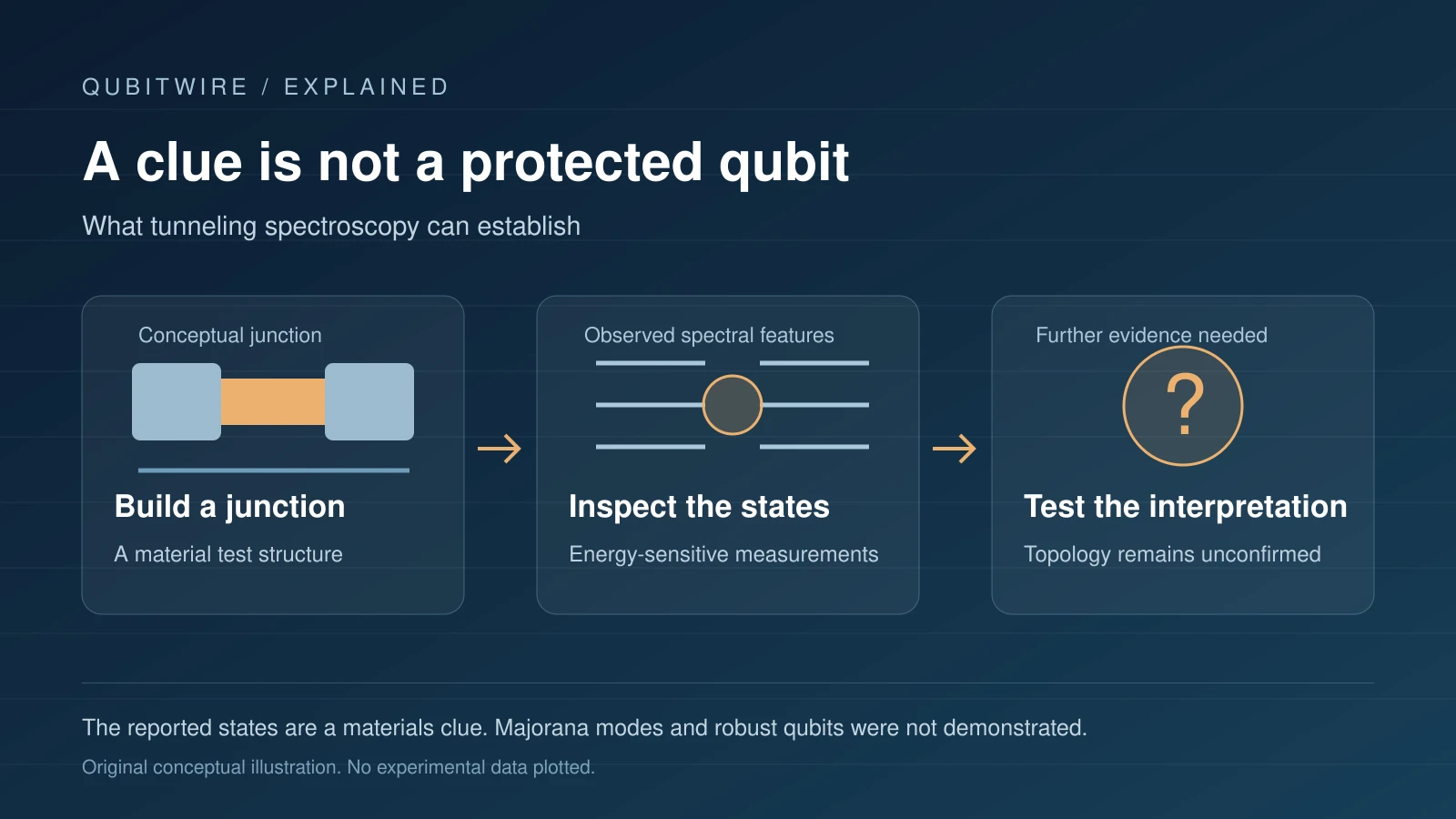
The finding and its boundary
Cologne researchers report an encouraging clue in a proposed route to more robust quantum bits. Their November 2 announcement describes highly transmissive Andreev states in a junction built on a topological insulator, consistent with relevant theoretical predictions. One decisive limitation remains: the predicted closing and reopening of an energy gap is unconfirmed. The result supports a research direction; it does not establish a protected .[1]
What the researchers probed
The team studied a : two superconductors separated by a region that is not itself superconducting. Tunneling spectroscopy probed states as the superconductors’ phase difference changed. The states appeared over a range of charge-carrier densities and became localized under magnetic field. Improved energy and time resolution is needed to demonstrate the transition. That qualification is central to interpreting what the observed states actually are.[1]
From a junction response to a computing claim
Tune the junction
Change superconducting phase and probe local electronic states.
Interpret the measured states
Compare the response with theory; the decisive gap behavior remains unresolved.
Test stronger claims separately
Protection and useful qubit operations would require additional evidence.
Three terms to know
- Josephson junction
- Two superconductors linked through a region that is not itself superconducting.
- Andreev state
- A state arising from electron–hole processes in a superconducting structure.
- Energy gap
- An energy interval without allowed excitations in the idealized description.
A surface is more than a location
A topological insulator has an insulating interior and conducting surface states. In the theoretical picture discussed by the authors, the surface electrons’ spin and motion are linked. Coupling that surface to a conventional superconductor changes the states available in the junction. The earlier author manuscript describes an aluminum loop controlling phase and tunnel contacts probing local electronic states. These details explain what the experiment is trying to test. They should not turn an instrument reading into proof of every consequence predicted by the model.[3]
Why the dates and versions matter
This is a new publication milestone with a longer research history. The November 2 university announcement follows publication in Science Advances. A matching author preprint was first submitted in June 2024 and revised in December 2024 under a stronger title about gap closing and reopening. The author dataset’s fourth version also predates the announcement. Readers comparing versions need to preserve that chronology. A journal milestone can be news without implying that the measurements were first made public on the day of an institutional announcement.[2][3][4]
Data help make the interpretation inspectable
The author dataset’s fourth version predates the announcement: it was published August 26, 2026. Its record identifies experimental figure data, numerical simulations and processing notes. Those notes describe temperature smearing, averaging and interpolation in parts of the simulation workflow. That record provides material for scrutiny; it is not independent confirmation. QubitWire has not reanalysed the raw data. The distinction is useful for a newcomer: publishing supporting material makes a scientific claim easier to examine, while checking that claim remains a separate job.[4]
Analysis: the distance between a clue and a device
Think of the measurement as a checkpoint on a route, not a miniature finished computer. An encouraging response from a material helps decide where to investigate next. A computing claim would additionally need to specify what information is stored, which operations manipulate it and how reliably the information survives. Those are different questions from whether a junction contains an interesting state.
Keeping the questions separate gives this experiment credit for its contribution while showing why a reader cannot infer a useful qubit from the headline alone. A careful account therefore names the intermediate question being answered. It lets a reader recognize a useful scientific advance without needing to pretend that the surrounding engineering questions have vanished.
What would make the next result more persuasive
The university identifies better energy and time resolution as the next experimental step. Analysis of future evidence should then ask which uncertainty was resolved and which alternatives remain. Any later claim about protection or computation would need its own measurements. Progress here means making a materials question more precise and testable, while keeping the distance to a useful qubit visible.[1]
Keep exploring
Continue with Learn quantum computing or Explore the quantum computer model.