
Undetected photons produce a spectral image of a zebrafish larva
An imaging demonstration separates the light that meets a sample from the light that is detected.
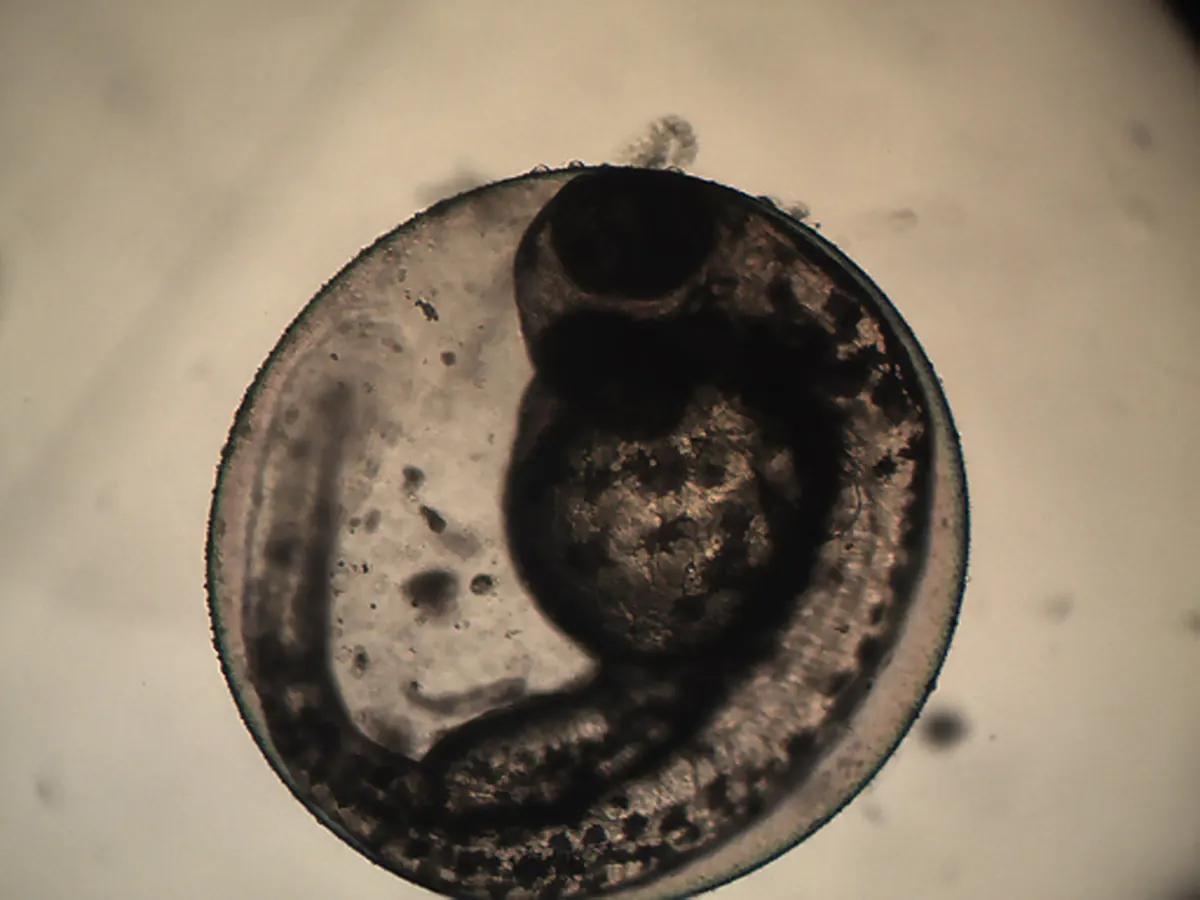

Researchers have used a nonlinear interferometer to produce spectrally resolved transmission images without directly detecting the photons that interacted with the sample. Their October 23 preprint includes a zebrafish larva as a biological feasibility test around a wavelength of 1,550 nanometers.[1]
The experiment uses spontaneous parametric down-conversion and a folded interferometer. The authors report a maximum baseline interference visibility of about 74 percent.[1]
Their grating-spectrometer readout yields a resolving power of approximately 1,460 when assessed using the spectrometer point-spread function and about 730 when assessed through coherence length.[1]
These are different characterizations and should not be merged into one number.[1]
The result is an imaging demonstration, not a validated medical diagnostic. The photons still interact with the sample, while correlated light carries information into the detection process. The work does not mean a biological object was imaged without illumination.[1]