
Why the next quantum computer might be built like a connected neighbourhood
Universal Quantum’s more-than-US$100-million financing puts modular trapped-ion computing back in focus. The engineering test is what can cross between modules without losing its usefulness.
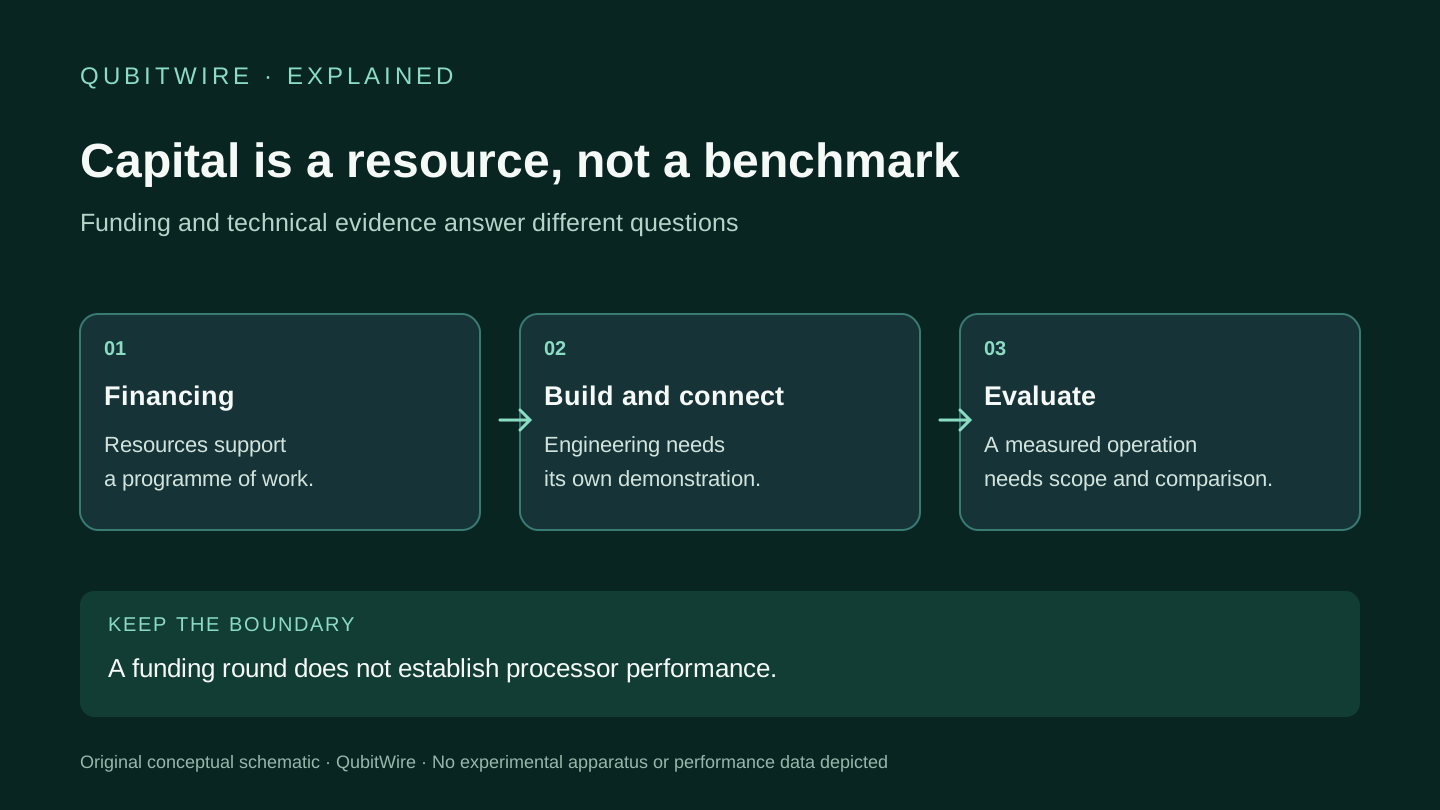
A city can build more houses and still become harder to live in if the roads cannot handle the traffic. A modular quantum computer faces different physics, but a similar systems question: how do its separate parts work together? Universal Quantum’s new financing makes that question timely. The important connection is between modules, not between the size of the cheque and the quality of a computation.
On 8 October, the University of Sussex and investor Nauta Capital reported a Series A round of more than US$100 million for Universal Quantum, a Sussex spin-out pursuing modular trapped-ion computers. The capital supports further development. It does not establish a newly measured quantum link, a completed fault-tolerant machine or revenue from delivered systems. Universal Quantum is a private company; this is sector reporting without a listed share or quote.[1][2]
Modularity changes the engineering problem. Instead of asking only how large one unit can become, engineers must ask how useful units can be made, connected and coordinated. Dividing a job among capable people helps only if their handoffs do not consume the benefit. Quantum information adds constraints that a shared document does not face: an unknown state cannot simply be copied into unlimited backups before it moves.
One relevant approach uses a matter-link between adjacent ion-trap modules. A Nature Communications paper published on 8 February 2023 described physically moving ion across that boundary and examining ion loss and phase coherence. Those are separate concerns. The paper is historical technical context for the financing, not a new October experiment, and its transport result should not be relabelled as a universal number.[3]
What crossed the boundary?
This differs from a photonic connection, in which light helps establish a quantum link between systems. The distinction does not establish a winner for every distance or task. It tells us what to compare. A rate of moving ions is not automatically the rate of creating high-quality pairs, completing remote gates or finishing application steps. Before comparing headline speeds, ask what one successful event means.
The connection is part of the computer. It brings timing, reliability and scheduling costs. Imagine one module ready to proceed while its neighbour is still busy: waiting cannot simply be assumed free. A connected demonstration should identify the local operations, the work crossing module boundaries and what the reported run excludes. A strong isolated component is encouraging; useful connected performance needs its own measurement.
Funding can pay for people, manufacturing and infrastructure. It also reflects investors’ judgment that the programme is worth pursuing. Neither fact replaces technical evidence. The same discipline applies to grants and partnerships: they can move a programme forward without answering whether a larger machine works as intended. The question is what new capability was measured, under which conditions, and on which date.
The next chapter needs a handoff
The next result worth following would show links and local operations working together, with scheduling costs and repeated-use reliability made visible. Another financing announcement could matter commercially, but it would answer a different question. A reader can follow the engineering with one plain test: what crossed the boundary, and what was still usable afterward? The connections will determine how much of a convincing module survives into a useful whole.
Read the deeper explanation · about 6 min
This estimate covers the explanation below, separate from the overview. Optional depth was added in this reading edition. The article keeps one canonical address and its original chronology. Source review: . The relevant source dates and limitations are recorded below.
A growing city eventually discovers that building more houses is not the same thing as building a better place to live. Roads, intersections and services determine whether the separate pieces work together. A modular quantum computer faces a different physical problem, but the comparison helps explain why connections deserve as much attention as the number of qubits inside each module.
Universal Quantum's funding announcement on October 8 brings that question back into focus. The University of Sussex spin-out reported a round of more than US$100 million, with its modular trapped-ion approach at the center of the investment story. The money is a financing milestone. It is not a new benchmark, a demonstrated logical-qubit count or proof that the intended system has already been built.[1][2]
The technical interest lies in how a larger machine might be assembled from smaller ones without allowing the connections to erase the advantages of the components.
Why not simply make one enormous chip?
A modular design changes the engineering problem. Instead of asking only how far a single unit can grow, it asks how useful units can be manufactured, connected and coordinated. This does not make scaling easy. It moves some of the difficulty from the interior of a module to its boundaries.
Consider an ordinary team project. Dividing work among several capable people helps only if the communication and handoffs do not consume all the benefit. The analogy is about coordination, not quantum mechanics. Quantum information introduces constraints that do not apply to a shared document: unknown quantum states cannot simply be copied into unlimited backups before being moved.
A successful modular architecture therefore needs evidence about both local operations and inter-module behavior. A high-performing isolated component is encouraging, but it cannot establish the performance of a connected system by itself. The larger the proposed machine, the more important it becomes to state which part has actually been tested.
A link that moves matter
One approach associated with Universal Quantum uses a matter-link between adjacent ion-trap modules. A Nature Communications paper published in February 2023 described moving ion qubits across that boundary and examining both loss and phase coherence. This is historical technical context for the current financing story, not an October 2026 experiment.[3]
The distinction between a matter-link and a photonic link is useful. In the former example, an ion physically moves between neighboring modules. In a photonic approach, light participates in establishing a quantum connection between systems. Those descriptions are broad architectural distinctions, not a claim that one implementation is best for every distance or task.
They also explain why apparently comparable headline rates may describe different things. A rate of ion transport is not automatically the rate of high-quality entangled pairs, completed remote gates or finished application steps. Before comparing two links, identify what one successful event means in each experiment. Otherwise the comparison can reward the label rather than the capability.
The boundary is part of the computer
A connection should not be treated as a wire drawn between two boxes after the real design work is finished. It has timing, reliability, interface and scheduling implications. The surrounding system must know when information is ready, where it can go and what to do when the intended operation does not succeed.
Imagine two modules that both work well on their own. One completes a local operation while the other is still busy. The combined machine needs a way to handle that mismatch without assuming that waiting is free. The exact solution depends on the architecture. The important editorial point is that local performance and useful connected performance are different measurement boundaries.
This is why a larger-system demonstration should describe the complete procedure. Which operations were local? Which crossed a module boundary? How much time was spent waiting or rearranging information? What was excluded from the reported run? A reader does not need to calculate the answers to understand why those questions matter.
Reliability is not one percentage
The 2023 matter-link paper separately considered ion loss and effects on phase coherence. Those are distinct concerns. A low probability of losing an ion during transport is not a universal gate-fidelity number, and it should not be presented as one.[3]
A useful analogy is a delivery service whose packages arrive physically intact. That is important, but it does not by itself establish that every instruction inside was preserved, that deliveries arrived on time or that the whole warehouse can support peak demand. The analogy is imperfect, but it exposes the danger of promoting one narrow success rate into a complete system verdict.
For quantum hardware, the solution is not to avoid numbers. It is to keep each number attached to the event, conditions and uncertainty it measures. A small table can be more honest and more useful than a large winner badge. It can show what improved, what remains unmeasured and which comparison would actually inform the next engineering decision.
What the investment can and cannot tell us
Financing can support hiring, manufacturing, infrastructure and development. It also expresses the judgment of investors who expect the work to be worth pursuing. None of those facts establishes that the technical plan will succeed or that a public-market investor can buy the company through an available ticker. Universal Quantum is presented here as a private-company financing story.[1][2]
A strong report separates three questions. What capital was announced? What work is that capital intended to support? What technical evidence has been demonstrated independently of the funding? Combining them into a single claim that investors have validated the machine loses useful information.
The same discipline applies to other quantum companies. A partnership, grant, acquisition and prototype result can all be important, but they are not interchangeable evidence. Readers should be able to revisit an Investing card and see which category changed rather than discover that every positive announcement has been converted into the same progress score.
Modularity changes manufacturing questions too
A modular approach invites questions about replaceability, repeatability and testing. Can modules be evaluated before they are assembled into a larger system? How is variation between units handled? What happens when one unit needs service? These are sensible questions to investigate, not capabilities this article claims have all been delivered.
The distinction is particularly important for a visually attractive diagram. Repeating an identical box fifty times can suggest that scaling is simply a matter of duplication. Real systems must address the interfaces between those boxes and the support infrastructure around them. A diagram should help a visitor identify the open questions rather than hide them behind symmetry.
For QubitWire's Model, this is a reason to use a separate architectural comparison instead of pretending the existing superconducting assembly depicts a trapped-ion modular machine. The two can teach related lessons while remaining visibly different systems.
The next chapter should contain a handoff
The strongest follow-up would show more of the connected machine operating as a machine: links and local operations together, explicit scheduling costs, reliability under repeated use and a result whose scope is stated clearly. Another funding announcement may matter commercially, but it does not substitute for that evidence.
A reader can follow the story with a simple question: what crossed the boundary, and what was still usable afterward? It is a better question than asking only how many boxes appear in a rendering. It also travels well across different architectures, provided the answer keeps the physical operation and measurement definition intact.
The promise of modularity is not that quantum computing can avoid difficult physics. It is that the difficult physics might be organized into a system that can grow. The connections will decide how much of that promise survives the journey from a convincing module to a useful whole.
Evidence for this explanation
- Sussex: Universal Quantum secures over US$100 million
8 October 2026 university report of the private company’s Series A; financing and intended development, not a new hardware benchmark.
- Nauta Capital: Universal Quantum Series A
8 October 2026 participating-investor report of the same more-than-US$100-million financing; not independent technical validation.
- A high-fidelity quantum matter-link between ion-trap microchip modules
Nature Communications, 8 February 2023. Historical ion-transport and phase-coherence experiment; neither an October 2026 result nor a remote entangling-gate fidelity measurement.