
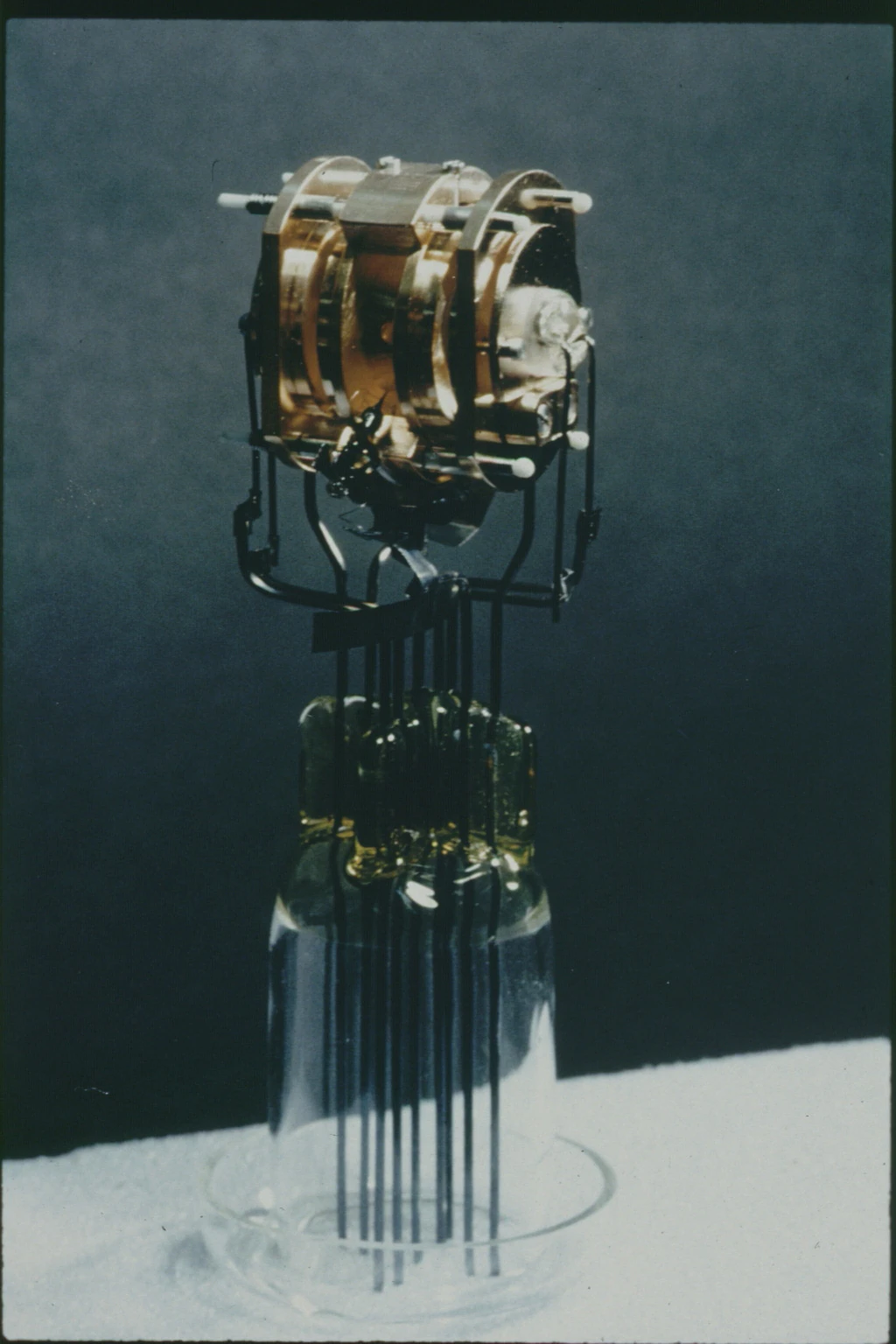
An early laser-cooling ion trap
A historical component can make an unfamiliar research method feel concrete. NIST identifies this object as an ion trap used in an early laser-cooling experiment. The visible metal supports and pins are the apparatus around the particles, not enlarged photographs of the particles themselves. Pair the image with a short chronology that dates the experiment from an authoritative historical source rather than assuming the digital file’s date is the experimental date. A useful reader exercise is to explain what is held, what does the holding and what must be measured to demonstrate cooling. The photograph gives the story an object to follow.
- Organization
- NIST
- Image type
- Photograph
- Capture date
- 2009-12-15
- Photographer / creator
- NIST
- Reuse terms
- Public domain
NIST — Ion Trap (5940481357).jpg — Public domain — https://commons.wikimedia.org/wiki/File:Ion_Trap_(5940481357).jpg — https://commons.wikimedia.org/wiki/File:Ion_Trap_(5940481357).jpg#Licensing.
Full original frame retained; EXIF orientation normalized where present, resized without enlargement and converted to WebP. No crop or content alteration.
Read the image
An old component can preserve the beginning of a technique
The metal assembly has circular supports and fine pins against a dark background. NIST’s source identifies it as the trap used in the first laser-cooling experiment. The photograph is an archival record of hardware associated with an important experimental technique, rather than a picture taken necessarily at the moment of that discovery.
Laser cooling uses controlled interactions between light and particles to reduce their motion. The counterintuitive idea is that absorbing and emitting light can be arranged to remove energy from selected motion rather than simply heat the object. The apparatus has to provide an environment in which that controlled process can be studied.
The age of the hardware and the date of the photograph are separate facts. Preserving both prevents an archive image from becoming a misleading event photograph. It also makes the object more interesting: a surviving component can connect later readers to the physical scale of an experiment described in historical papers.
Does the photograph date establish the experiment date?
No. An object can be photographed many years after it was used. The source’s historical identification and image metadata should remain separate.
Why is cooling relevant to precision experiments?
Reducing unwanted motion can make preparation and measurement more controllable. The exact benefit depends on the system and protocol.
What should an archive caption avoid?
Do not supply an unverified discovery date or claim the photographed assembly is currently operating. Link to a historical primary account for those details.
An independent QubitWire lesson based on this image and the cited source reading. The image does not establish a performance result.
Keep exploring
More from the same organization or hardware architecture.
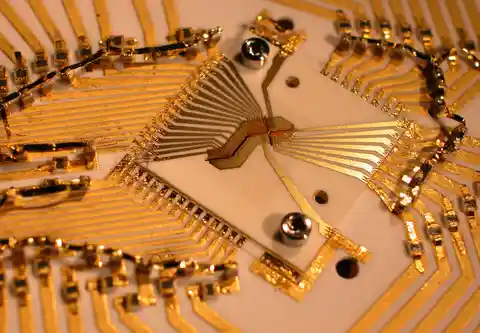 Gold electrodes for trapped ionsBlakestad/NIST · NQI gallery reuse permission
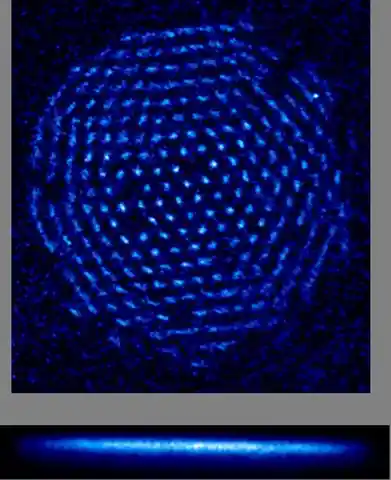 A crystal of trapped ionsNational Institute of Standards and Technology · Public domain (U.S. Government)
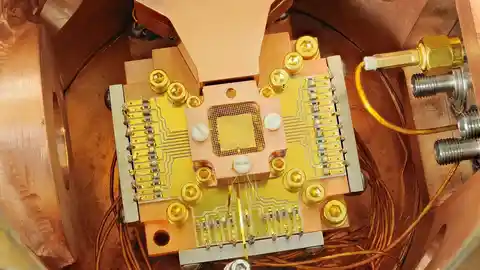 NIST’s beryllium-ion apparatusY. Colombe / NIST · Public domain (U.S. Government)
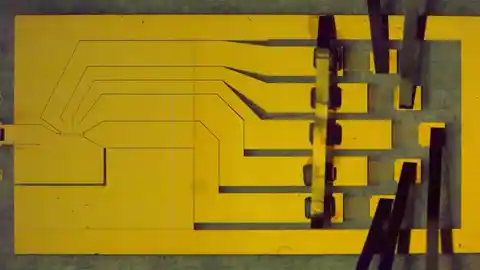 Gold electrodes for trapping ionsSigne Seidelin and John Chiaverini / NIST · Public domain (U.S. Government)
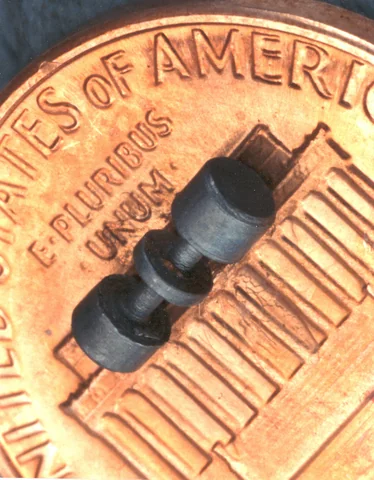 An ion trap resting on a pennyJ. Bergquist and D. Wineland / NIST · Public domain
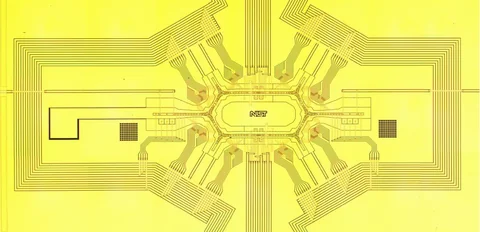 A racetrack for trapped ionsJ. Amini / NIST · Public domain
Back to all images · Explore the interactive Model · Image rights and corrections