
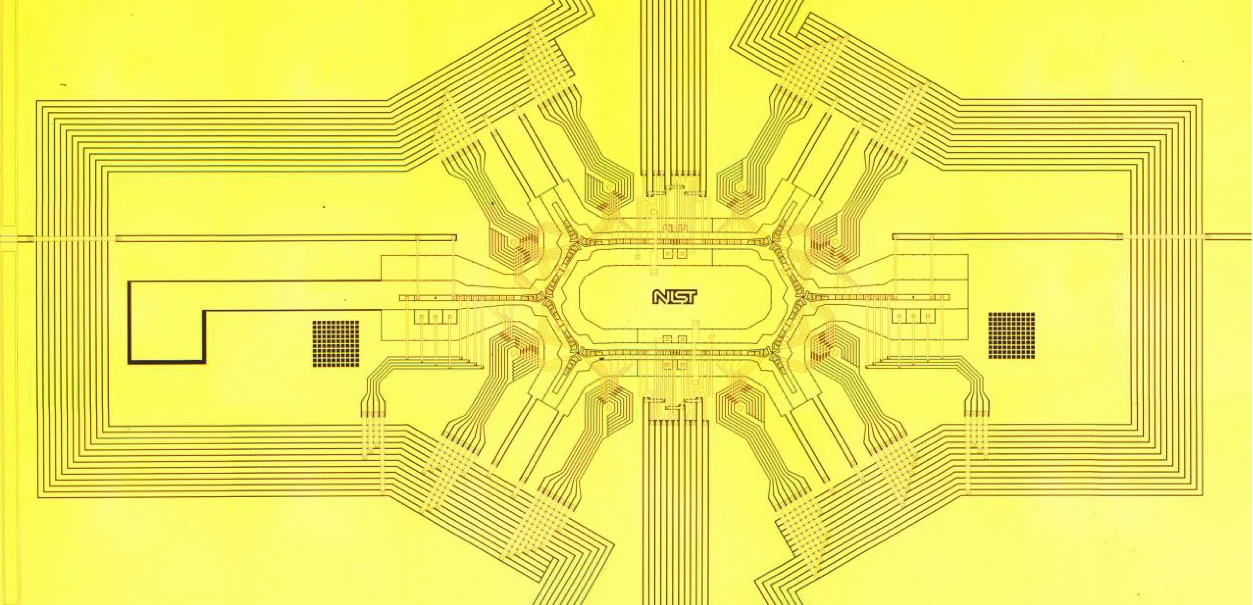
A racetrack for trapped ions
The shape makes transport a natural question. NIST’s source identifies a racetrack ion trap with separate regions for storing, moving and probing ions. The photograph shows the patterned architecture, while successful transport and the quality of operations require experimental measurements. That division is a useful way to introduce modular thinking within a single device. Ask readers why a design might use different locations for different tasks and what could be lost during movement. Keep the source’s architectural description separate from any claim about a current commercial system; this is an archival chip photograph, not a specification for all trapped-ion computers.
- Organization
- NIST
- Image type
- Photograph
- Capture date
- 2010-03-30
- Photographer / creator
- J. Amini / NIST
- Reuse terms
- Public domain
J. Amini / NIST — Ion Trap (5941039382).jpg — Public domain — https://commons.wikimedia.org/wiki/File:Ion_Trap_(5941039382).jpg — https://commons.wikimedia.org/wiki/File:Ion_Trap_(5941039382).jpg#Licensing.
Full original frame retained; EXIF orientation normalized where present, resized without enlargement and converted to WebP. No crop or content alteration.
Read the image
A racetrack trap separates location from qubit identity
The patterned chip has an oval central route and channels extending toward contact regions. NIST identifies it as a multi-zone racetrack ion trap. Its geometry makes it useful for explaining why a trapped-ion architecture can care about where ions are located and how they move between regions.
Electrode structures shape the fields used to confine and transport charged particles. Different zones can support different parts of a control sequence, depending on the design. A zone is therefore an addressable region or function in the apparatus, not automatically one permanently assigned logical qubit.
The source describes many trap zones, but that should not become a claim that the photograph shows the same number of operating qubits. The image records the fabricated structure. Demonstrating loading, movement, operations and measurement requires a sequence of experiments associated with that structure.
Why might ions move in an architecture?
Movement can bring selected ions to regions used for interaction, storage or measurement. The exact functions of this device’s zones require its technical source.
Does every visible channel contain an ion?
The photograph does not establish occupancy. A channel is part of the structure that can support a controlled trapping region.
What should a zone-count caption explain?
Define zones separately from physical ions and logical qubits. Preserve the source’s terminology rather than replacing it with a more dramatic count.
An independent QubitWire lesson based on this image and the cited source reading. The image does not establish a performance result.
Keep exploring
More from the same organization or hardware architecture.
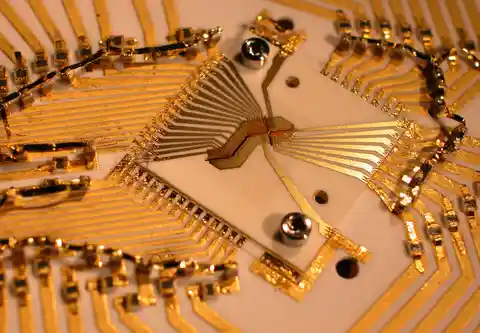 Gold electrodes for trapped ionsBlakestad/NIST · NQI gallery reuse permission
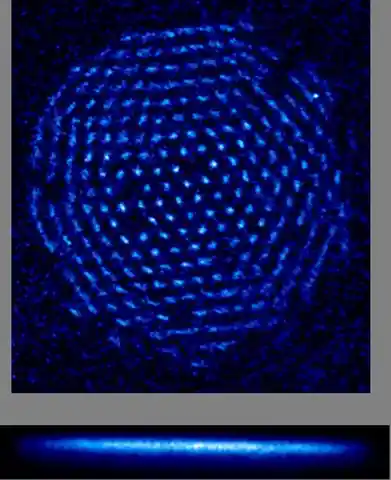 A crystal of trapped ionsNational Institute of Standards and Technology · Public domain (U.S. Government)
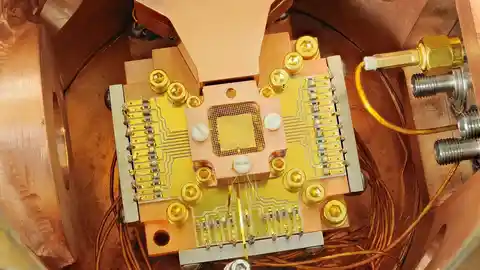 NIST’s beryllium-ion apparatusY. Colombe / NIST · Public domain (U.S. Government)
 Gold electrodes for trapping ionsSigne Seidelin and John Chiaverini / NIST · Public domain (U.S. Government)
 An ion trap resting on a pennyJ. Bergquist and D. Wineland / NIST · Public domain
 An early laser-cooling ion trapNIST · Public domain
Back to all images · Explore the interactive Model · Image rights and corrections