
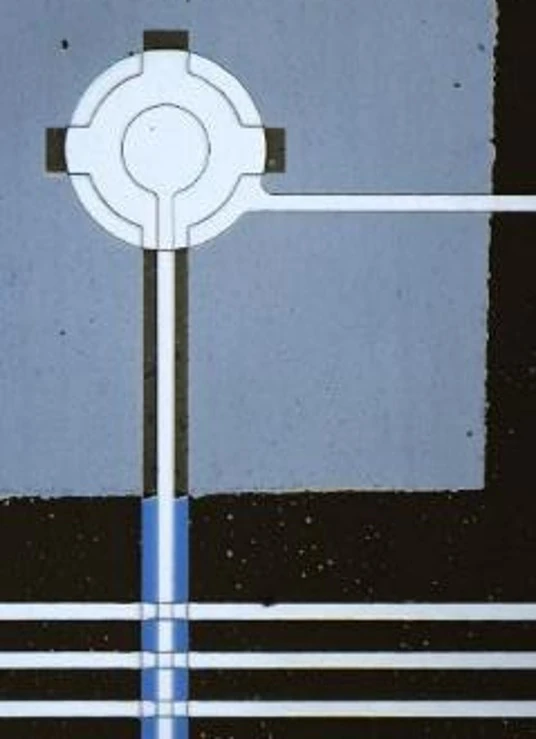
A released drumhead capacitor on a membrane
The circle and narrow lines are a useful starting point for thinking about movement in a fabricated device. The NIST source identifies a released drumhead capacitor on a membrane, associated with research on quantum transduction. A still image cannot show that membrane vibrating, quantify its loss or demonstrate conversion between optical and microwave signals. It can show that the proposed mechanism has a physical fabrication problem: a movable structure must coexist with supporting material and connections. Keep this modest-resolution micrograph as an inset. Add an original conceptual explanation beside it rather than enlarging it until the edges imply false detail.
- Organization
- NIST
- Image type
- Device micrograph
- Capture date
- Not supplied by source
Source publication and upload dates are separate from capture dates. The capture date is not verified.
- Photographer / creator
- P. Slayback/NIST
- Reuse terms
- Public domain in the United States; NIST worldwide reuse terms
P. Slayback/NIST — A released drumhead capacitor on a membrane — Public domain in the United States; NIST worldwide reuse terms — https://www.nist.gov/programs-projects/quantum-transducer-design-and-fabrication — https://www.nist.gov/open/copyright-fair-use-and-licensing-statements-srd-data-software-and-technical-series-publications.
Full original frame retained; EXIF orientation normalized where present, resized without enlargement and converted to WebP. No crop or content alteration.
Read the image
A still micrograph can introduce a moving device
The central circle and connecting lines give the image a clear geometric structure. NIST identifies the object as a released drumhead capacitor on a membrane. The important visual limitation is immediate: a still micrograph records a structure, while the proposed device function involves behavior over time.
Teach that distinction with a familiar reasoning exercise. A photograph of a bridge can show its arrangement, but measuring how it responds to a load is another task. Similarly, a fabricated membrane needs measurements of its motion and response before a claim about conversion or noise can be assessed. The analogy is conceptual and supplies no numerical property of this device.
The native image is modest in size and has no supplied scale bar. Keep it as a small inset and avoid inventing dimensions from the apparent width of the lines. An original schematic can explain a mechanism beside the micrograph, provided it is clearly labeled as conceptual and does not copy source artwork.
Can we infer vibration frequency from the circle’s apparent size?
No. The image supplies neither a calibrated physical scale nor all the material and mechanical properties needed for that inference.
Why retain the micrograph if it does not prove function?
It connects the conceptual device to an actual fabricated structure and gives readers a precise object to associate with later measurements.
An independent QubitWire lesson based on this image and the cited source reading. The image does not establish a performance result.
Keep exploring
More from the same organization or hardware architecture.
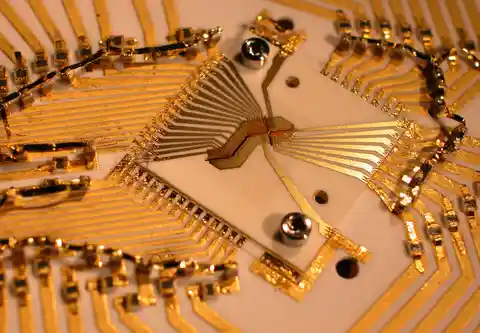 Gold electrodes for trapped ionsBlakestad/NIST · NQI gallery reuse permission
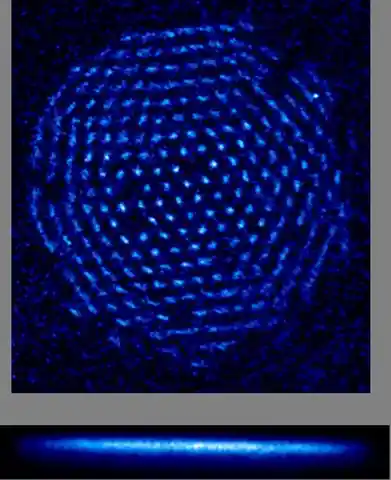 A crystal of trapped ionsNational Institute of Standards and Technology · Public domain (U.S. Government)
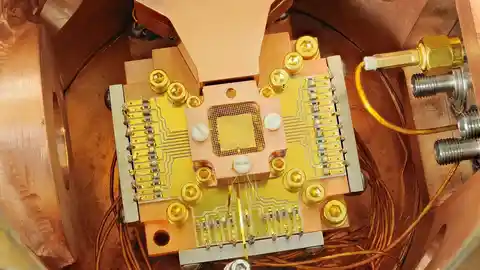 NIST’s beryllium-ion apparatusY. Colombe / NIST · Public domain (U.S. Government)
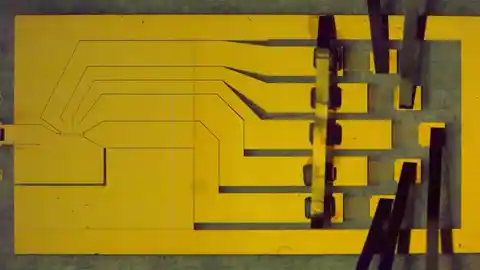 Gold electrodes for trapping ionsSigne Seidelin and John Chiaverini / NIST · Public domain (U.S. Government)
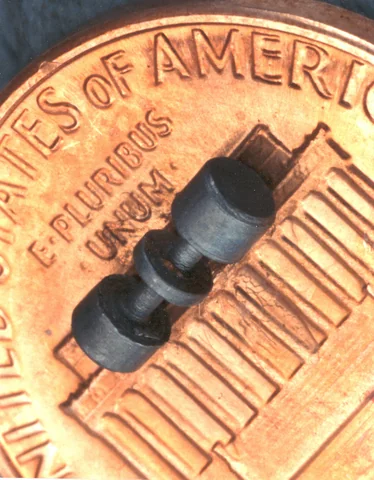 An ion trap resting on a pennyJ. Bergquist and D. Wineland / NIST · Public domain
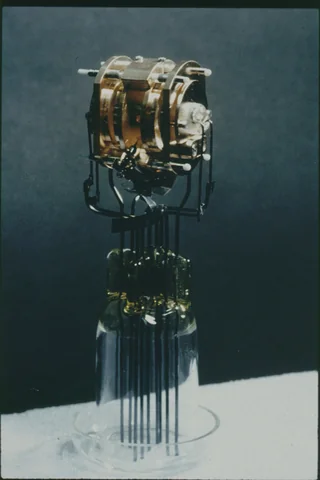 An early laser-cooling ion trapNIST · Public domain
Back to all images · Explore the interactive Model · Image rights and corrections