
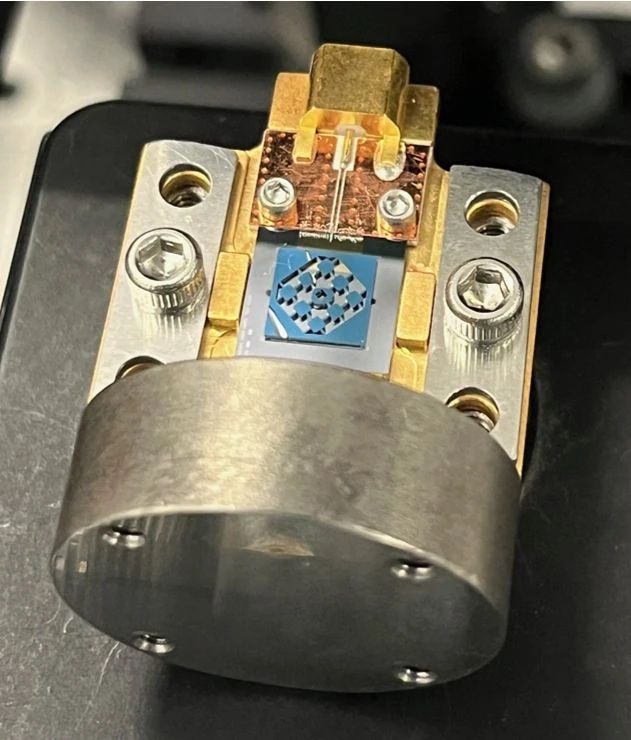
A flip-chip transducer cavity mount
Packaging gives a small patterned device somewhere to operate. In this photograph, screws, a substantial mount and metallic fittings occupy more of the frame than the blue square at the center. NIST identifies the assembly with its transducer research. The useful question is how a device’s optical, electrical, mechanical and thermal requirements can be satisfied together. The photograph does not answer that question, but it makes the interfaces concrete enough to discuss. When a story promises to connect quantum processors, show readers the experimental hardware while separately reporting conversion efficiency, noise, operating conditions and the remaining engineering work.
- Organization
- NIST
- Image type
- Photograph
- Capture date
- Not supplied by source
Source publication and upload dates are separate from capture dates. The capture date is not verified.
- Photographer / creator
- H. Le Corre/NIST
- Reuse terms
- Public domain in the United States; NIST worldwide reuse terms
H. Le Corre/NIST — A flip-chip transducer cavity mount — Public domain in the United States; NIST worldwide reuse terms — https://www.nist.gov/programs-projects/quantum-transducer-design-and-fabrication — https://www.nist.gov/open/copyright-fair-use-and-licensing-statements-srd-data-software-and-technical-series-publications.
Full original frame retained; EXIF orientation normalized where present, resized without enlargement and converted to WebP. No crop or content alteration.
Read the image
The mount is part of the engineering story
The blue patterned component occupies a small region inside a much larger metallic assembly. That proportion is useful. It reminds a reader that a device operates through interfaces with its surroundings, including supports and connections whose requirements must coexist.
A transducer story can be organized around those interfaces without pretending the photograph reveals every one. Ask where signals enter and leave, what holds the relevant parts in place and which operating conditions must be maintained. Keep unknown paths unknown unless the source identifies them. The visible screws and fittings do not provide a wiring diagram.
NIST identifies this as a flip-chip transducer cavity mount. Use it to show experimental hardware associated with the research program. A successful quantum-network claim would require additional evidence about the converted information, efficiency, added noise and operating conditions. The picture is a documentary anchor for those questions, not a substitute for their answers.
Why distinguish conversion from networking?
Demonstrating an interface is one part of a larger communication task. A network also requires a complete protocol and performance assessment across its connected components.
Which credit belongs to this image?
The source credits H. Le Corre/NIST. Adjacent transducer images have different named credits, so a page-level blanket attribution would be inaccurate.
An independent QubitWire lesson based on this image and the cited source reading. The image does not establish a performance result.
Keep exploring
More from the same organization or hardware architecture.
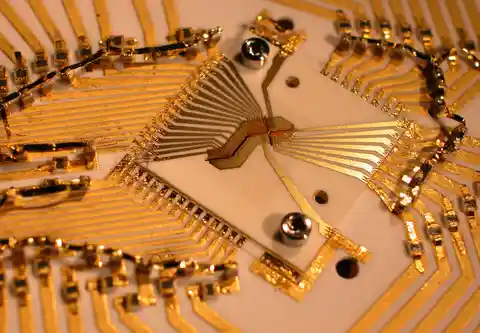 Gold electrodes for trapped ionsBlakestad/NIST · NQI gallery reuse permission
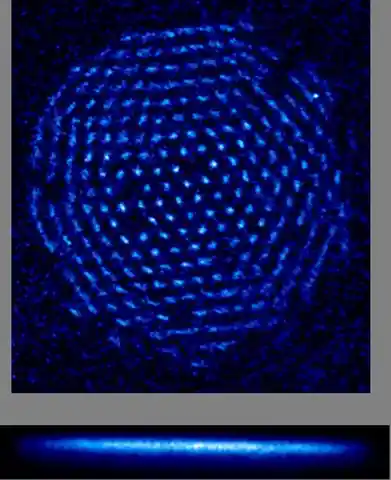 A crystal of trapped ionsNational Institute of Standards and Technology · Public domain (U.S. Government)
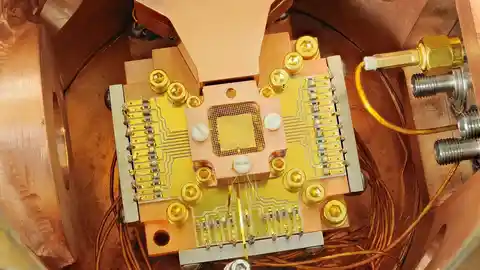 NIST’s beryllium-ion apparatusY. Colombe / NIST · Public domain (U.S. Government)
 Gold electrodes for trapping ionsSigne Seidelin and John Chiaverini / NIST · Public domain (U.S. Government)
 An ion trap resting on a pennyJ. Bergquist and D. Wineland / NIST · Public domain
 An early laser-cooling ion trapNIST · Public domain
Back to all images · Explore the interactive Model · Image rights and corrections