
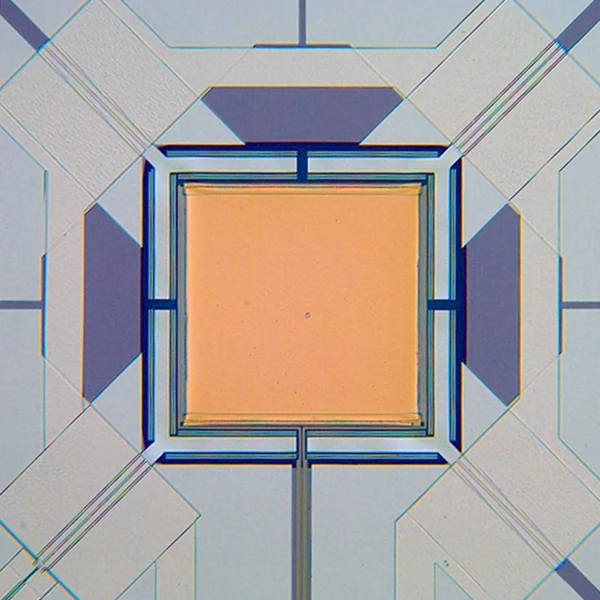
A thin-film payload with tunnel-junction cooling
The warm color in this micrograph is not a temperature reading. It distinguishes a central region from the patterned structures around it. NIST describes a thin-film payload cooled through tunnel junctions at its corners. That makes the image useful for explaining local thermal engineering: a tiny component can need a carefully designed path for removing energy even inside a larger cold instrument. Readers should not infer the achieved temperature, cooling power or material composition from color alone. Use the supplied source identity and a separate measurement citation if a story needs numerical performance. This is a micrograph of enabling hardware.
- Organization
- NIST
- Image type
- Device micrograph
- Capture date
- Not supplied by source
Source publication and upload dates are separate from capture dates. The capture date is not verified.
- Photographer / creator
- NIST
- Reuse terms
- Public domain in the United States; NIST worldwide reuse terms
NIST — A thin-film payload with tunnel-junction cooling — Public domain in the United States; NIST worldwide reuse terms — https://www.nist.gov/news-events/news/2026/06/nist-launches-center-drive-manufacture-quantum-technologies — https://www.nist.gov/open/copyright-fair-use-and-licensing-statements-srd-data-software-and-technical-series-publications.
Full original frame retained; EXIF orientation normalized where present, resized without enlargement and converted to WebP. No crop or content alteration.
Read the image
Color is not a thermometer
The orange center and repeated surrounding lines make this micrograph visually accessible. The source identifies a thin-film payload and tunnel-junction cooling structures. That identity supports a lesson about thermal design, but the displayed color should not be treated as a map of temperature.
Thermal reasoning asks how energy enters and leaves a defined object. A small component can receive unwanted heat through several paths while relying on a deliberately engineered route to remove it. Whether a particular design succeeds depends on operating conditions and measurements, not on whether a region looks cool or warm in a micrograph.
This is therefore a useful enabling-hardware image for a broader quantum manufacturing or cryogenics explainer. Keep it separate from pictures of computing qubits. The manufacturing-center article supplies its publication context; it does not turn the image into a photograph of a newly installed center or a newly announced processor.
Can the central color identify material composition?
Not by itself. Microscopy conditions, processing and display choices can influence appearance. Use a source-identified material or leave composition unspecified.
Why label this as a micrograph?
Readers then understand that scale and appearance come from an imaging method, and they are less likely to mistake it for a macroscopic photograph or a measured heat map.
An independent QubitWire lesson based on this image and the cited source reading. The image does not establish a performance result.
Keep exploring
More from the same organization or hardware architecture.
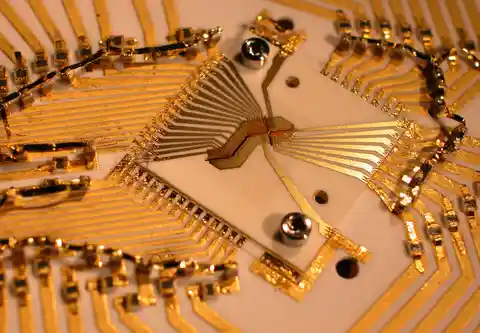 Gold electrodes for trapped ionsBlakestad/NIST · NQI gallery reuse permission
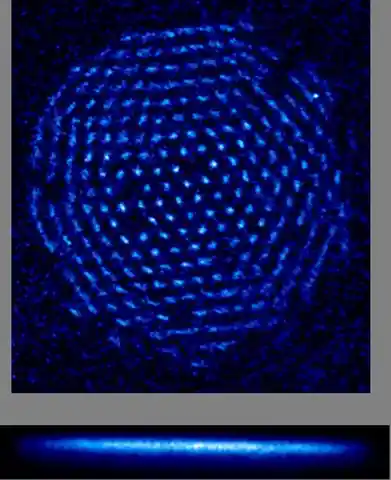 A crystal of trapped ionsNational Institute of Standards and Technology · Public domain (U.S. Government)
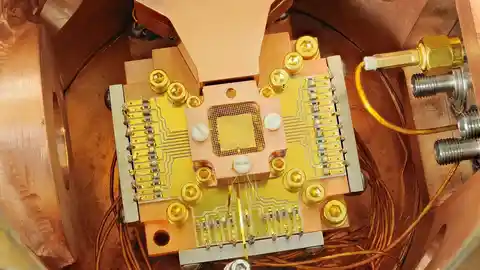 NIST’s beryllium-ion apparatusY. Colombe / NIST · Public domain (U.S. Government)
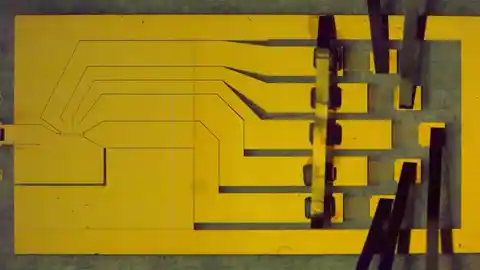 Gold electrodes for trapping ionsSigne Seidelin and John Chiaverini / NIST · Public domain (U.S. Government)
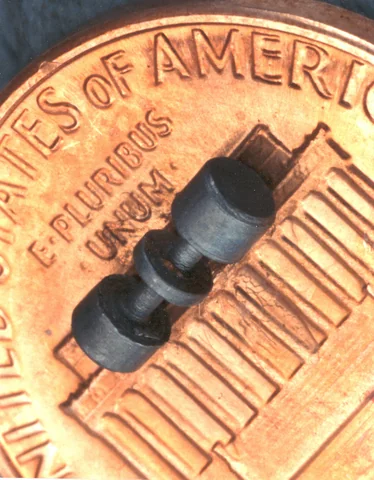 An ion trap resting on a pennyJ. Bergquist and D. Wineland / NIST · Public domain
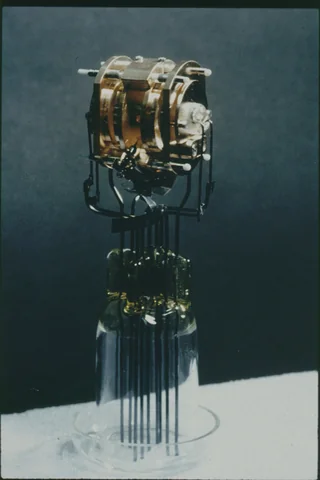 An early laser-cooling ion trapNIST · Public domain
Back to all images · Explore the interactive Model · Image rights and corrections