
Quantum in pictures
The window at the end of a quantum link
Two archival laboratory photographs make a quantum communication link look surprisingly local: an instrument, a window and another building.
Research context: October 19, 2026 · Source review: October 20, 2026
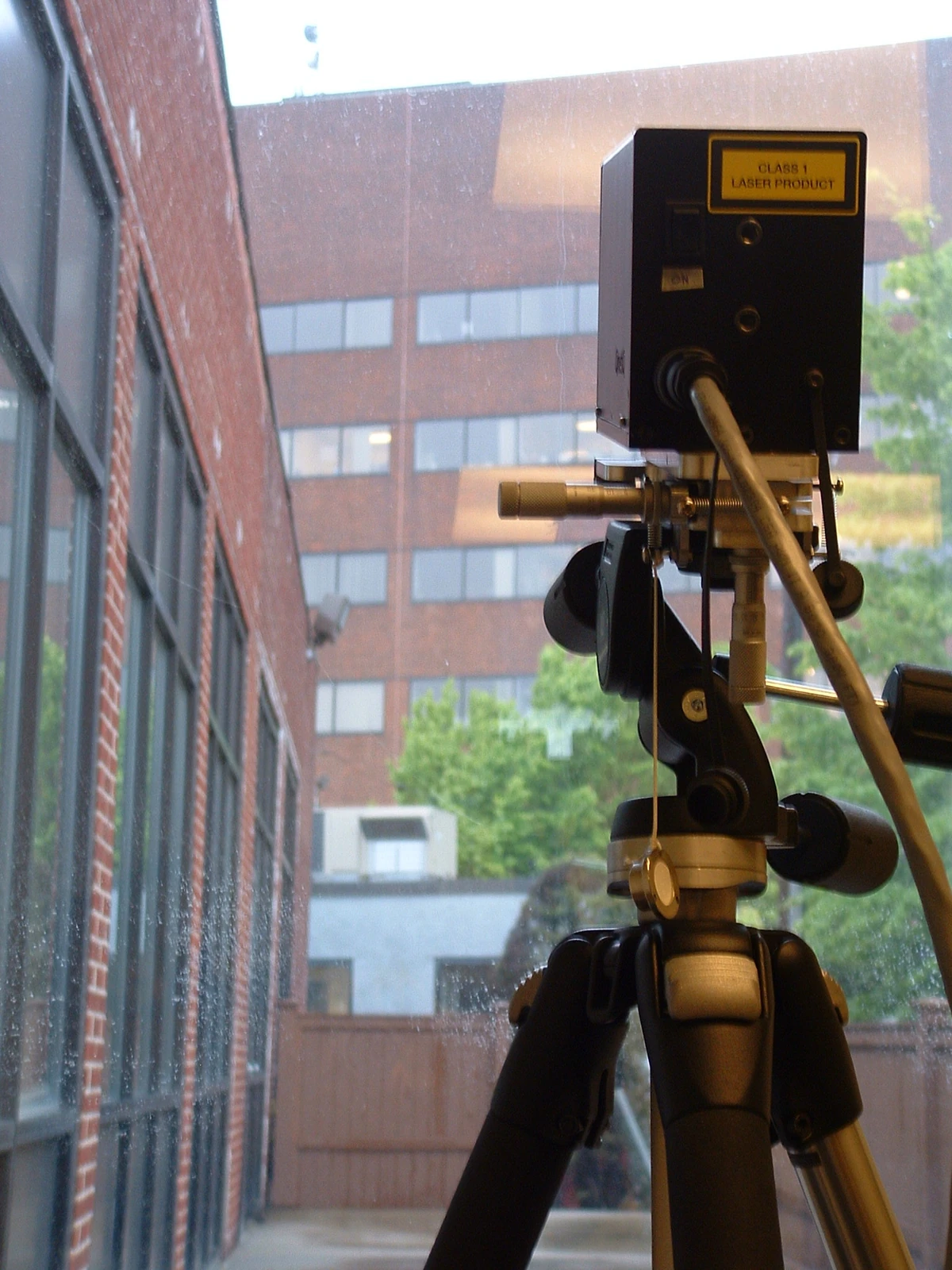
A free-space link needs a view. This archive photograph makes that requirement intuitive by placing the optical endpoint against an ordinary building across the way. The source identifies a QinetiQ system in the DARPA Quantum Network, while the file’s title and recorded date differ slightly; retain 2005 as the reliable historical context unless the original capture date is resolved. The image is useful for a comparison of free-space and fiber routes, but it does not establish a key rate or security proof. Show the endpoint as apparatus, then use a separate labeled diagram for the protocol and communications around it.
Daderot — Qinetiq free-space QKD system in the DARPA Quantum Network - March 2005.jpg — CC0 — https://commons.wikimedia.org/wiki/File:Qinetiq_free-space_QKD_system_in_the_DARPA_Quantum_Network_-_March_2005.jpg — http://creativecommons.org/publicdomain/zero/1.0/deed.en.Full original frame retained; EXIF orientation normalized where present, resized without enlargement and converted to WebP. No crop or content alteration.
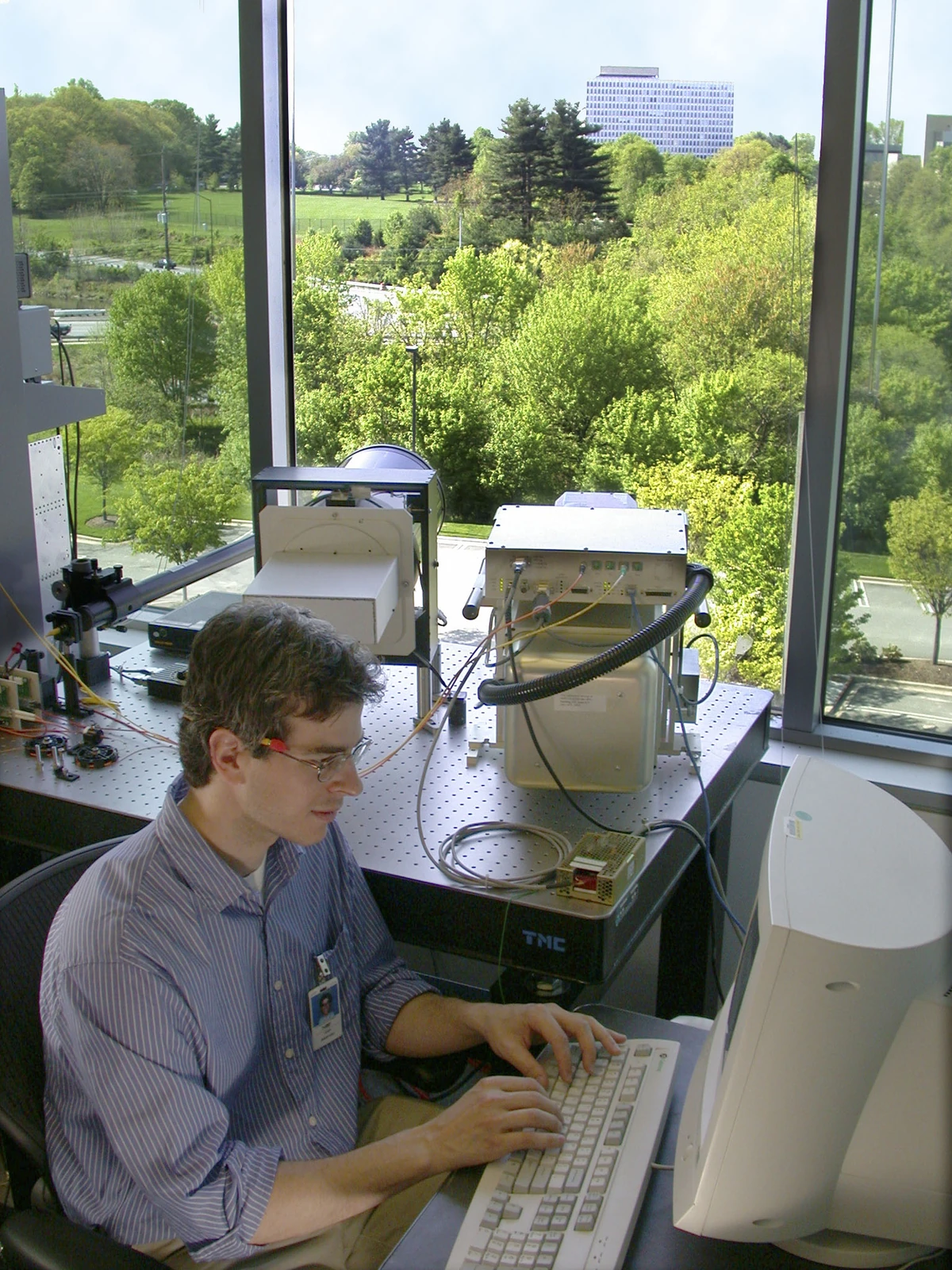
The building in the background is part of the story, not decorative scenery. NIST’s caption describes an experiment receiving photons from colleagues elsewhere on the campus, with a telescope collecting the incoming light. This gives a newcomer a physical picture of a free-space link: endpoints must share an optical path through an ordinary environment. The photograph cannot establish the link’s security or performance by itself. A companion article can distinguish the visible apparatus from the protocol and its implementation assumptions. Keep the historical context and describe quantum key distribution specifically rather than relabeling the scene as a general quantum internet.
Gail Porter / NIST — Physicist Joshua Bienfang (5941064854).jpg — Public domain — https://commons.wikimedia.org/wiki/File:Physicist_Joshua_Bienfang_(5941064854).jpg — https://commons.wikimedia.org/wiki/File:Physicist_Joshua_Bienfang_(5941064854).jpg#Licensing.Full original frame retained; EXIF orientation normalized where present, resized without enlargement and converted to WebP. No crop or content alteration.
A black instrument stands on a tripod, pointed through a window toward a neighboring building. The photograph identifies a Qinetiq free-space quantum-key-distribution endpoint in the DARPA Quantum Network in 2005. There is no glowing line drawn across the scene. The geometry is ordinary enough to understand immediately: equipment at one location has to exchange light with equipment somewhere else.[1]
A second photograph, from NIST, places physicist Joshua Bienfang beside a telescope and computer, again with a campus building beyond the window. The source identifies the work as free-space quantum communication. The two photographs are from different settings; putting them together does not make them the ends of one link. Their common feature is that they allow the reader to see the physical problem of establishing an optical path.[2]
For a reader encountering quantum networking for the first time, that path is a useful starting point. A transmitter prepares signals. An optical channel carries some fraction of them to a receiver.
The receiver records measurement events, and classical processing determines which data can contribute to a shared key. The complete security argument depends on a specified protocol, authenticated communication and the assumptions used to model the equipment. A clear line of sight is one ingredient, not a security certificate.
The NIST team’s 2004 paper on high-speed quantum key distribution is also a reminder to read the units attached to a performance claim. A system clock rate describes how quickly timed opportunities occur. A count rate describes detected events. A sifted-key rate describes data surviving an initial selection. A final secret-key rate accounts for additional processing and security requirements. Those quantities answer different questions even when they appear in the same technical report.[3]
The window photographs make the distinction easier to grasp. Increasing the rate at which a transmitter sends signals does not ensure that the receiver detects them all. An experiment has to deal with collection, alignment, timing and the behavior of its detectors. Some of those challenges concern the optical path outside the building; others are inside the boxes that the photograph presents as a single instrument.
An original diagram can therefore do something the photograph should not be asked to do. It can draw a quantum optical channel between two labeled endpoints and a separate authenticated classical channel used during the protocol. Under the receiver, it can show a sequence from detected events to data processing to an accepted key. No arrow needs to travel instantaneously, and no private message needs to be depicted as riding inside a visible photon.
These archival frames are engaging because their scale is human. Someone can stand at the instrument, look toward the destination and understand where the link is trying to go. The deeper lesson begins after that recognition. Quantum communication depends on carefully prepared and measured signals, while its deployment depends on the practical work of making endpoints, channels and processing agree. A window onto another building turns that system into something a reader can begin to examine.[1][2][3]
Two channels, one key-establishment protocol
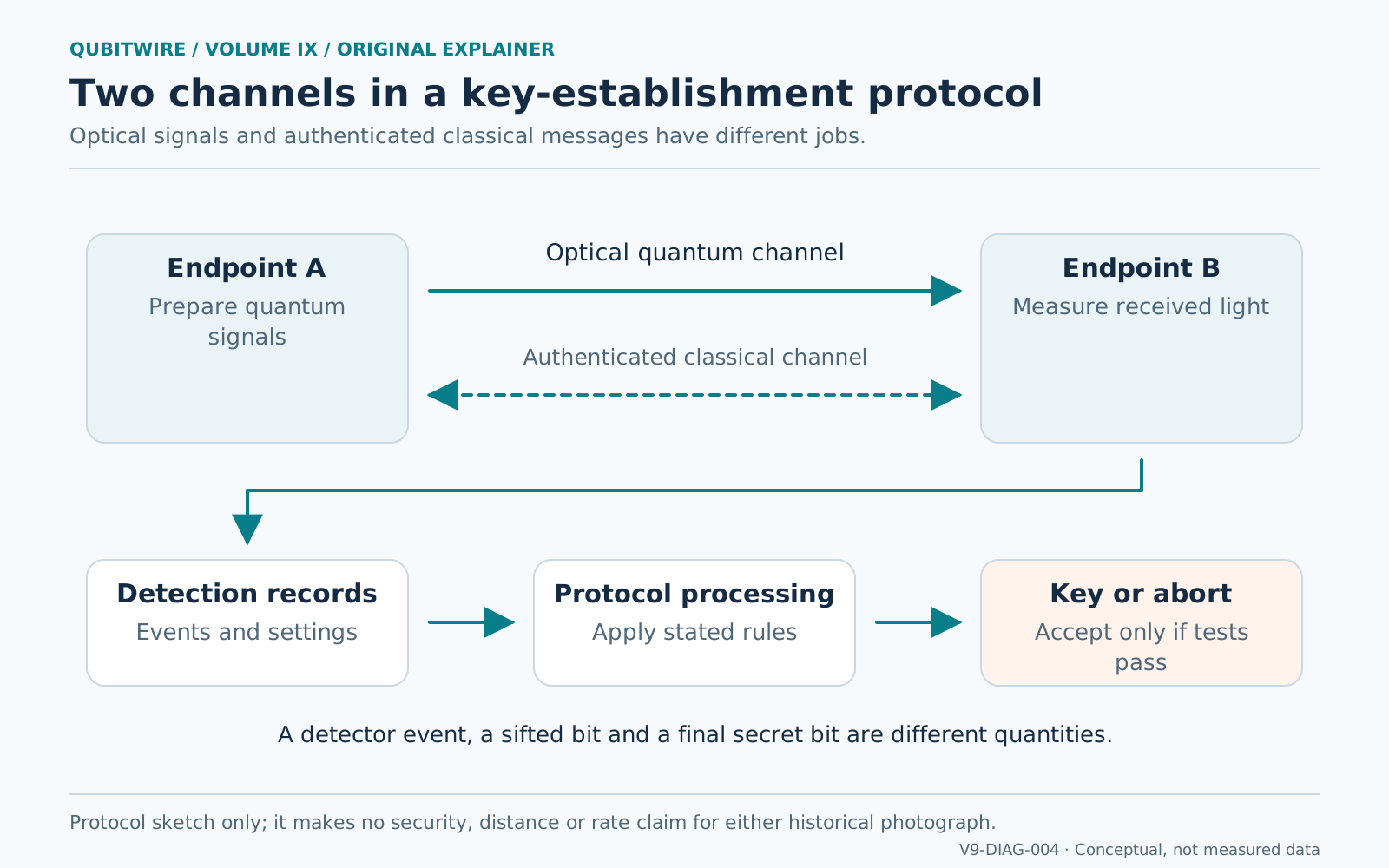
Endpoint A prepares quantum signals and sends them through an optical channel to endpoint B, which measures received light. An authenticated classical channel also connects the endpoints. Detection records undergo protocol processing, leading to an accepted key or an abort. The endpoint photographs are separate historical examples, not two ends of this depicted link.
Conceptual explanation; not an apparatus construction drawing or a measured result. Original QubitWire explanatory diagram.
Sources and further reading
- Qinetiq free-space QKD system in the DARPA Quantum Network – March 2005 ↗Daderot / Wikimedia Commons
Archival endpoint photograph, CC0; title and EXIF have conflicting months, so use 2005 only.
- Physicist Joshua Bienfang ↗Gail Porter / NIST
NIST researcher with campus free-space quantum-communication apparatus; asset identity and public-domain basis.
- Quantum Key Distribution With 1.25 Gbps Clock Synchronization ↗NIST / Optics Express
2004 protocol experiment; distinguish clock, detected, sifted and secret-key rates. Linked primary paper.