
Receiving photons across a campus
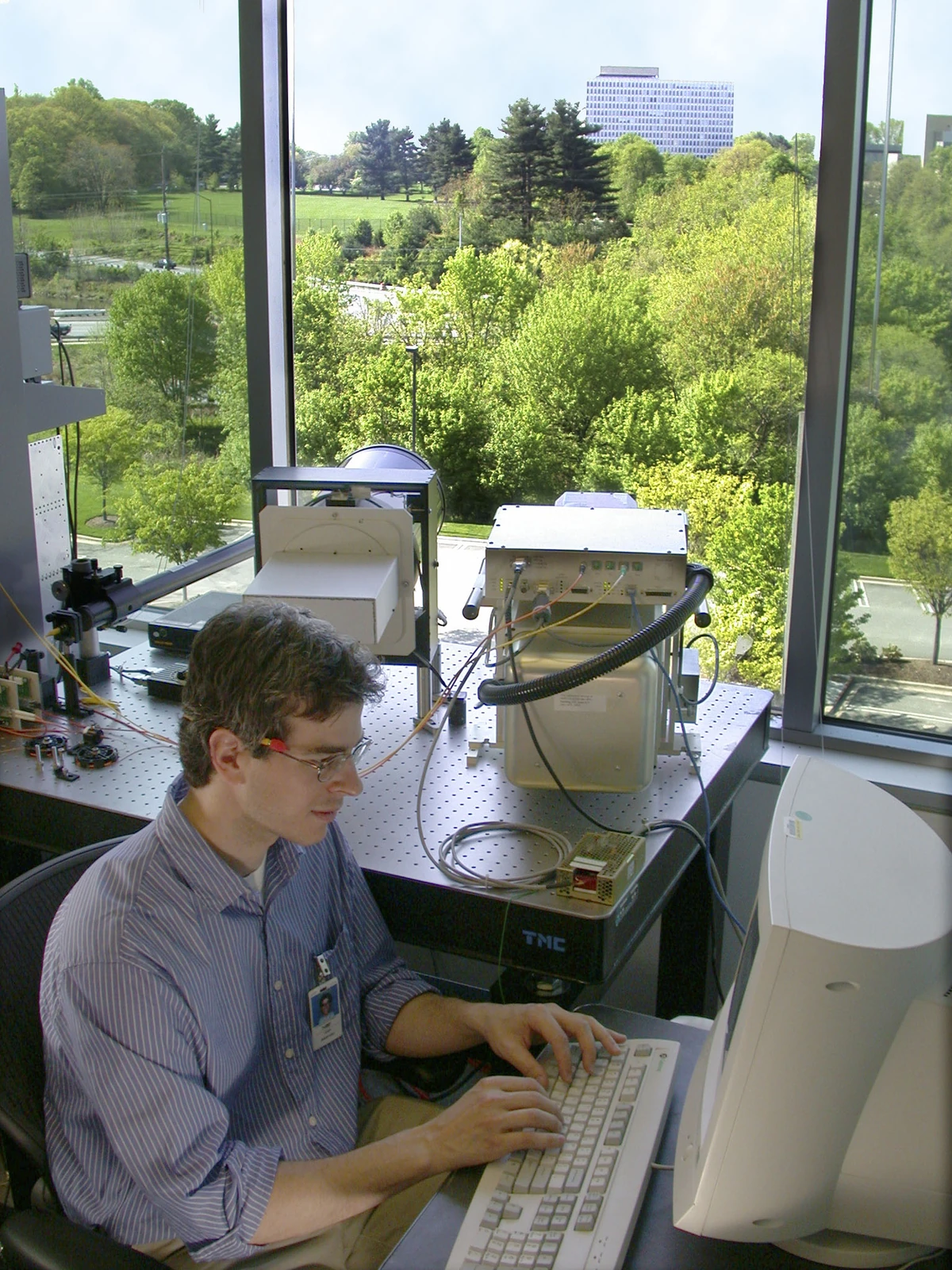
The building in the background is part of the story, not decorative scenery. NIST’s caption describes an experiment receiving photons from colleagues elsewhere on the campus, with a telescope collecting the incoming light. This gives a newcomer a physical picture of a free-space link: endpoints must share an optical path through an ordinary environment. The photograph cannot establish the link’s security or performance by itself. A companion article can distinguish the visible apparatus from the protocol and its implementation assumptions. Keep the historical context and describe quantum key distribution specifically rather than relabeling the scene as a general quantum internet.
- Organization
- NIST
- Image type
- Photograph
- Capture date
- 2011-07-15
- Photographer / creator
- Gail Porter / NIST
- Reuse terms
- Public domain
Gail Porter / NIST — Physicist Joshua Bienfang (5941064854).jpg — Public domain — https://commons.wikimedia.org/wiki/File:Physicist_Joshua_Bienfang_(5941064854).jpg — https://commons.wikimedia.org/wiki/File:Physicist_Joshua_Bienfang_(5941064854).jpg#Licensing.
Full original frame retained; EXIF orientation normalized where present, resized without enlargement and converted to WebP. No crop or content alteration.
Read the image
A telescope turns a distant endpoint into a measurement input
Joshua Bienfang sits beside a computer and a telescope near a window. Another building and trees are visible outside. NIST identifies the apparatus with free-space quantum key distribution, giving the photograph a concrete communication setting: optical signals must be collected from a remote location.
A receiver must do more than notice that some light arrived. The experiment has to associate detections with the relevant signals and measurement choices. Timing, filtering, collection and detector behavior can all affect how much useful information survives into the protocol’s data processing.
The photograph makes collection geometry understandable, while the computer reminds readers that a communication result also requires records and analysis. A telescope view does not establish the link’s distance, secret-key rate or security guarantee. Those quantities belong to the specific experiment and its documented conditions.
Why is timing important?
Detection events must be related to the intended signal opportunities. Timing uncertainty can make that association harder and affect usable data.
Can the neighboring building be assumed to contain the transmitter?
Only if a reliable source identifies it. The visual direction alone does not establish the link partner or exact path.
Why distinguish detected events from secret-key bits?
Protocol processing and security requirements determine which data can contribute to a final key. Every detector event is not automatically a secret bit.
An independent QubitWire lesson based on this image and the cited source reading. The image does not establish a performance result.
Keep exploring
More from the same organization or hardware architecture.
 Gold electrodes for trapped ionsBlakestad/NIST · NQI gallery reuse permission
 A crystal of trapped ionsNational Institute of Standards and Technology · Public domain (U.S. Government)
 NIST’s beryllium-ion apparatusY. Colombe / NIST · Public domain (U.S. Government)
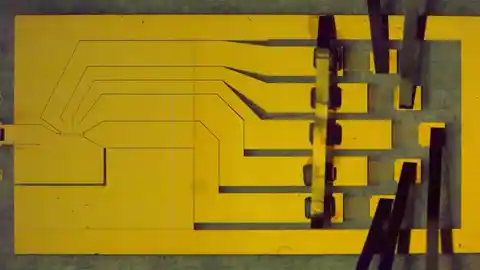 Gold electrodes for trapping ionsSigne Seidelin and John Chiaverini / NIST · Public domain (U.S. Government)
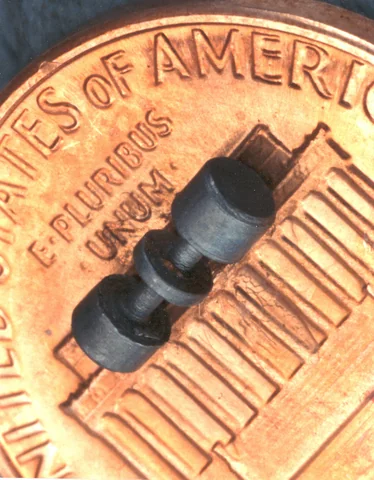 An ion trap resting on a pennyJ. Bergquist and D. Wineland / NIST · Public domain
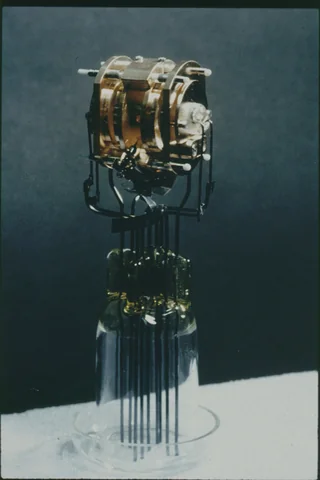 An early laser-cooling ion trapNIST · Public domain
Back to all images · Explore the interactive Model · Image rights and corrections