
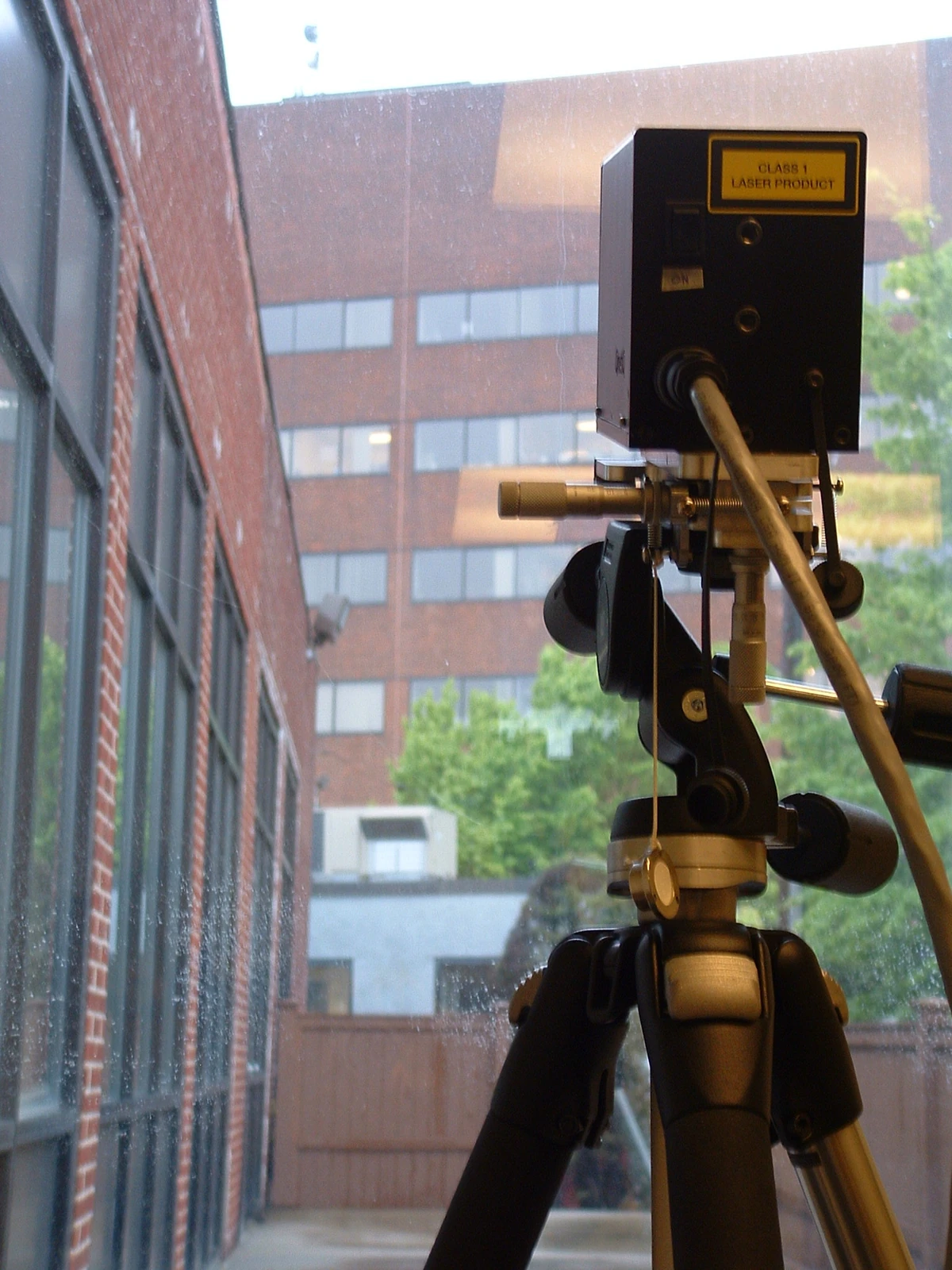
A free-space endpoint facing another building
A free-space link needs a view. This archive photograph makes that requirement intuitive by placing the optical endpoint against an ordinary building across the way. The source identifies a QinetiQ system in the DARPA Quantum Network, while the file’s title and recorded date differ slightly; retain 2005 as the reliable historical context unless the original capture date is resolved. The image is useful for a comparison of free-space and fiber routes, but it does not establish a key rate or security proof. Show the endpoint as apparatus, then use a separate labeled diagram for the protocol and communications around it.
- Organization
- DARPA Quantum Network / BBN
- Image type
- Photograph
- Capture date
- 2005
The source filename and EXIF month conflict; only the supported year is shown.
- Photographer / creator
- Daderot
- Reuse terms
- CC0
Daderot — Qinetiq free-space QKD system in the DARPA Quantum Network - March 2005.jpg — CC0 — https://commons.wikimedia.org/wiki/File:Qinetiq_free-space_QKD_system_in_the_DARPA_Quantum_Network_-_March_2005.jpg — http://creativecommons.org/publicdomain/zero/1.0/deed.en.
Full original frame retained; EXIF orientation normalized where present, resized without enlargement and converted to WebP. No crop or content alteration.
Read the image
The free-space channel begins with a direction through a window
A black optical instrument on a tripod faces a brick building through a window. The source identifies a Qinetiq free-space QKD endpoint in the DARPA Quantum Network at BBN in 2005. Its title and camera metadata disagree about the month, so the gallery should use the supported year without inventing a resolution.
The view makes line-of-sight geometry tangible. A free-space optical path needs the transmitted field and receiving optics to overlap appropriately. Pointing, collection and changing channel conditions can therefore affect the signals available to the protocol.
The building in the frame helps a reader picture an endpoint’s orientation, but it does not establish a measured distance, the identity of every remote component or a security result. A useful companion diagram separates the physical optical path from the classical protocol communication and explains that both belong to the complete key-establishment procedure.
Why does alignment matter?
Light that does not reach the receiving aperture cannot contribute the intended detection events. The relevant tolerances depend on the optical design and path.
How should the conflicting month be handled?
Use 2005 in the public caption and retain the title and EXIF dates in the source record. Do not silently choose the more convenient month.
Does a visible optical path certify security?
No. Security depends on the protocol, implementation and stated assumptions, with evidence beyond a photograph of the endpoint.
An independent QubitWire lesson based on this image and the cited source reading. The image does not establish a performance result.
Keep exploring
More from the same organization or hardware architecture.
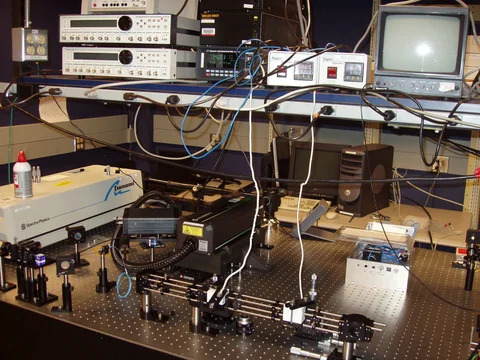 The optical bench of an early quantum-network linkDaderot · CC0
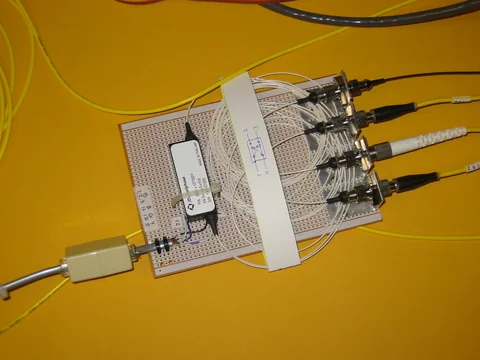 An optical switch in a quantum-network experimentDaderot · CC0
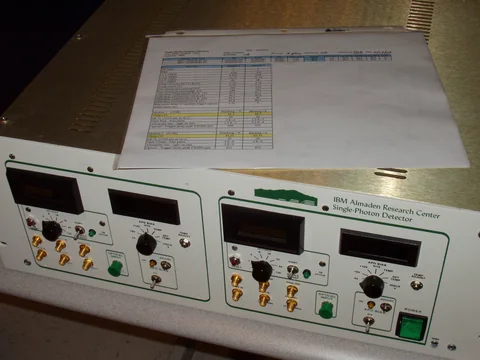 An early single-photon detector instrumentDaderot · CC0
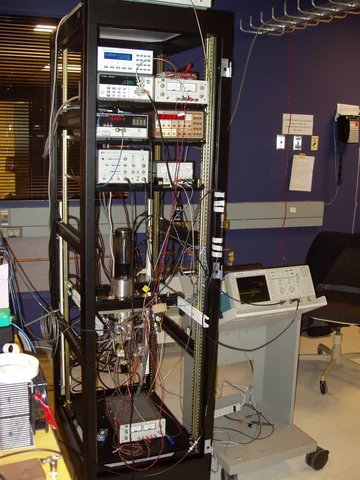 The instrument stack around a photon detectorDaderot · CC0
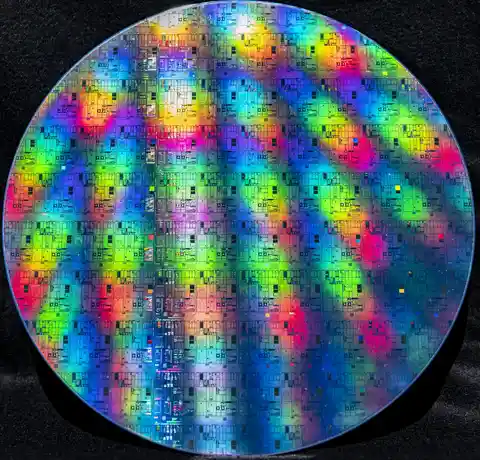 A 300 mm quantum photonic waferAFRL Information Directorate · NQI gallery reuse permission
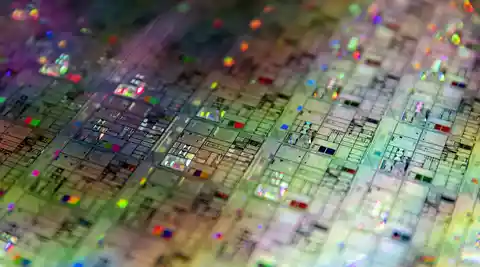 Patterns on a photonic waferAFRL Information Directorate · NQI gallery reuse permission
Back to all images · Explore the interactive Model · Image rights and corrections