
An early single-photon detector instrument
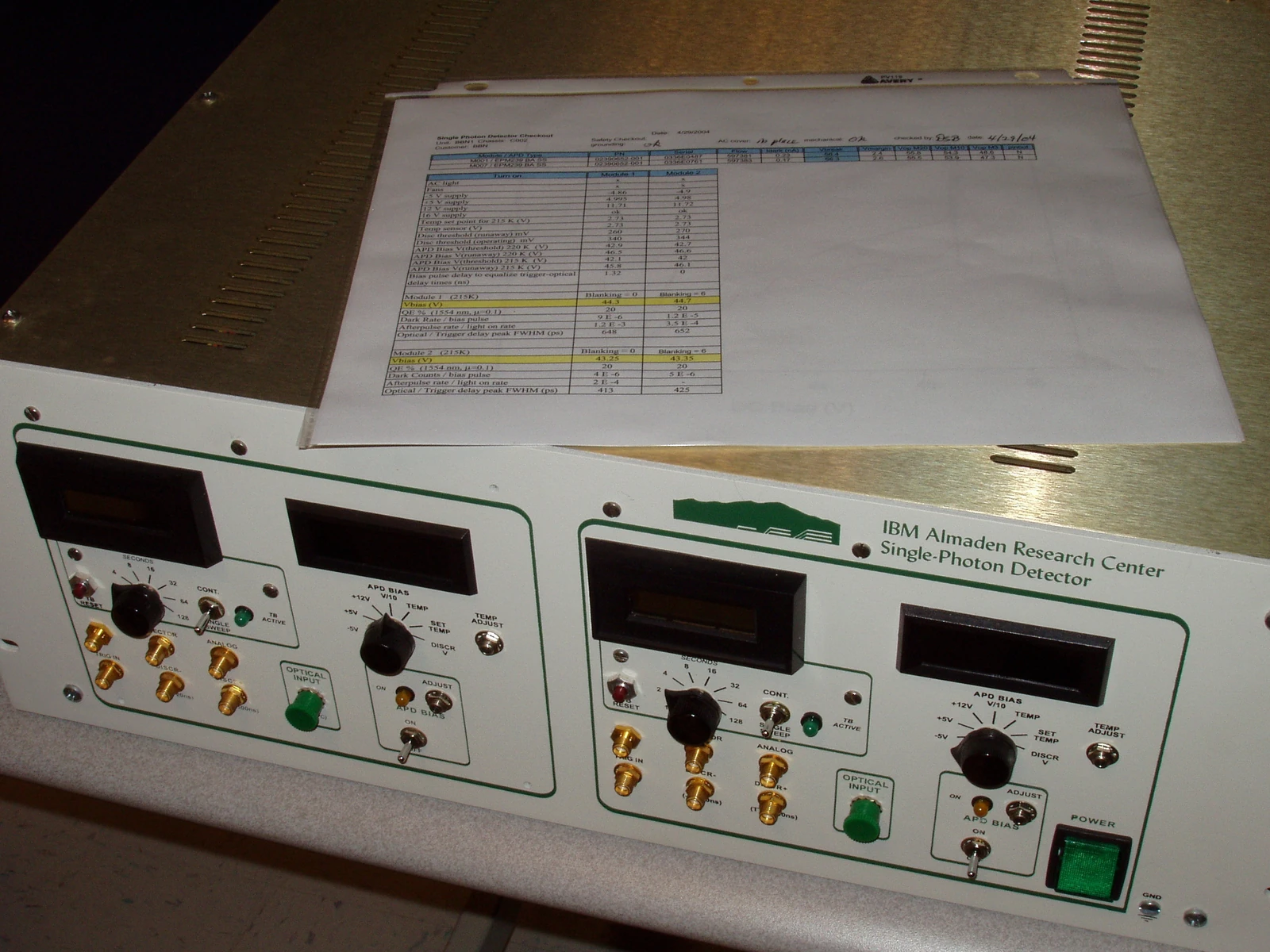
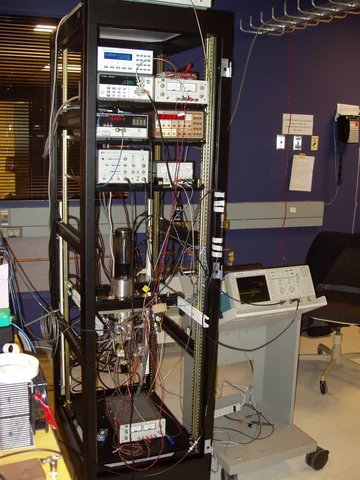
Detecting a photon sounds like one event, but an experimental instrument must turn that event into an output a larger system can use. This historical photograph shows the hardware boundary around such a task. The source identifies an IBM Almaden detector used in the DARPA Quantum Network; it does not disclose every internal detector specification. Use the front panel to introduce the difference between the sensing element and the complete instrument. A separate diagram can follow a hypothetical detection signal through timing and recording, while clearly avoiding the claim that the diagram is a reconstruction of this particular device.
- Organization
- DARPA Quantum Network / BBN
- Image type
- Photograph
- Capture date
- 2004-05
- Photographer / creator
- Daderot
- Reuse terms
- CC0
Daderot — Single-Photon Detector, created by IBM Almaden Research Center - DARPA Quantum Network, in the BBN laboratory - P1010031.jpg — CC0 — https://commons.wikimedia.org/wiki/File:Single-Photon_Detector,_created_by_IBM_Almaden_Research_Center_-_DARPA_Quantum_Network,_in_the_BBN_laboratory_-_P1010031.jpg — http://creativecommons.org/publicdomain/zero/1.0/deed.en.
Full original frame retained; EXIF orientation normalized where present, resized without enlargement and converted to WebP. No crop or content alteration.
Read the image
A photon detector turns a physical event into a recorded signal
The silver instrument has connectors, controls and a front-panel display, with a sheet of paper resting on top. The source identifies a single-photon detector instrument created by IBM Almaden for the DARPA Quantum Network, photographed at BBN in May 2004.
The educational question is what happens between an incoming photon and a usable data record. Detection requires a physical response that electronics can register. The resulting event must then be interpreted within the experiment’s timing and selection rules.
Several properties matter to that interpretation. Some incoming photons may not be recorded; some recorded events can occur without the intended photon; and the timing of a record has finite uncertainty. A front-panel photograph cannot supply those performance values, but it gives a tangible starting point for explaining why a detector requires characterization rather than a simple yes-or-no label.
What is detection efficiency conceptually?
It describes the probability of registering an event under defined input and operating conditions. It must be tied to a measurement protocol.
What is a background or dark event?
It is a recorded event not attributable to the intended signal under the stated conditions. The exact definition should follow the experiment.
Why can timing uncertainty matter?
It affects how confidently a detection can be associated with a signal or with another event in a coincidence experiment.
An independent QubitWire lesson based on this image and the cited source reading. The image does not establish a performance result.
Keep exploring
More from the same organization or hardware architecture.
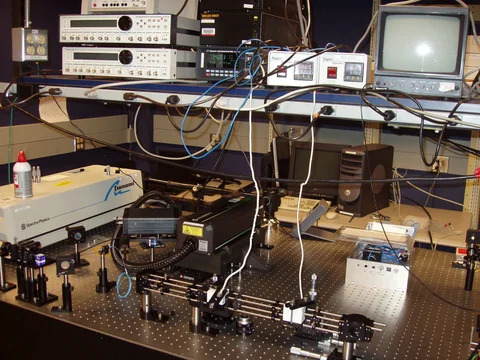 The optical bench of an early quantum-network linkDaderot · CC0
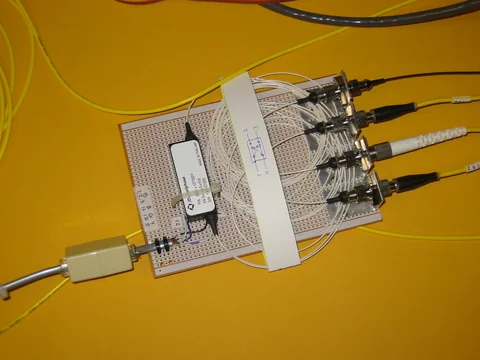 An optical switch in a quantum-network experimentDaderot · CC0
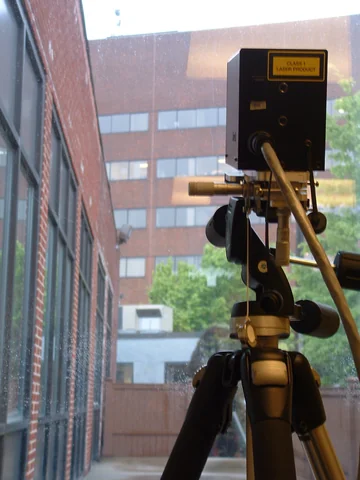 A free-space endpoint facing another buildingDaderot · CC0
 The instrument stack around a photon detectorDaderot · CC0
 A 300 mm quantum photonic waferAFRL Information Directorate · NQI gallery reuse permission
 Patterns on a photonic waferAFRL Information Directorate · NQI gallery reuse permission
Back to all images · Explore the interactive Model · Image rights and corrections