
Quantum in pictures
At O’Hare, quantum hardware met the airport concourse
An airport photograph and a trade-show sequence offer two ways to introduce the machinery around a quantum processor.
Research context: October 19, 2026 · Source review: October 20, 2026
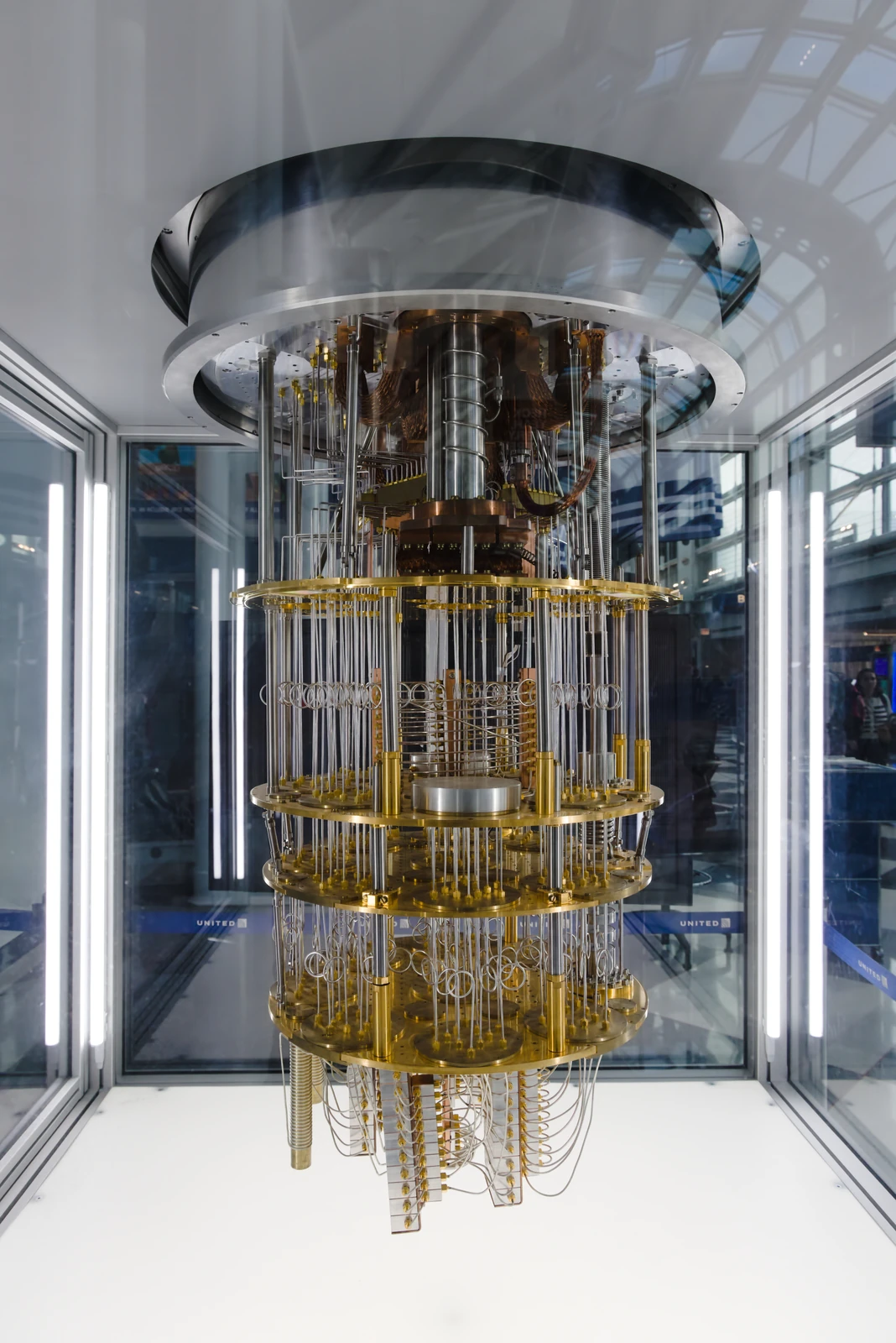
This is a public display of quantum-computing hardware at an airport, a setting far removed from a laboratory. The unusual placement makes it a strong introduction for newcomers: an unfamiliar machine becomes something they can encounter at everyday human scale. Label it as an exhibition and retain the location and photograph date. Neither the appearance of the equipment nor the presence of a familiar brand establishes that the display is operating as a quantum computer. A companion explainer can ask which parts are visible and what additional infrastructure an operational installation would require, using a separately sourced diagram.
Brainandforce — IBM Quantum System One on display at O'Hare International Airport.jpg — CC BY 4.0 — https://commons.wikimedia.org/wiki/File:IBM_Quantum_System_One_on_display_at_O%27Hare_International_Airport.jpg — https://creativecommons.org/licenses/by/4.0.Full original frame retained; EXIF orientation normalized where present, resized without enlargement and converted to WebP. No crop or content alteration.
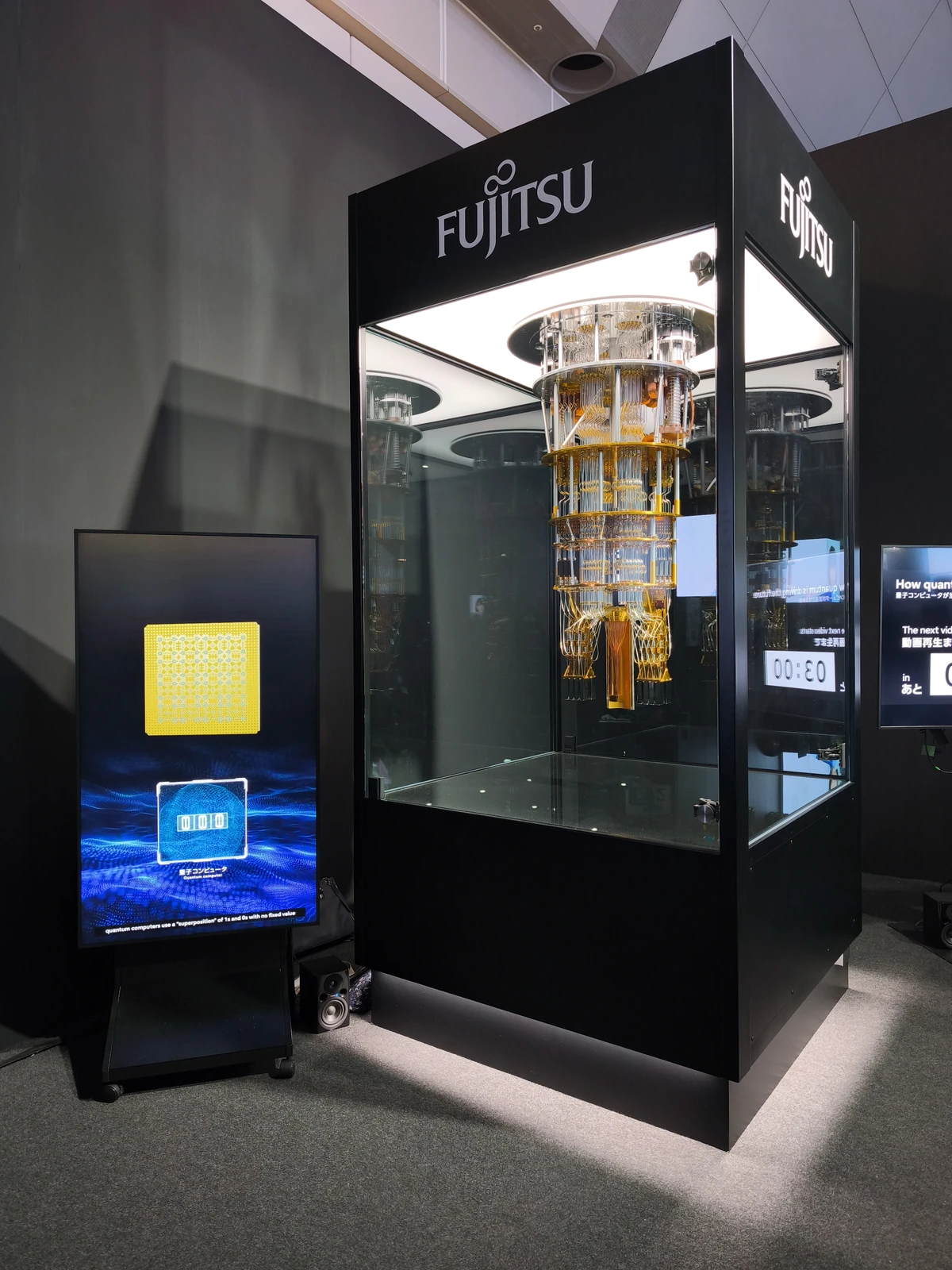
Start this sequence with the whole exhibition rather than a tightly cropped piece of metal. The stand, branding and information screen establish that the scene is a public demonstration at Japan Mobility Show 2025. That context prevents an attractive close-up from being mistaken for a photograph taken during operation in a laboratory. The following detail views can help readers notice how the apparatus is arranged, but they cannot reveal a running algorithm or measured error rate. Use the series to teach observation: first identify the setting, then the visible components, then the questions that require documentation beyond the photograph.
RuinDig/Yuki Uchida — Japan-Mobility-Show-2025-RuinDig 0570.jpg — CC BY 4.0 — https://commons.wikimedia.org/wiki/File:Japan-Mobility-Show-2025-RuinDig_0570.jpg — https://creativecommons.org/licenses/by/4.0.Full original frame retained; EXIF orientation normalized where present, resized without enlargement and converted to WebP. No crop or content alteration.
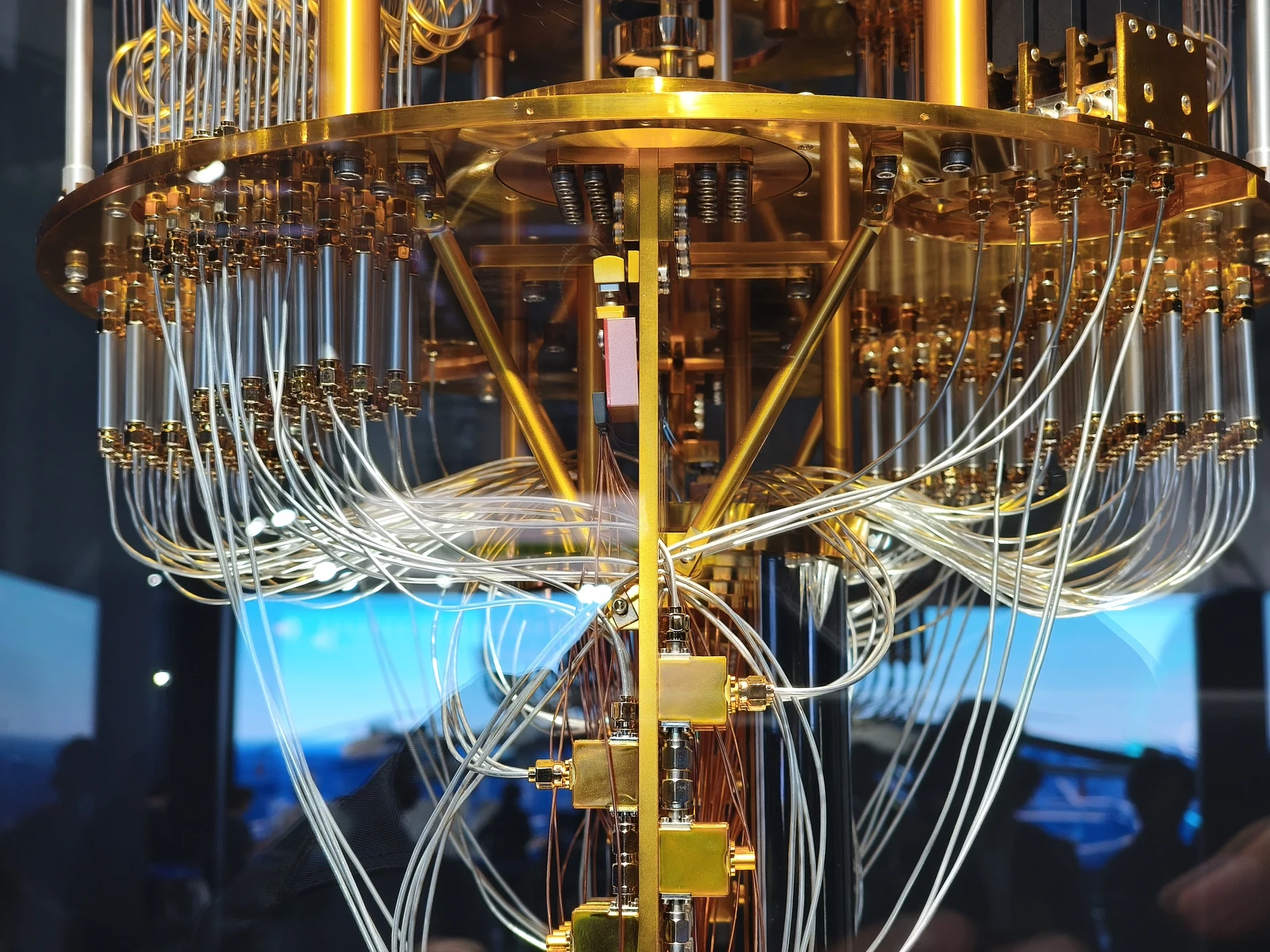
The loops and bundles in this view make wiring a visible subject in its own right. A beginner may assume that adding a qubit is simply adding a tiny feature to a chip; the equipment around the chip raises further questions about routing, connections and access. Let the image open those questions without counting lines or declaring that each visible cable corresponds to one qubit. The exhibition source supplies the apparatus context, not a complete wiring diagram. A companion drawing can illustrate a generic signal path and explain why its labels should not be pasted onto this photograph as if they were verified component identities.
RuinDig/Yuki Uchida — Japan-Mobility-Show-2025-RuinDig 0578.jpg — CC BY 4.0 — https://commons.wikimedia.org/wiki/File:Japan-Mobility-Show-2025-RuinDig_0578.jpg — https://creativecommons.org/licenses/by/4.0.Full original frame retained; EXIF orientation normalized where present, resized without enlargement and converted to WebP. No crop or content alteration.
An airport concourse is an unusual place to encounter the apparatus associated with a quantum computer. In a photograph dated September 13, 2026, an IBM Quantum System One display stands behind transparent walls at Chicago’s O’Hare International Airport. The enclosure gives passing travelers a view of a golden suspended assembly, while the surrounding architecture supplies a familiar scale. A technology usually introduced through diagrams has become an object in a public room.[1]
The display’s educational value begins with that change of setting. Many readers first meet quantum computing as a promise about calculation. Here the first questions are physical. Why does so much equipment surround the part that processes information? Why are components arranged at different heights? What has been made visible for an audience, and what would need additional equipment in an operating installation?
A second set of photographs, taken at the Japan Mobility Show in 2025, approaches those questions from closer range. Fujitsu’s exhibition presents a cryogenic assembly with a view of its larger structure and several views of its lower connections. The wide photograph shows the apparatus as part of a stand. The closer photographs make the density of the wiring easier to see. Their purpose in this sequence is to connect a recognizable public exhibit to details a visitor might otherwise pass over.[2][3][4]
In superconducting quantum systems, the refrigeration equipment creates the environment in which the processor operates. IBM’s account of its characterization laboratory describes cooling chips for measurements of qubit frequency, coherence and coupler tuning. That account concerns IBM’s laboratory process; it does not establish the operating condition of either photographed exhibit. It does, however, explain why a quantum computer can have an elaborate structure around a comparatively small chip.[5]
An exhibit chooses a point of view. A transparent wall favors an uninterrupted look at the object. A trade-show stand supplies signs and context but also introduces reflections, lighting and visual competition.
The photographer makes another choice by deciding whether to include the full room or concentrate on a connection. A thoughtful gallery should preserve those choices: first orient the reader, then move closer, then explain the function being discussed.
The useful comparison is between ways of teaching. The airport image answers “What size is the thing I keep hearing about?” The exhibition details invite “How does the surrounding equipment support it?” A short original diagram can answer a third question by separating a processor, its cold environment and the room-temperature controls into clearly labeled conceptual regions.
These photographs document particular displays on particular dates. They are not a current visitor guide or a report that an airport installation was executing quantum programs. That modest historical precision makes them better teaching material. Readers can enjoy the sight of unfamiliar machinery in a familiar place, then leave with a sharper distinction between the quantum device and the substantial physical system built around it.[1][2][3][4][5]
Three regions around a superconducting processor

A processor sits within a controlled cold environment. Control and readout connections join it to room-temperature electronics. Both occupy a larger laboratory-support setting. This is a generic explanatory diagram, not a cutaway of the airport or Fujitsu display photographs.
Conceptual explanation; not an apparatus construction drawing or a measured result. Original QubitWire explanatory diagram.
Sources and further reading
- IBM Quantum System One on display at O’Hare International Airport ↗Brainandforce / Wikimedia Commons
Real exhibition photograph, September 13, 2026; identity and CC BY 4.0.
- Japan-Mobility-Show-2025-RuinDig 0570 ↗RuinDig/Yuki Uchida / Wikimedia Commons
Fujitsu exhibition context and full apparatus view.
- Japan-Mobility-Show-2025-RuinDig 0578 ↗RuinDig/Yuki Uchida / Wikimedia Commons
Lower-stage wiring photograph; documentary source and license.
- Japan-Mobility-Show-2025-RuinDig 0575 ↗RuinDig/Yuki Uchida / Wikimedia Commons
Additional upper-stage context in the licensed photo set.
- How to test a quantum computer chip ↗IBM Research
Separate operating-laboratory example: refrigeration and characterization measurements.