
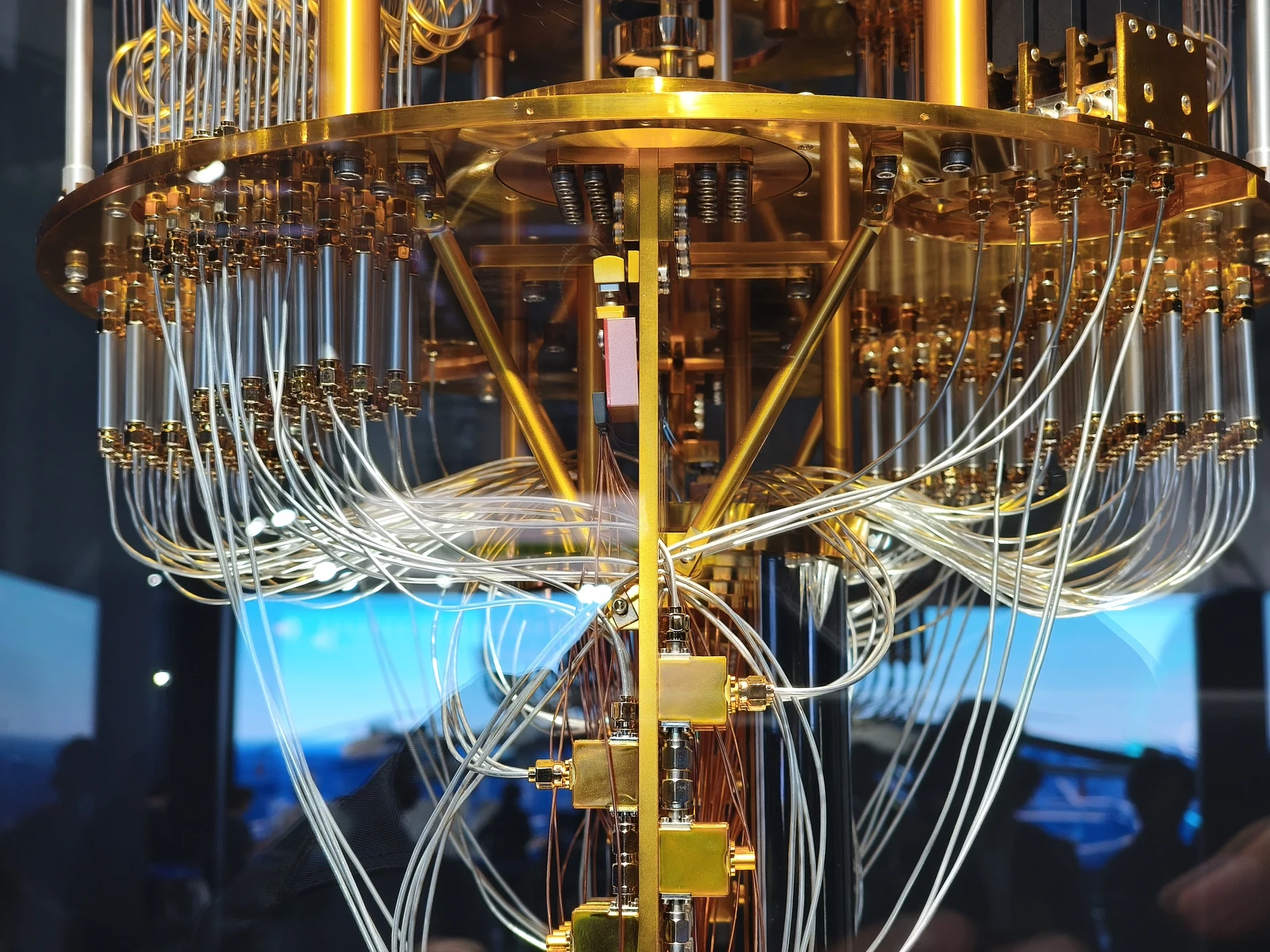
Wiring below a displayed cold stage
The loops and bundles in this view make wiring a visible subject in its own right. A beginner may assume that adding a qubit is simply adding a tiny feature to a chip; the equipment around the chip raises further questions about routing, connections and access. Let the image open those questions without counting lines or declaring that each visible cable corresponds to one qubit. The exhibition source supplies the apparatus context, not a complete wiring diagram. A companion drawing can illustrate a generic signal path and explain why its labels should not be pasted onto this photograph as if they were verified component identities.
- Organization
- Fujitsu
- Image type
- Photograph
- Capture date
- 2025-10-31
- Photographer / creator
- RuinDig/Yuki Uchida
- Reuse terms
- CC BY 4.0
RuinDig/Yuki Uchida — Japan-Mobility-Show-2025-RuinDig 0578.jpg — CC BY 4.0 — https://commons.wikimedia.org/wiki/File:Japan-Mobility-Show-2025-RuinDig_0578.jpg — https://creativecommons.org/licenses/by/4.0.
Full original frame retained; EXIF orientation normalized where present, resized without enlargement and converted to WebP. No crop or content alteration.
Read the image
The loops are visible; their electrical jobs need documentation
Bundles of thin wires loop beneath a circular plate and converge around supports. This lower-stage photograph makes the density of connections easier to appreciate than the full exhibition view. It also makes a useful distinction between tracing a visible path and knowing what travels along it.
In a quantum instrument, connections can carry control signals, readout information, power or other functions. Their routing may reflect mechanical, thermal and electrical requirements. A photograph does not reliably identify those roles by color, thickness or location alone.
Use the loops to introduce interface questions. Where does a connection begin and end? What environment does it cross? How is it supported? What unwanted coupling or heat flow must be managed? These questions explain why wiring is an engineering subject, while keeping the specific answers tied to verified documentation rather than visual guesses.
What can a reader trace directly?
Visible curves and points where wires pass behind structures. Hidden endpoints and the purpose of each line remain uncertain.
Does more wiring imply more working qubits?
No. Connections can serve many functions, and some devices share control paths. A wire count is not a processor benchmark.
Why preserve the wide-view link?
It locates this detail within the Fujitsu exhibition sequence and prevents it from being treated as an unrelated operating-machine photograph.
An independent QubitWire lesson based on this image and the cited source reading. The image does not establish a performance result.
Keep exploring
More from the same organization or hardware architecture.
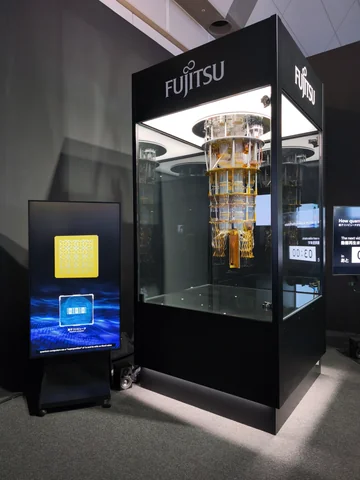 Fujitsu’s quantum-computing exhibition
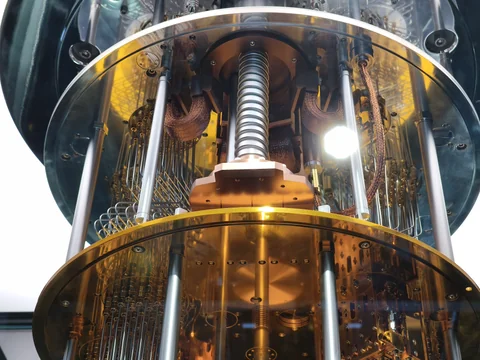 The upper stages of a displayed cryogenic assembly
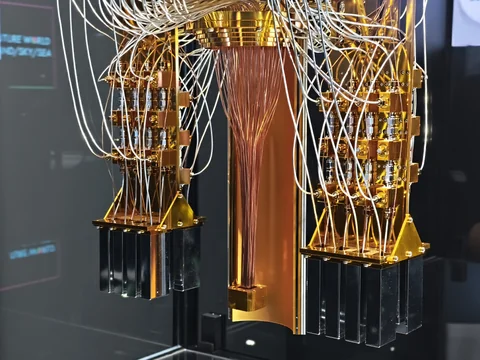 Connections at the bottom of the display
Back to all images · Explore the interactive Model · Image rights and corrections