
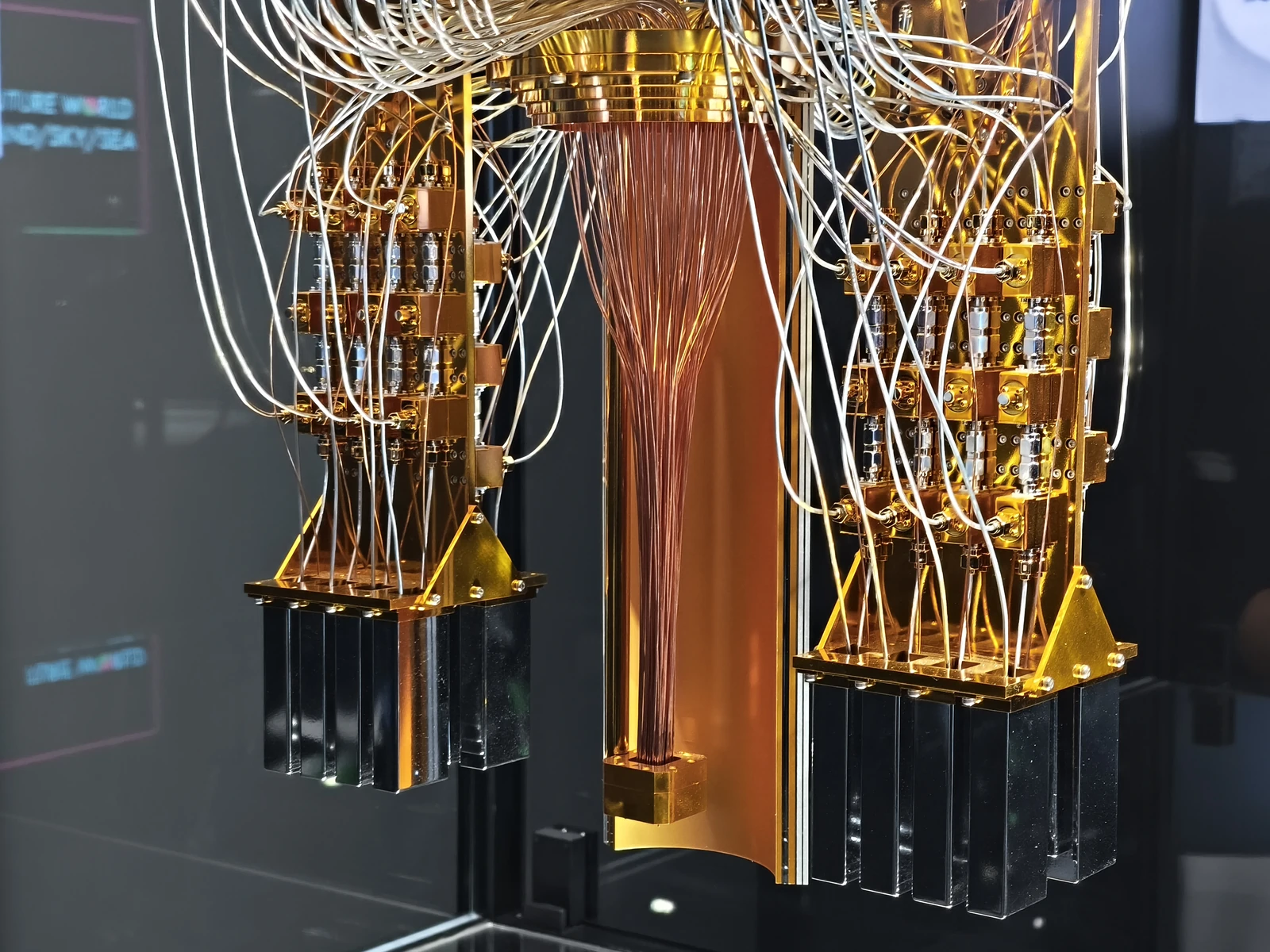
Connections at the bottom of the display
The lowest visible part of an assembly often attracts attention because people expect the processor to be there. This detail is an opportunity to slow down that assumption. The image shows connections and suspended components, but their exact identities should come from documentation rather than visual guesswork. Ask readers to separate three levels of description: the shapes they can see, the functions explained by a generic system diagram and the functions confirmed for this particular exhibit. That habit makes hardware photographs more informative and makes later stories about packaging or control easier to assess. Preserve the original exhibition date beside the image.
- Organization
- Fujitsu
- Image type
- Photograph
- Capture date
- 2025-10-31
- Photographer / creator
- RuinDig/Yuki Uchida
- Reuse terms
- CC BY 4.0
RuinDig/Yuki Uchida — Japan-Mobility-Show-2025-RuinDig 0579.jpg — CC BY 4.0 — https://commons.wikimedia.org/wiki/File:Japan-Mobility-Show-2025-RuinDig_0579.jpg — https://creativecommons.org/licenses/by/4.0.
Full original frame retained; EXIF orientation normalized where present, resized without enlargement and converted to WebP. No crop or content alteration.
Read the image
A lower connection view invites an interface inventory
Thin cables curve around a central post, with dark cylindrical components hanging below. This photograph adds a view of the lower connections in the Fujitsu exhibition assembly. The most useful reading is organizational: several physical paths must fit into a limited region while remaining connected to the larger structure above.
An interface inventory is a simple way to explain that organization. For each documented connection, an engineer would record its endpoints, signal or service, operating conditions and acceptance test. That record lets another person understand how the assembly should behave and how to investigate a fault.
The photograph cannot fill every field in such an inventory, but it makes the need for one intuitive. A crowded region is not necessarily a disorderly one; it may reflect a carefully planned design whose logic becomes clear only when physical routing is paired with documentation.
Why avoid identifying the hanging components by appearance?
Several component types can look similar. An unsupported label would be less informative than a clear description of what is actually visible.
What does an interface record contribute?
It connects a physical path with its intended function and test conditions, supporting assembly, maintenance and later interpretation.
How is this detail different from the wiring-loop view?
It emphasizes endpoints and hanging components lower in the assembly, giving the sequence a new spatial question rather than another near-identical angle.
An independent QubitWire lesson based on this image and the cited source reading. The image does not establish a performance result.
Keep exploring
More from the same organization or hardware architecture.
 Fujitsu’s quantum-computing exhibition
 The upper stages of a displayed cryogenic assembly
 Wiring below a displayed cold stage
Back to all images · Explore the interactive Model · Image rights and corrections