
Explaining quantum noise | Tools for Quantum Advantage | Ep2
Original upload · 16:43
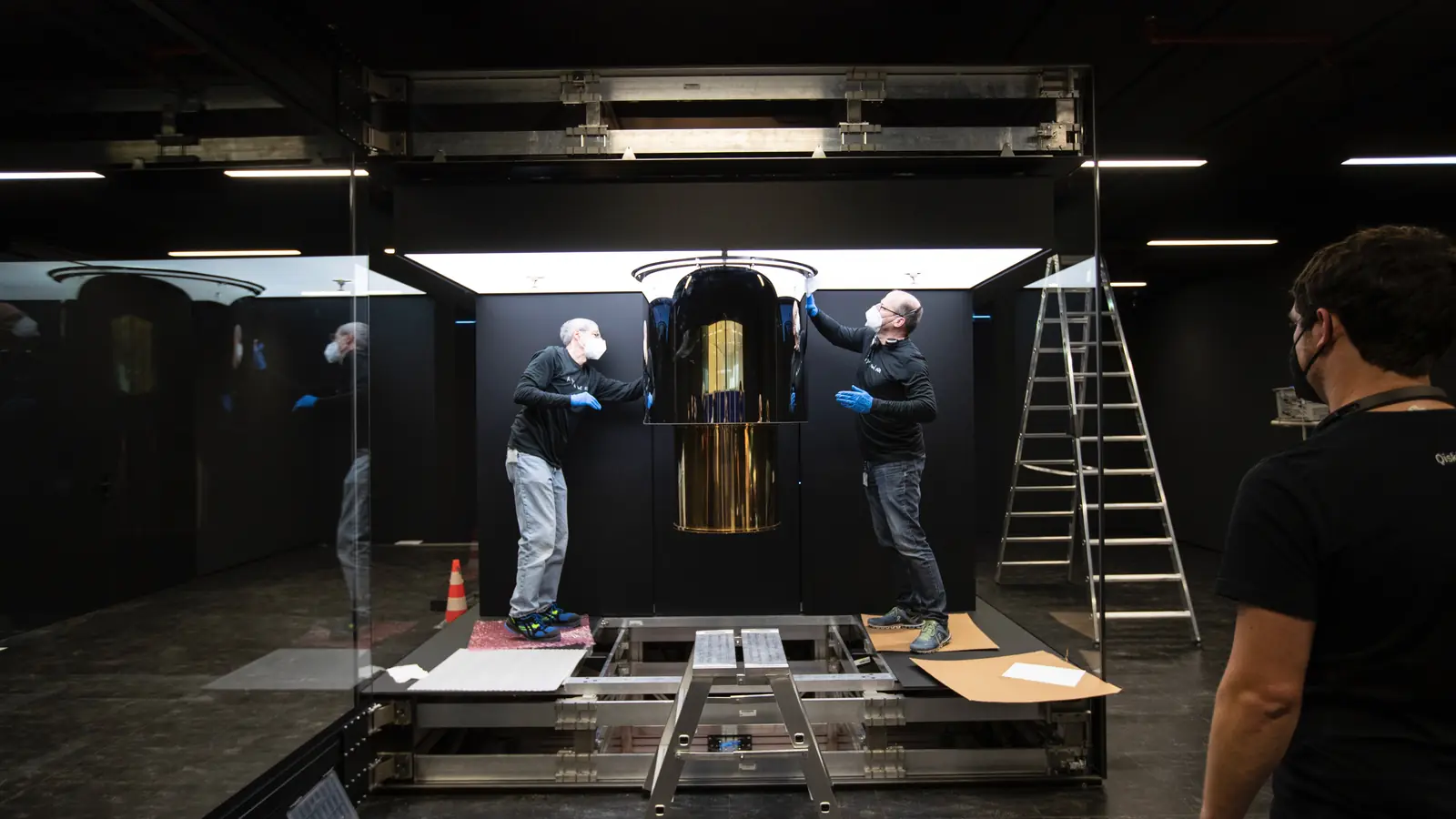 Context photo · Holger Muench / IBM · CC BY 2.0
Engineers install IBM Quantum System One at Fraunhofer. Archival quantum-computing context, not a video frame or the apparatus of another study.
Open on YouTubeBrowse more videosHow privacy choices workPhoto source and licenseQiskit explains two practical ways to manage noise: dynamical decoupling for idle qubits and Pauli twirling to tailor how errors accumulate. The lesson discusses when to use these methods and how they interact with mitigation strategies. It supplies the missing earlier lesson in Tools for Quantum Advantage before the library’s episode on mitigation. Error suppression and noise tailoring improve particular workflows; they do not create fault-tolerant hardware.
Viewing question: What is the error bar telling you?
Use these statistical questions alongside a discussion of quantum noise. If a result has error bars, first find their definition: do they describe sampling, variation between runs or another uncertainty model?
A narrow interval can still miss a persistent measurement bias. More independent observations can reduce sampling uncertainty without repairing that bias. Ask which effects the uncertainty calculation includes. These questions do not assume that this recording contains a particular chart.
- What outcome is being counted or estimated?
- Which uncertainty does the interval represent?
- Which systematic effects remain outside it?
Original QubitWire viewing questions. Source reading:
- Confidence intervals for a binomial proportion ↗ — NIST Engineering Statistics Handbook.
Binomial-proportion intervals and the role of sample size; relevant to appropriately modelled counts.
Handbook reference; publication date not stated. - Uncertainty analysis — approach ↗ — NIST Engineering Statistics Handbook.
Distinguishes measurement uncertainty, precision and bias, and accounts for random and systematic contributions.
Handbook reference; publication date not stated.
Video by Qiskit. Added to QubitWire .