
How 256 atoms gave a classical calculation a head start
Researchers used records from a 256-atom experiment to help a classical calculation converge. The biggest gains came when the software had the weakest starting guess.
Reading tools for text size, copying, printing and your reading list
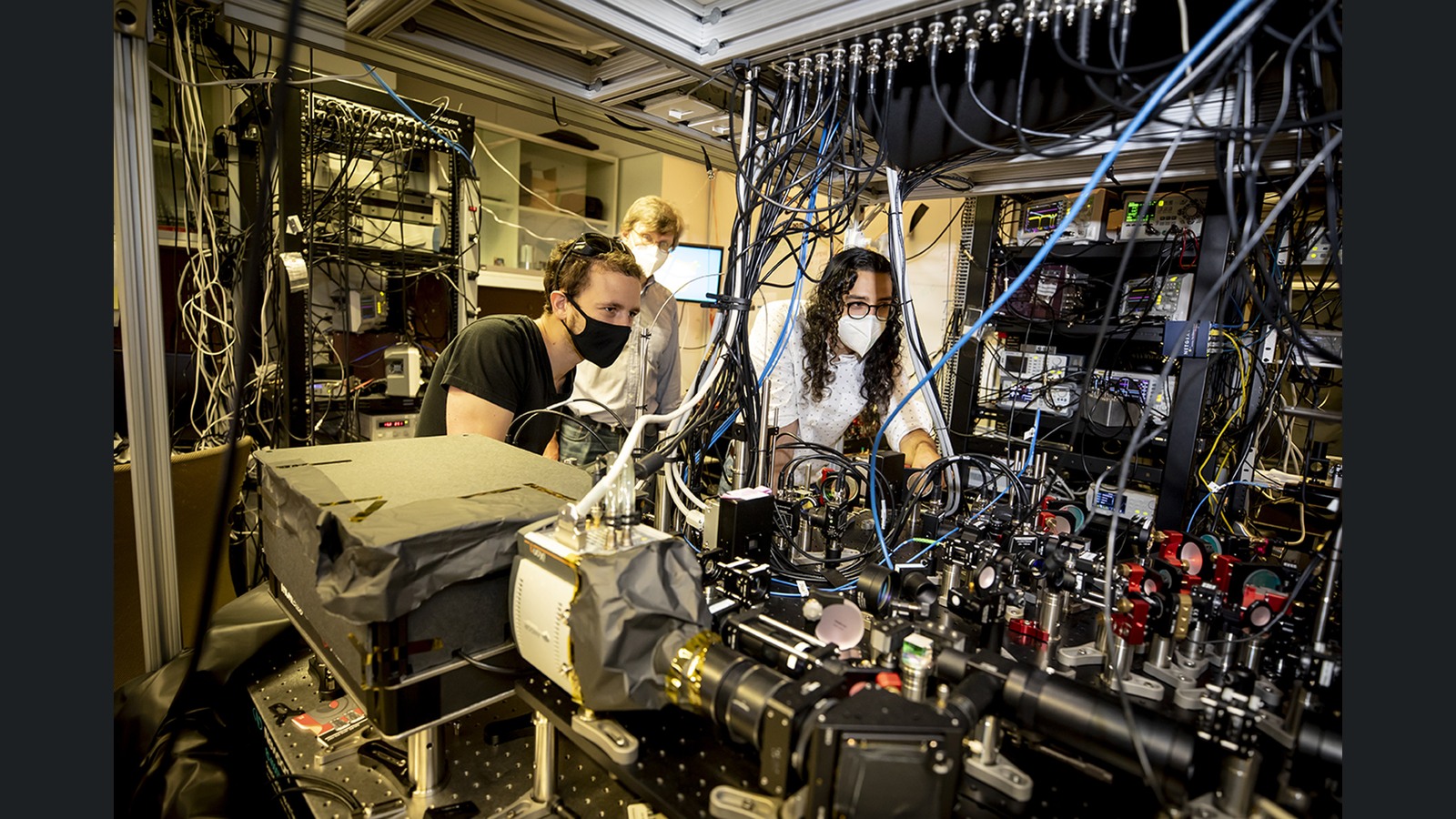
A quantum experiment doesn't have to get the final answer to be useful. In a November 25 preprint, V. Imchitr and colleagues used measurements from an earlier experiment with 256 rubidium atoms to help a classical simulation estimate the energy of its lowest-energy state. The measurements gave the software a better starting guess. The calculation then refined that guess on conventional computers, without needing to go back to the quantum machine for another round of measurements.[1][2]
What the atoms contributed
The original experiment lined up rubidium atoms in a 16-by-16 grid using lasers as tweezers. By adjusting the lasers, the experimental team could push the array toward a regime where excited atoms tend to sit on alternating sites, like squares of one color on a checkerboard. Fluorescence measurements gave the researchers snapshots of which sites had atoms in particular states at the end of a sweep. The new study pooled 4,000 measured configurations per setting from seven sweep rates. Rotating those patterns made a larger training set, but it did not create more independent measurements.[1][2][3]
Earlier work had used these records with a different kind of Monte Carlo calculation. This team asked whether they could also improve a method that refines its starting guess as it runs. The new team trained a model on those records to recognize which configurations were worth paying attention to. Then a classical method called projective quantum Monte Carlo adjusted the estimate. It uses many simulated samples, or walkers, to explore the configurations and gradually suppress contributions from states above the lowest-energy one. The experimental patterns could be imperfect and still steer the walkers toward useful parts of the search.[1][2]
The weaker software model gained more
Near the transition to checkerboard order, the team compared two types of model with and without the experimental head start. A restricted Boltzmann machine, the weaker of the two guides in this benchmark, got closer to the classical reference with fewer walkers when trained on atom data first. A recurrent neural network already did better without the data than the other model did with it. The snapshots still helped the recurrent network, but by less. That comparison matters: improving a classical algorithm can sometimes make more difference than feeding it quantum measurements.[1]
The advantage was also largest early in the calculation. With a fixed population of 4,096 walkers in one comparison, the version trained on measurements started closer to the reference energy and improved more quickly. The version that started from a random model eventually approached it as it learned from its own simulated samples. The measurement records saved effort getting to a good answer; they weren't the final answer.[1]
Where the result stops
The team tested models of one kind of atom array that a classical method can already simulate. It did not show that collecting the quantum measurements and doing the calculation beats the best classical alternative end to end. Tests on smaller grids used crops of the original 16-by-16 measurement records, not separate experiments on those sizes. The next useful benchmark is one that counts the cost of producing the measurements as well as using them and asks whether the same head start survives against a stronger classical baseline.[1]
Keep your reading trail
Keep up with these topics
Explore the subjects covered in this story.