
Two clouds of atoms helped a sensor keep its place
A rubidium experiment tracked a large, vibration-like shift through 5,000 readings without a separate motion sensor.
Reading tools for text size, copying, printing and your reading list
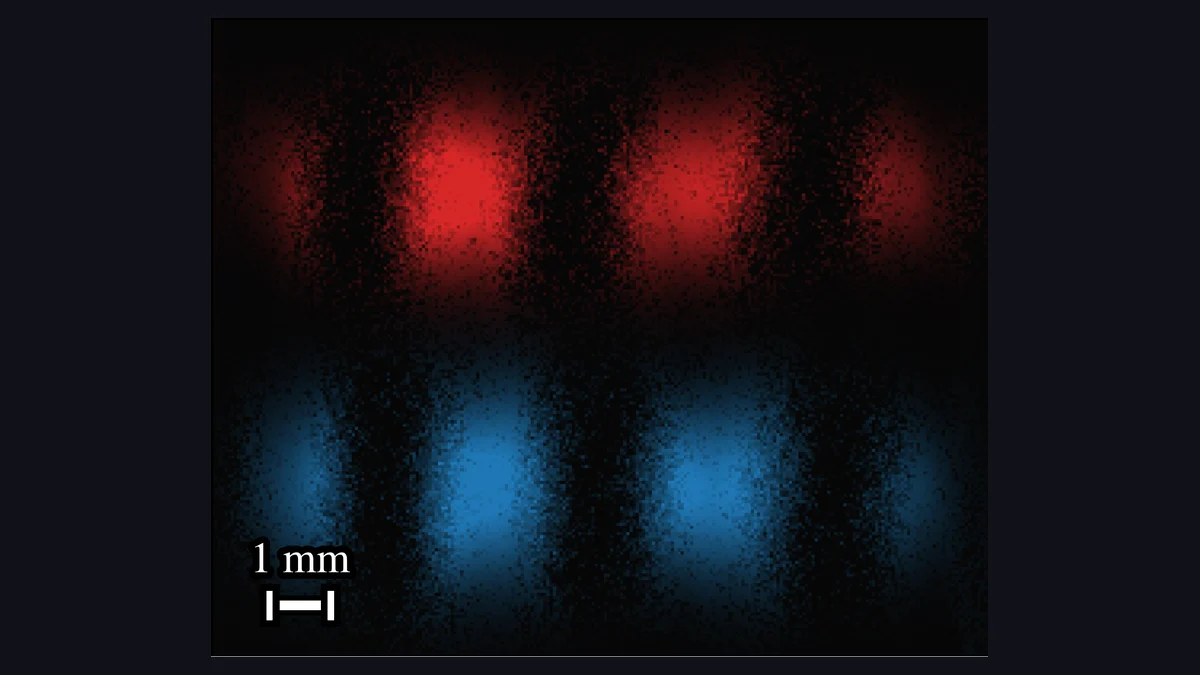
A sensitive instrument can lose its place when the disturbance it measures grows too large. Researchers in Wuhan found a way to keep track without adding a separate accelerometer. In a laboratory experiment using two clouds of the same rubidium isotope, their method tracked a large shared shift that mimicked vibration, then estimated the difference between the clouds’ accelerations. arXiv listed the preprint on November 20.[1]
The problem is familiar if you’ve ever looked at a clock without knowing whether it’s morning or evening. The same face repeats every 12 hours. An atom interferometer also produces a repeating pattern. Its pattern moves when acceleration changes, but once it wraps around, one reading alone can leave several possible answers. With two sensors, the researchers can compare patterns that repeat at slightly different rates and use the recent history of readings to help pick the right match.
Two clouds, one camera
In the experiment, laser pulses sent the atoms in each cloud along paths whose quantum waves later recombined. Where the waves reinforced or cancelled one another, they left bands in an image. A single camera frame captured the patterns from both clouds. Using the same isotope allowed the team to prepare and detect both clouds in much the same way while making their signals respond by different amounts.[1]
Instead of shaking the instrument, the researchers swept the laser settings to create a large phase shift equivalent to the same acceleration change for both clouds. The method followed that controlled sweep through 5,000 readings. At an averaging interval of 997 shots, their repeatability metric (Allan deviation) was about 15 billionths of standard gravity. The team didn’t inject a known acceleration difference to see how accurately the method could recover it.[1]
What this experiment adds
Some of the same authors reported a way to read a single atom interferometer’s phase in 2023. Other groups have used related fringe methods to extend a sensor’s measurement range and Bayesian methods to compare rubidium and potassium sensors. The Wuhan team combined the repeating moiré pattern with each reading’s recent history in a controlled test. Its two clouds were made from the same isotope but had different responses to the same change.[2][3][5][1]
The work could help researchers design a more demanding comparison: checking whether atoms of different elements fall at the same rate. Earlier groups have made that comparison with rubidium and potassium. Here, the team used rubidium for both clouds to test the method under controlled conditions. It did not conduct a new test of the law of free fall; its results for random vibrations, drift and a known differential input came from simulations.[4][1]
The next test is to repeat the result with two different elements, then see how well it holds up under measured vibrations rather than a prescribed sweep. That’s a different challenge from using gravity readings to help a ship navigate or from NASA’s planned gravity mission, but it gets at the same problem: keeping track of a large disturbance while estimating a smaller difference.