
One extra measurement cut this qubit’s average gate error in half
A superconducting qubit kept jumping between two frequencies. Checking which one was active let a controller retune the next set of operations.
Reading tools for text size, copying, printing and your reading list
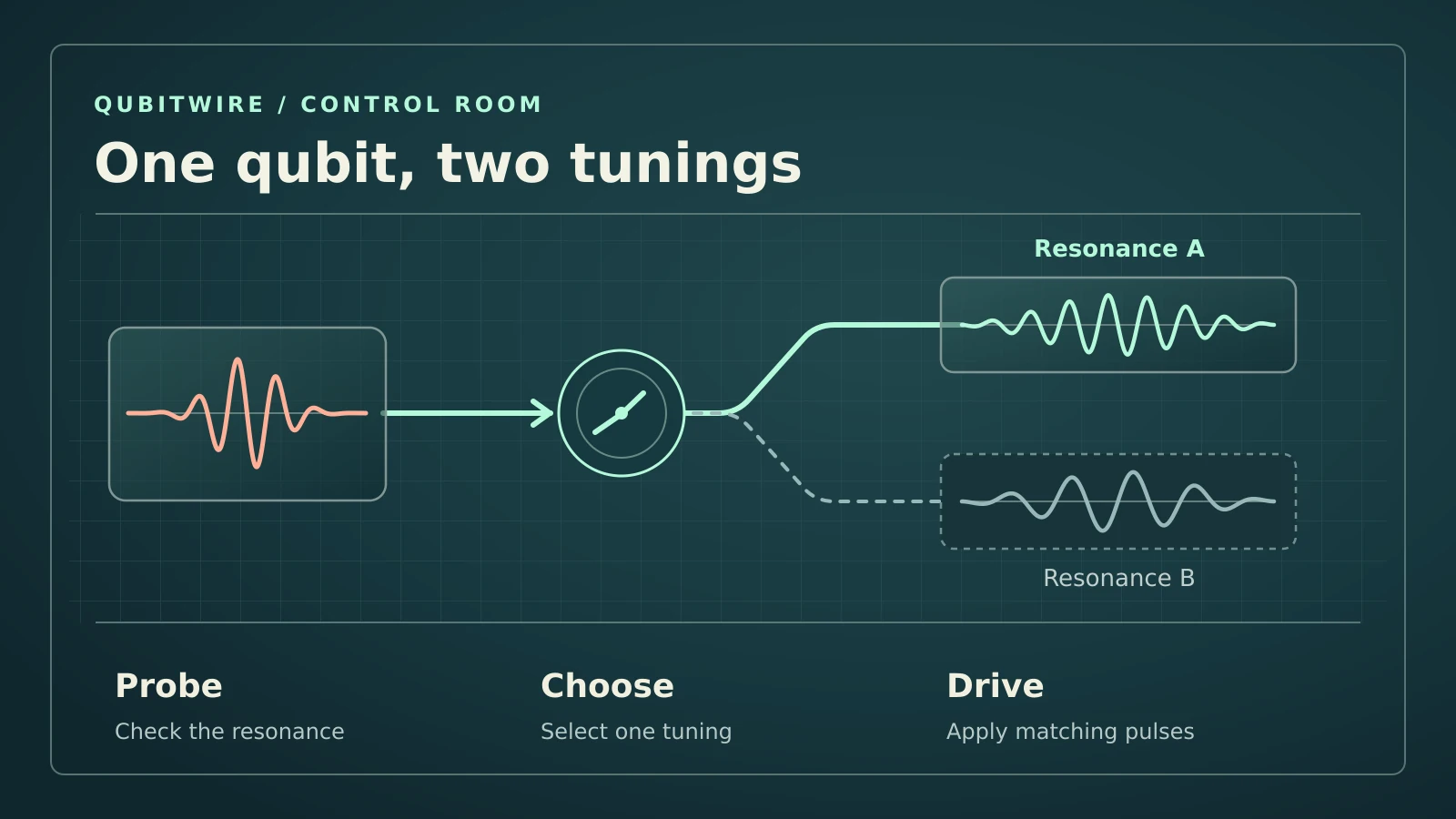
The microwave pulse worked until the qubit changed its tune. On a superconducting chip at the Israeli Quantum Computing Center, one qubit would jump between two familiar resonances. A signal set for one frequency could miss the other. Fabrizio Berritta and colleagues gave the electronics a way to ask which frequency to use just before a sequence of operations. On this qubit, that check more than halved the average gate error.[1][2][3]
Which frequency is the qubit listening to?
A gate is an instruction carried out by a pulse. For a pulse to turn the qubit by the intended amount and in the intended direction, the two must keep time. The researchers suspect a microscopic defect near the circuit periodically shifted its resonance. Imagine a radio station that moves between two known frequencies. Finding it again is a much smaller job than sweeping the whole dial.[1][3]
The team prepared the qubit for a brief test before running the gates. The two resonances produce different outcomes in that test, so one measurement gave a programmable controller enough information to pick a frequency. Both resonance settings can support quantum information. The bit that goes back to the electronics tells it how to drive the device.[1][3]
The probe finds resonance A. What happens next?
Open either case to follow the same pulse from the check to the gate.
The qubit stays at A
The electronics choose drive A. When the gate begins, its pulse matches the qubit’s tuning.
The qubit switches to B
The electronics still choose drive A. The check was right when it happened, but the gate now receives an off-frequency pulse.
Why the paper reports two different improvements
For about 14 minutes the team ran sequences of randomly chosen gates in pairs. The same sequence ran once at a fixed control frequency and once with feedback. By watching how performance changed as sequences grew longer, the team could estimate how far a typical physical gate strayed from its target.[3]
Across the run, estimated gate error averaged 0.14% with the fixed setting and 0.065% with feedback. That is a drop of 0.075 percentage points, or about 54% relative to the original average.[1][2][3]
The journal abstract’s 77% figure answers a different question. The authors’ public manuscript compares the largest error seen with the fixed setting, about 0.28%, with the stabilized level of about 0.065%.[1][3]
How long is the answer good for?
Here the qubit typically held its tuning for tens of seconds. Reading the probe took about two microseconds, followed by roughly six for the readout resonator to reset, according to the May manuscript. That leaves plenty of time in this particular device. A faster switch could make the answer stale before the next gate starts. Applying the same check to several qubits would also mean finding time for their measurements.[3]
That distinction matters for anyone designing a processor. A gate can look unreliable because the device itself loses information, or because the electronics have kept sending yesterday’s perfectly good instruction. This experiment shows how much of the second problem can be recovered on one . A protected across many devices, or an application that finishes with fewer errors, requires a separate test.[1][3]