
Cold atoms mimicked a particle turning into a matter–antimatter pair
A laser-trapped rubidium experiment watched one kind of simulated particle turn into a particle–antiparticle pair, then turn back. The atoms were stand-ins, not newly made antimatter.
Reading tools for text size, copying, printing and your reading list
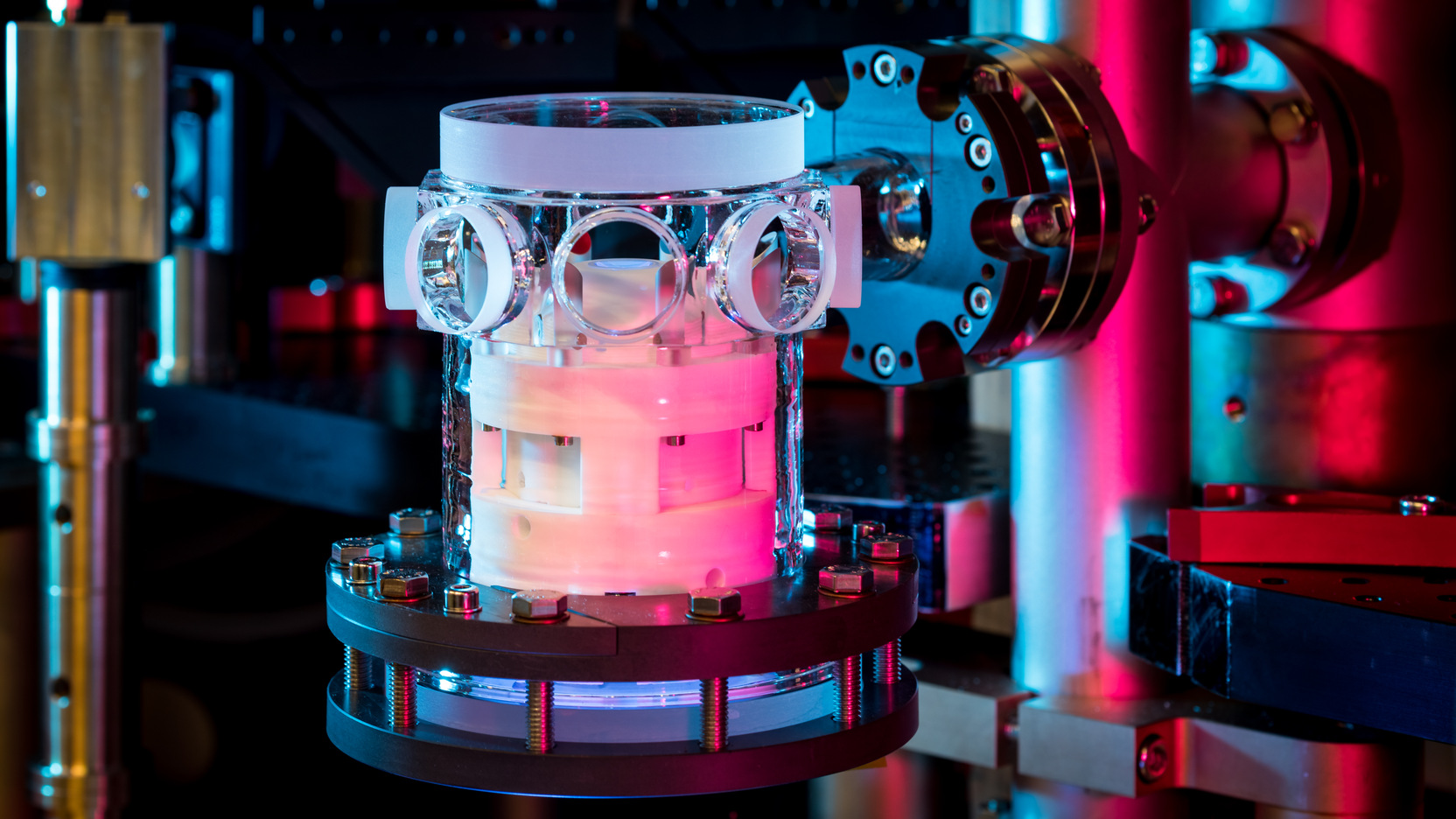
Physicists in Hefei set rows of ultracold rubidium atoms in motion and watched patterns form, fade and return. Those patterns represented a switch between two kinds of particles bound by the strong force. The rubidium did not turn into nuclear matter. Instead, the researchers built a small quantum model whose atoms followed a simplified set of rules for how matter and its force field can change together.[1]
The strong force binds quarks inside particles called hadrons. A proton is a baryon, the familiar kind of hadron built from three quarks. A meson contains a quark and an antiquark. Keeping track of how such particles and their force fields evolve together is hard in computer simulations, especially as time passes. A laboratory model offers another way in: build something more tractable that follows a deliberately chosen set of similar rules, let it evolve and measure what happens.[1]
How rubidium became a stand-in
The team used intersecting laser beams to make an optical lattice, a grid of places where rubidium atoms could sit. The atoms occupied parallel rows, typically about 20 sites long, with about 230 atoms total in the reported mass-ramp experiment. Two internal states of the same rubidium isotope acted as labels. An unlike pair on neighboring sites could represent a meson. When an atom hopped and shared its neighbor’s site, the resulting arrangement could represent a baryon–antibaryon pair or a vacuum configuration, depending on which site held the pair.[1]
The researchers separated the two atomic states into neighboring readout rows and took fluorescence images. This let them infer which state was on each site rather than measuring only the average across the whole cloud. The microscope was photographing rubidium. The team inferred the simulated particles from the resulting pattern, using the model’s rules.[1][3]
The pattern did not just disappear
When the starting meson pattern and the baryon–antibaryon pattern were close in energy, the meson population dropped and the paired population rose. Then mesons reappeared, including on bonds shifted by one lattice site. Under the study’s reference conditions, the first fitted peak in pair production, normalized to the starting meson population, was about 64% with no initial baryon imbalance. In a group with an excess of simulated antibaryons, it was about 52%. Those percentages measure the model’s response, not the fraction of rubidium transformed into other elements or particles.[1]
The same group’s earlier optical-lattice experiment modeled a simpler kind of gauge field, the mathematical structure that links matter and a force. The new setup follows a model with noncommuting symmetry operations, meaning their order can matter. That gives the experiment more of the structure that makes the strong force interesting, while still leaving it a one-dimensional, restricted model.[1][2]
The work is a preprint, not yet peer reviewed. Its value is that an experiment could track how the meson pattern reappeared one site over and test how that behavior changed with the starting conditions. The researchers also compared the measured dynamics with calculations on short chains. They did not reproduce the full three-dimensional strong force, demonstrate a computational speedup or produce real baryons and antibaryons in the lab.[1]