
A tiny fiber cavity made photons less likely to arrive in pairs
A semiconductor experiment found that the dip in photon coincidences held even when researchers nudged the laser frequency in either direction.
Reading tools for text size, copying, printing and your reading list
A steady laser ordinarily sends photons through a detector at random intervals. In an experiment published November 25 in Physical Review Letters, Gian-Marco Schnüriger and colleagues found a way to make close pairs less common. They sent laser light through a tiny cavity containing a semiconductor and watched when the outgoing photons arrived. With the cavity tuned to one particular setting, the dip in coincidences held even as the laser was shifted above or below the frequency of the light-matter resonance.[1][2]
The peer-reviewed paper follows a March preprint. The striking part is what the researchers think caused the effect. A short-lived state that comes into play when there are two excitations can make it harder for the second one to build up. The setup uses loss selectively: a single excitation does not have access to the same route.[1][2]
How the researchers tested for pairs
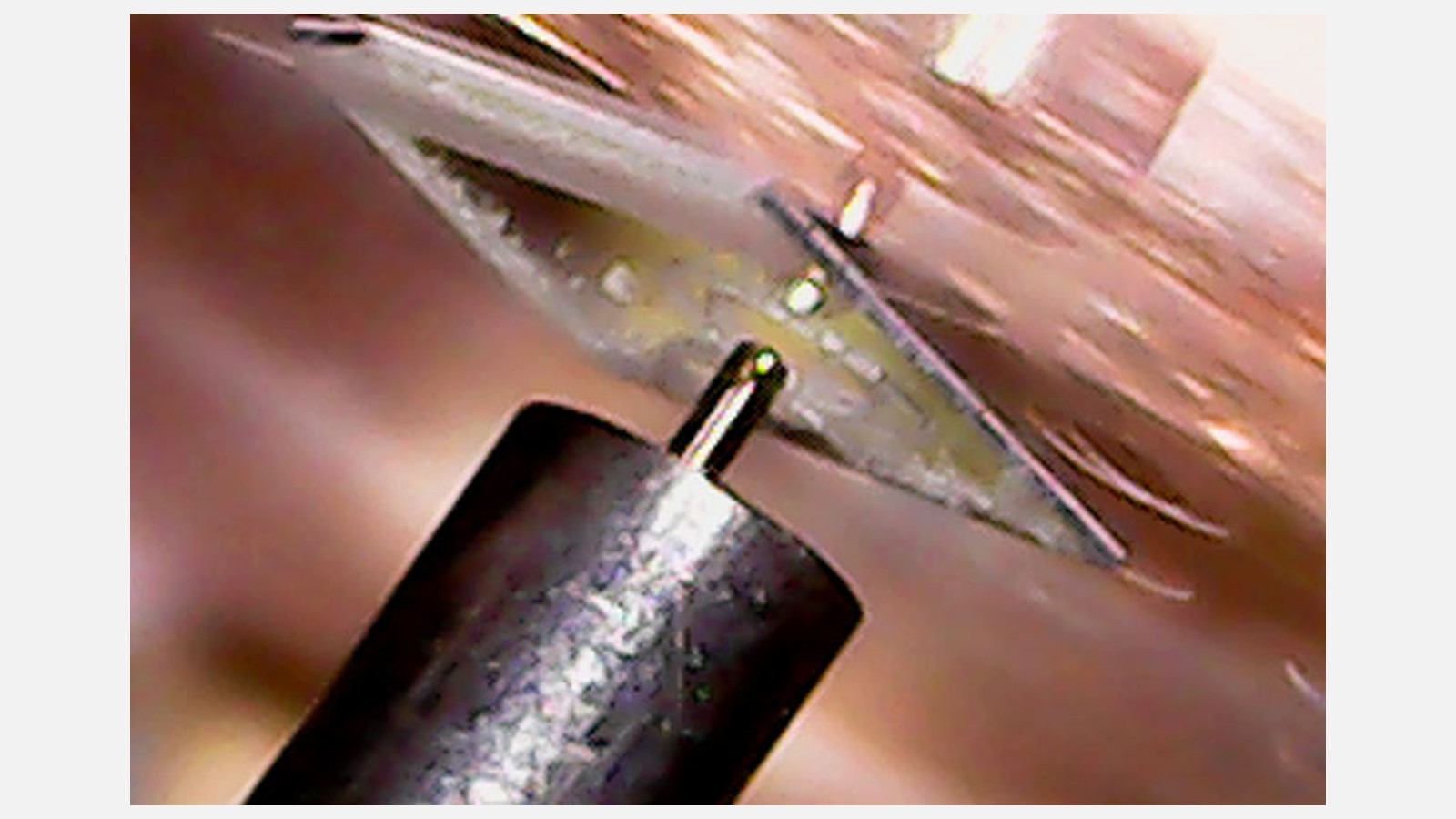
The team placed two thin semiconductor layers, known as quantum wells, between highly reflective mirrors. One mirror was formed on the end of an optical fiber. Inside the cavity, light mixes with an exciton, a bound pair of an electron and the mobile vacancy left by an electron. The resulting light-matter excitation is called a polariton. Changing the spacing between the mirrors changes how much of that excitation behaves like light and how much behaves like an exciton.[1][2]
The researchers timed individual photons coming out of the cavity. The March manuscript reports a lowest normalized coincidence value of about 0.92. A value of 1 would mean arrivals are uncorrelated; below 1 means photons tend to arrive separately at very short delays. The number describes a dip in coincidences, not the percentage of light delivered as single photons.[2]
At a setting where the polariton behaved more like an exciton, small changes in laser frequency could flip the result from fewer near-simultaneous arrivals to more. At a different cavity setting, the dip persisted on both sides of the resonance over the range tested. That contrast is what led the team to look beyond the usual explanation based on how polaritons shift one another's energies.[1][2]
Why a little loss could help
The authors' model puts the persistent dip near a resonance with a biexciton, a short-lived state made from two excitons. When two polaritons have the right combined energy, they can couple to that state. Its rapid decay blurs the two-excitation resonance, reducing the chance that the same laser drives both excitations. The team measured how the coincidence pattern changed with tuning; the selective-loss mechanism is their explanation for that pattern.[1][2]
For experiments that need control over individual photons, keeping light around long enough to interact remains a bottleneck. The authors estimate that a roughly tenfold reduction in the polariton decay rate would be needed to reach strong blockade, where a second excitation is much harder to create. The result identifies a way to suppress pairs in a semiconductor cavity, but it does not yet demonstrate strong blockade or a source that reliably delivers one photon at a time.[1][2]