
A flake thinner than a wavelength made pairs of entangled photons
Researchers used the symmetry of a semiconductor to generate and tune a two-photon quantum state at the source, without a separate interferometer to prepare it.
Reading tools for text size, copying, printing and your reading list
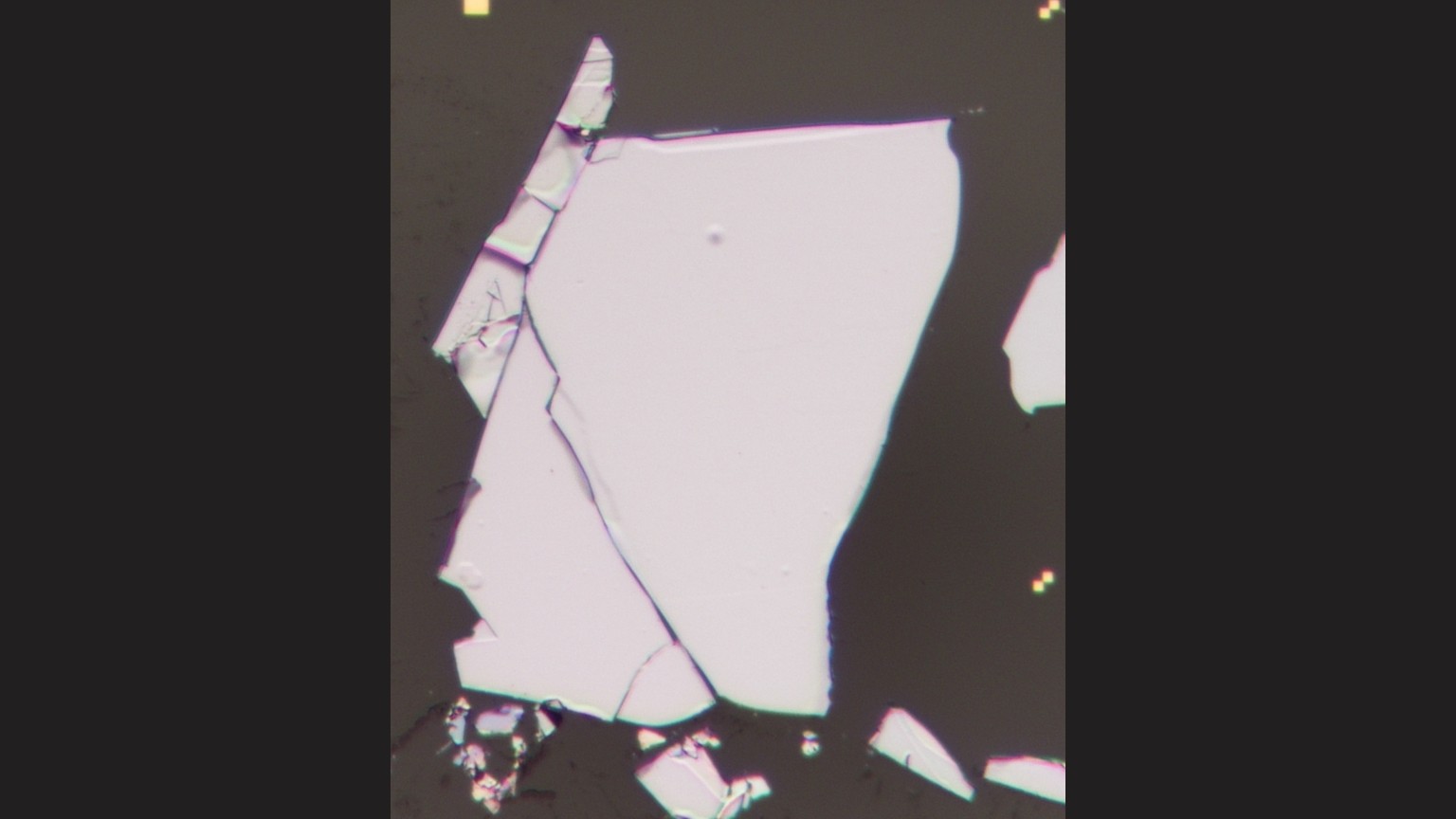
A laser aimed at a 285-nanometer flake of molybdenum disulfide produced pairs of photons in a quantum state that usually takes several optical components to prepare. In a new lab experiment, rotating the incoming light’s polarization changed the orientation of the pairs’ quantum state. The flake itself did the work of preparing the state; researchers used separate optics afterward to check what it had made.[1][2]
The report from researchers at the University of Vienna and collaborating institutions appeared in arXiv’s November 26 release. It is a preprint, not a peer-reviewed paper. Its result is about simplifying one stage in making special light for experiments, not about a finished quantum sensor or the elimination of all laboratory optics.[1][3]
What the flake does
Polarization describes the orientation of a light wave’s electric field. An ordinary experiment can record two photons with the same polarization just by chance. Here, the team made a pair in a superposition: in one measurement basis the photons could both register as horizontal or both as vertical, with a consistent quantum relationship between those alternatives. The same detection counts could come from an ordinary mixture, so the team checked for the interference that distinguishes the quantum pair. This kind of two-photon state is one example of what physicists call a N00N state.[1]
The flake is made of a form of molybdenum disulfide whose layers follow a repeating stacking pattern. It sometimes converts an incoming photon into two lower-energy photons. The crystal’s symmetry lets different ways of making that pair add together coherently. Rotating the incoming laser’s polarization then turns the orientation of the output state rather than requiring the researchers to rebuild the source. They checked this by reconstructing the state for ten laser settings and comparing it with the expected result.[1][2]
A cleaner source, not yet a better sensor
Across those settings, the reconstructed pairs agreed with the intended quantum state at an average fidelity of 95%, a measure of resemblance rather than the percentage of laser photons converted. In another test the paired photons produced interference fringes that changed twice as fast as a single-photon fringe as the researchers rotated the analyzing optics. That gives the experiment a finer signal pattern. It does not show that the complete setup measures a real-world signal more precisely than an ordinary instrument after failed and lost detections are counted.[1]
The next challenge is getting more usable pairs out. The source produced about ten detected pairs per second per milliwatt of input power in the reported brightness test, after subtracting accidental coincidences. Higher photon numbers were a theoretical extension, not part of the demonstration. The achievement is that the material can prepare the state directly. If the team can make the source brighter without losing that control, it could simplify experiments that depend on carefully prepared pairs of light particles.[1]