
A fluorine coating made tiny diamond sensors shine brighter
Researchers made nanodiamonds shine more brightly and used their quantum defects to detect changes in the concentration of a dissolved gadolinium compound.
Reading tools for text size, copying, printing and your reading list
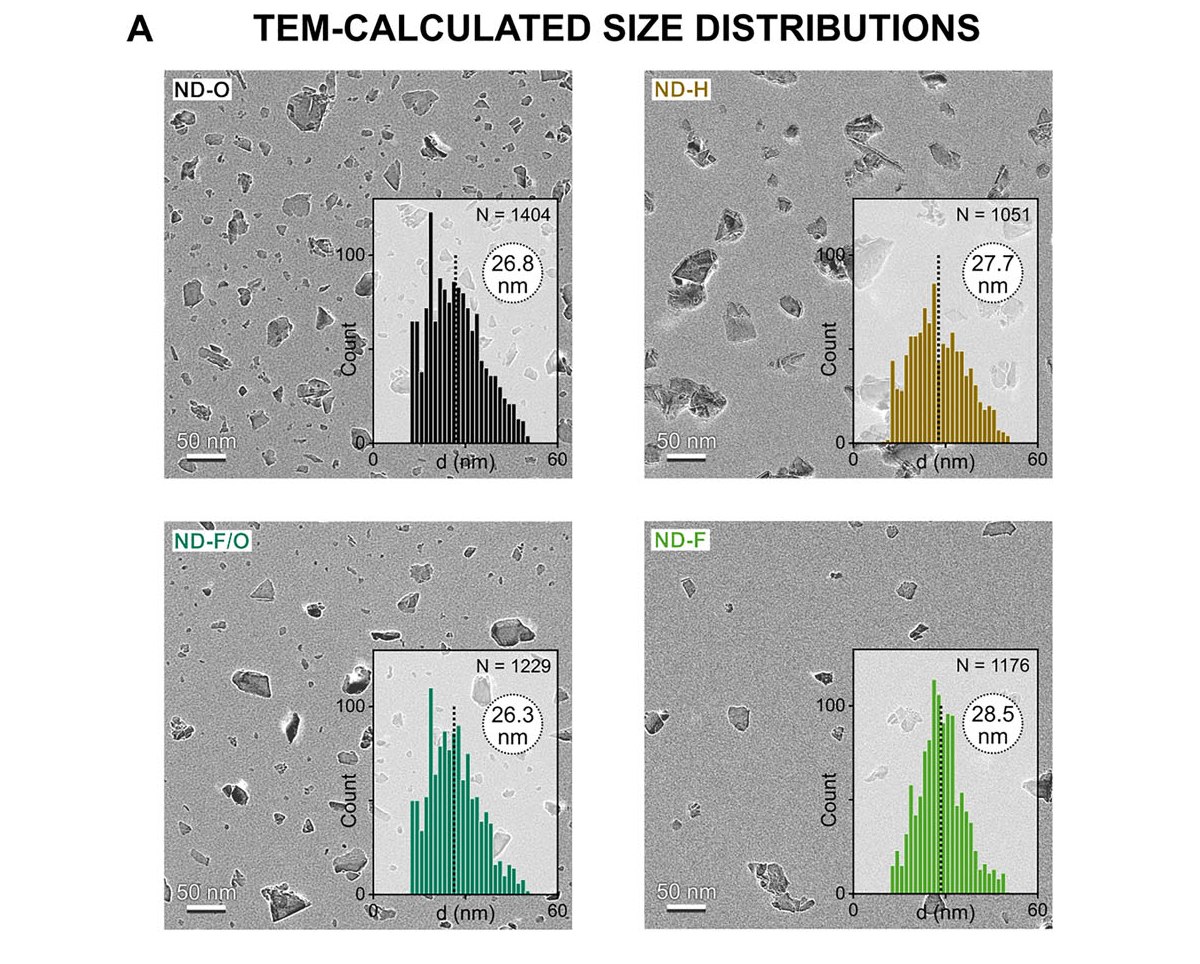
A nanodiamond can be small enough to get close to a molecule and still contain a quantum sensor. But at that scale, the surface can change what the sensor sees, or make it go dark. In a study published November 26 in Advanced Science, researchers added a fluorine-rich surface to diamond particles about 28 nanometers across. The treated particles were brighter than the oxidized comparison particles, and the team used them to detect changes in the concentration of a gadolinium compound dissolved in water.[1][2]
The useful defect sits close to the surface
The sensor is a nitrogen atom next to a missing carbon atom in the diamond lattice. That pair is called a nitrogen-vacancy center. In its negatively charged form, the defect gives researchers a way to use light to read out its spin, a quantum property that responds to nearby magnetic activity. Putting the defect near the particle’s surface brings it closer to whatever researchers want to measure. The trade-off is that chemistry at the surface can change the defect’s charge or make the measurement less reliable.[1]
The researchers compared several surface treatments on similar particles. In one analysis of thin layers of particles, the estimated share of defects in the useful negative charge state was about 94% after the strongest fluorine treatment, compared with about 57% for oxidized particles. In separate measurements of individual particles, the fluorinated particles were up to 2.3 times as bright. Those are two different results: the first describes the charge states of defects, and the second describes the amount of light the instrument collected. Neither number is a measurement of sensitivity in a living cell.[1]
What moved the signal in water
For the water test, the team used gadoteridol, a compound that holds a gadolinium ion inside a larger, electrically neutral molecule. A nearby gadolinium ion generates magnetic fluctuations that can shorten the time a prepared diamond spin takes to relax. As the concentration increased, the spins relaxed faster. Using the bound form of gadolinium helped reduce a source of confusion: free ions can stick to the diamond and make the signal reflect what coats the particle rather than what is in the surrounding water.[1]
The fully fluorinated and oxidized particles showed similar sensitivity in this water test; a surface with a mix of fluorine and oxygen did slightly better. The main advantage the authors identify for the fluorinated particles is a brighter readout, not a dramatically lower detection limit. This was a controlled experiment with a known compound, not a general-purpose water test or a medical diagnostic. A harder test would ask whether the particles can still distinguish changes in concentration in a mixture containing other molecules. The authors also note a practical challenge: adding groups that target particular molecules without giving up the fluorine-rich surface that kept the quantum defects working.[1]