
A quantum networking experiment put a third party in the loop
The experiment switched optical settings at 20 MHz. That is the control clock, not the rate at which the participants established secrets.
Reading tools for text size, copying, printing and your reading list
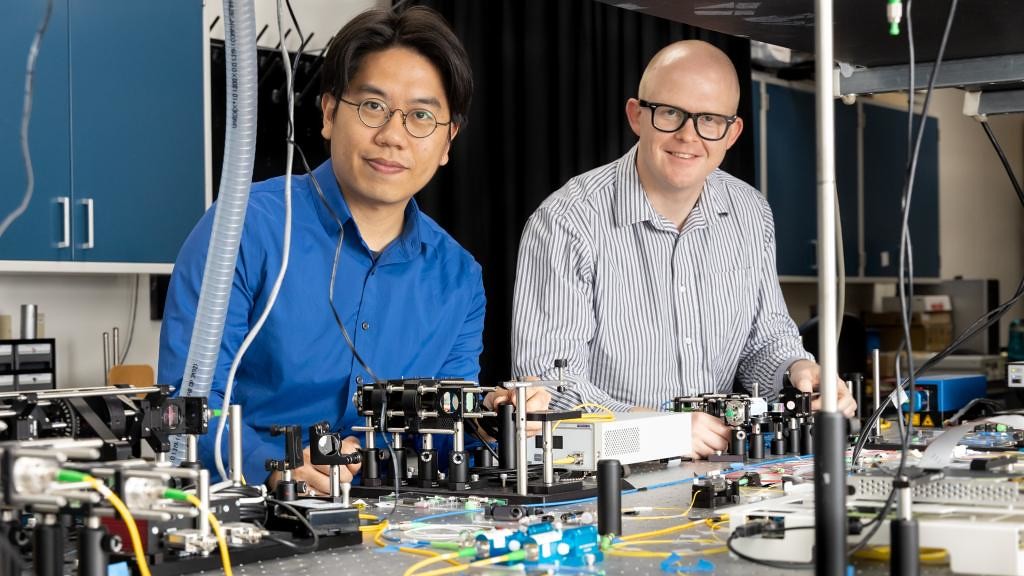
Two people can each receive a piece of information that is useless on its own, yet meaningful when they compare notes. Researchers led by Chen-You Su tested a quantum version of that idea using two photons and a third participant who prepares them. The lab experiment encoded information in distinct frequencies of light and changed its optical settings at 20 million setting intervals per second. That number is the speed of the settings, not the speed at which the participants established secrets.[1]
Two photons, three roles
In the experiment, one participant prepares a pair of entangled photons, and the other two each receive one. The experiment uses frequency bins: narrow, distinguishable slices of the light spectrum. Quantum states can span more than one such slice. By choosing how they measure the incoming photons, the two receivers can obtain results that are related to one another and to a bit chosen at the source. For the right combinations of settings, it is the relationship between the two results, rather than either receiver's result alone, that carries the bit.[1]
The use of two photons matters because the arrangement does not require each of the three parties to receive a separate photon. The party at the source already has a role in preparing the state. This is a way to test cooperation among the three parties, not a test of a larger network with multiple independent senders and receivers.[1]
What switched at 20 MHz
To test whether the correlations survived rapid reconfiguration, the team changed the preparation and measurement settings in patterned and pseudorandom sequences. At 20 MHz, a new setting can be selected every 50 nanoseconds. In the selected correlated cases with brief windows around switching transitions excluded, the authors report correlation contrast of at least 0.91 and a bit-error rate of at most 4.5%. Counting events around transitions raised the worst reported error to about 6.4%. The second figure matters because it shows what changes when the system keeps readings that were excluded from the first comparison.[1]
The preprint does not show 20 million detected photon pairs per second, or 20 million usable secret bits. Selecting a setting and detecting a photon pair are separate steps. Turning those detections into useful secret information would also require comparing compatible settings and processing the surviving data. The three stations in this test shared a frequency and phase reference. The authors discuss what distributed operation would need, rather than showing that the same setup works between independent sites.[1]
The distinction is easy to miss in announcements about quantum networking. A fast control clock shows how quickly hardware can ask a different question of light. A useful communication link is limited by how often the answers arrive, survive noise and loss, and can be used by the parties. This experiment advances the first part and measures correlations under those conditions. It does not establish the final speed or security of a deployed service.[1]