Google’s Quantum Echoes Has a Bigger Story Than Speed
The 13,000× benchmark estimate grabs attention. A result another quantum computer could check is the more useful idea.

The striking claim was speed. The more interesting question is whether someone else can check the answer.
Google’s Quantum Echoes research, announced in October 2025, offers a different kind of quantum benchmark. Instead of producing a huge collection of hard-to-reproduce samples, the algorithm measures a repeatable physical quantity: a quantum echo.[1]
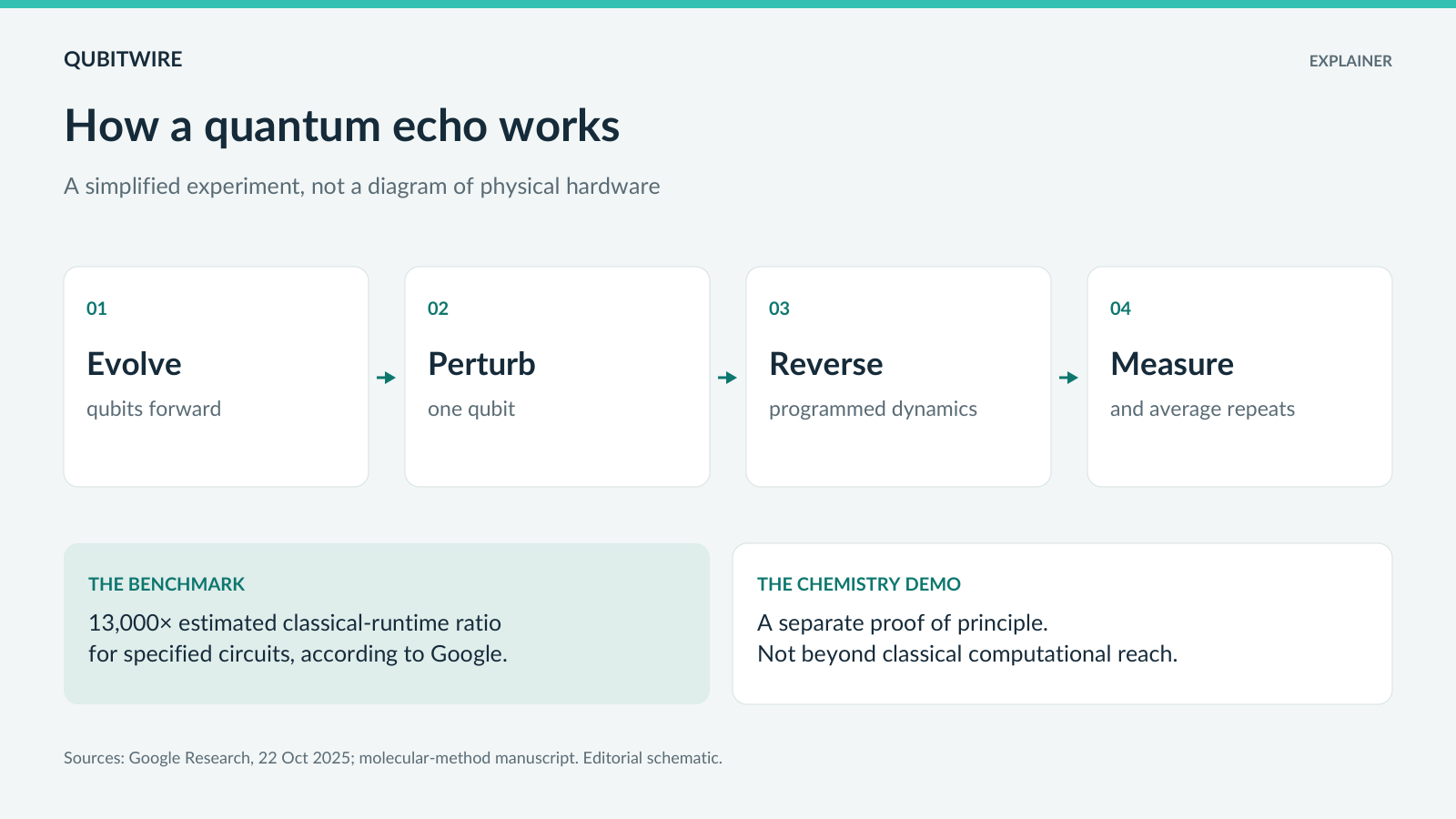
The basic experiment is surprisingly easy to picture. Let a system of evolve. Give one qubit a small nudge. Reverse the programmed evolution, then measure what changed. Repeating the experiment reveals how that disturbance spread through the system. The researchers call the measured quantity an out-of-time-order correlator, or OTOC.[1]
Why does that matter? Another sufficiently capable quantum computer could, in principle, run the same experiment and compare the resulting quantity. That is a route to checking a calculation that may be prohibitively expensive to reproduce classically. It is not the same as having a laptop verify every answer.[3]
Google estimates that a specified benchmark taking about two hours on Willow would take leading classical approaches roughly 13,000 times longer. That comparison belongs to those benchmark circuits. It does not mean Willow runs ordinary software 13,000 times faster.[1]

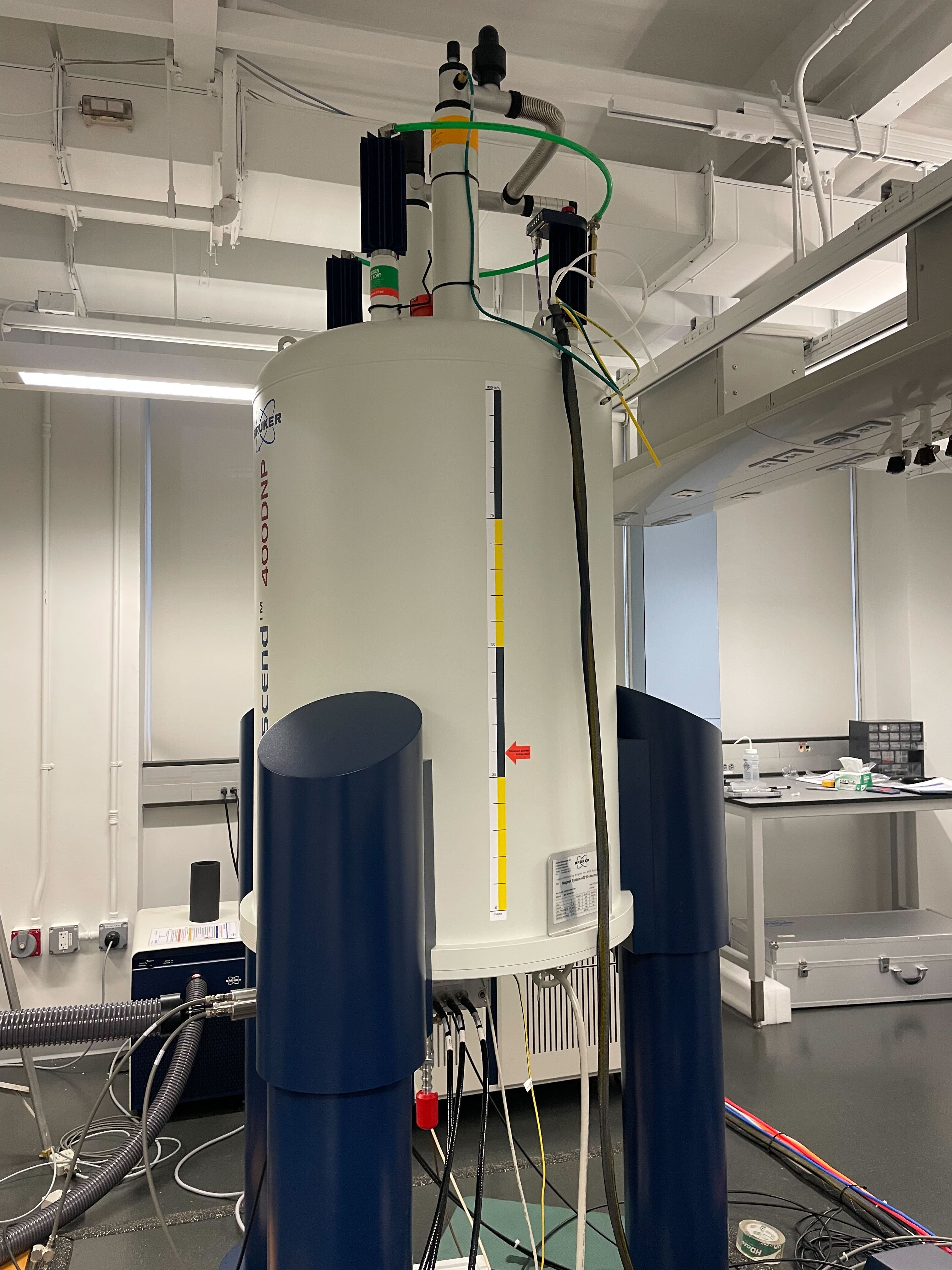
A separate proof of principle points toward chemistry. Researchers connected echo-style measurements with nuclear magnetic resonance, a technique used to study molecular structure. The idea is to compare measurements with candidate molecular models and use the differences to learn more about a molecule.[2]
That chemistry demonstration was not beyond classical reach. No drug-discovery breakthrough follows from the speed comparison, and the benchmark and molecular experiment should not be treated as one result.[1][2]
The useful shift is from an astonishing runtime to a scientific question that can be tested. Quantum computing needs more than answers that arrive faster. It needs answers researchers can trust.